
Paedophilia:
a factual report
by
Bernard, Frits
This book is included in the catalogue of the Royal
Library, The Hague.
First published in English by Enclave (Rotterdam),
1985. ISBN 90-71179-02-8.
This edition by Books
Reborn, July 2002, ISBN 1-877051-17-9 (PDF).
Copyright © 1985 Frits Bernard
101 p. ; 21 cm.
This edition of Paedophilia: a factual report has been OCR scanned from the 1985 edition for publication on the Internet. Pagination and layout of this edition closely mimics that of the 1985 edition, so references to specific pages of that edition remain valid here. The copyright holder, Frits Bernard, has given permission for this edition to be made available to the public on the Internet. He retains all rights to this work.
Please see the Colophon for information about previous editions of this work in other languages.
I.
Introduction
II.
Long term effects on the child
III.
Outlines of paedophiles
IV.
Age limits of paedophilia
V.
How normal are paedophiles?
VI.
How social are paedophiles?
VII.
A provisional picture
VIII.
Other publications by the author
If one wishes to pursue the history of the emancipation of paedophiles, one has to draw on one's own recollections to a large extent, as this history has not been written down so far.
My own thoughts, in the first instance, go back to the years 1938 to 1939, when I first experienced the desire to undertake something in the field of paedophilia. But how? It was neither the right time nor the right place. I wanted to get scientific researchers interested in the subject, and in May 1940, shortly after the German occupation of the Netherlands, I got in contact with the lawyer J.A. Schorer, who was chairman of the 'Wissenschaftlich-Humanitäre Kommittee' (Scientific Humanitarian Committee, founded by Dr. Magnus Hirschfeld in Berlin), Dutch section; a forerunner of what was later to become the COC (Dutch homophile organisation, nowadays called 'Nederlandse Vereniging tot integratie van Homosexualiteit COC': Netherlands Association for the Integration of Homosexuality). Through him I got to know Dr. Benno Premsela, who was also known as the first sexologist in the Netherlands. I had the opportunity to talk to him once or twice.
The War, and the following years made it impossible to do any work in this field, at least openly. In the nineteen-fifties came the second step, the foundation of the International Enclave Movement in The Hague. The Enclave Movement had members in the Netherlands and abroad, and came into the open, inter alia, through its publishing activities, which put books and brochures in the field of paedophilia onto the market. It was thus the first such publisher. In the meanwhile, contacts had been established with the COC, especially with the then Chairman, Bob Angelo.
In 1970, as preparation for the creation of a Work-Group on Paedophilia within the Netherlands Association for Sexual Reform (NVSH) was being made, we saw as the first task the job of writing a book on this theme. The book appeared in June 1972 under the title 'Sex met Kinderen' (Sex with children), published by the NVSH. My comment: 'The Law knows boundaries, love does not' (p. 86), quickly became a slogan. It was printed on the NVSH Work-Group's first poster.
Of decisive influence in the development of the NVSH Work Group were the five international congresses held in Breda, from 1973 to 1975, at which there were always between about 75 and 150 participants from the Netherlands and abroad: the first 'coming-out'. Through Breda, Work-Groups in other countries were formed, such as, for example, those in Switzerland, the German Federal Republic and Denmark. Pedophile Information Exchange PIE (defunct), in Great Britain, and the North American Man/Boy Love Association NAMBLA, in the United States of America came later into being.
The get-togethers in Breda smoothed the way for a subsequent conference 'Pedofilie en Samenleving' (Paedophilia and Society), which was held in Amsterdam on 19th March 1977. This conference, at which there were more than two hundred participants, was organised by the NVSH Work-Group under the auspices of the 'Nationaal Centrum voor Geestelijke Volksgezondheid' (National Centre for Public Mental Health). The conference was attended by scientists, social workers, police officials, parents and children.
The final report of the 'Adviescommissie Zedelijkheidswetgeving' (Advisory Committee for Moral Legislation), published in the Summer of 1980, contains proposals for a new legislation on sexuality in the Netherlands.
In 1958 I could not foresee that the thought expressed in my novel 'Vervolgde minderheid' (Persecuted minority), p. 163: '...then you could go and form a group, and could bring a certain influence to bear...' would one day become reality.
It is not true that sexual contacts are always harmless for the partner. That is shown by practical experience. This applies, however, not only to paedophile relationships, but also to non-paedophile ones. Careful attention must thus be paid to the nuances. A child who is constrained against its will to submit to acts performed by children of the same age or by adults may thereby be harmed. That such cases occur is clear. In this book we have not dealt with relationships in which coercion or aggression have led to trauma. The material was not obtained from police files or psychiatric case-histories. When someone writes an article about non-paedophile relationships between man and woman, he does not give emphasis to the negative and exceptional cases. In the case of paedophilia however, most people are particularly inclined to do so, highlighting exclusively the negative sides. In discussions, too, the accent often lies only on the latter.
We have given less emphasis to the secondary
consequences, such as the harm caused by factors external to the contact
itself. The reactions of the neighbours, the interrogation and arrest of the
older partner may indeed have a very negative effect on the child's mind. An
influence that can last for many years. The taboo that is applied to these
relationships can also have a deleterious effect.
When sexual contacts with a girl or a boy have themselves no harmful consequences for the child, there may still be some harm done, due to the attitude of those persons closest to the child. A negative attitude can have as a result that something pleasant for the child suddenly becomes a problem. This secondary harm, however, has really nothing to do with paedophilia.
Apparently nobody is really concerned with the fate of the children as a result of prosecution for sexual offences. The children are here used as a means to the end that the case may be prosecuted successfully. The child does not receive a fair share of attention. Nobody considers that it may have received something of a blow, especially when it enjoyed the contacts with the adult. Something that had been agreeable suddenly turns out to be something to feel guilty about.
The child has to bear the ordeal of the prosecution practically alone, for society adopts a particular attitude towards it; the child is stigmatised. People often feel sorry for it, but at the same time might feel suspicious of it. They keep their children away from the child, for it might spoil their own offspring. They assume that the child has suffered mental or moral harm. The child should not be isolated socially. Its self-respect can be impaired in that way and the children may feel themselves to be accomplices, in the criminal sense.
It is not the intention to recommend here that children involved in such cases should be taken care of by psychiatrists and social-workers; that would already give the children the impression that they were something extraordinary, that they had been 'harmed'.
And what must I do then, when I suspect, discover or know that my child has a sexual relationship with an adult? Even today this is all too often followed by a complaint to the police and prosecution, to say nothing of panic, tears, the extortion of confessions and chastisements by parents, enquiries by the doctor, by the psychiatrist, by authorities all of whom make very clear to the child that the occurrence was at the least unusual. Little by little uncertainty has grown over the question of whether this traumatising experience is inevitable.
We have still not come far enough, although I suspect that there exists a growing number of parents who begin to observe calmly whether the relationship with the adult is experienced positively by the child. And what social advantages (from the educational point of view) does this regular contact with the adults have? Does it have a positive contribution towards education, or does it remain no more than sharing sweets and going to the cinema? In any case, a discussion is then necessary, and regular contacts between all involved. A paedophile relationship should be able to develop in intimacy and with a degree of openness. But where, as now, a relationship with an adult must take place in secret, it cannot always be seen as positive from an educational point of view.
It goes without saying that here and in my
research I am not dealing with crimes of violence and their victims. But in
those cases, too, the cure may be worse than the disease. The attitude of the
public with regard to the accident (for that is the case) is of essential
importance for the psychological consequences for the victim.
Paedophilia does not seem to be principally the problem of the paedophile; it is apparently not principally the child's problem. Paedophilia is, above all, the problem of people who are not paedophiles; that is, of society in general. It is therefore necessary for paedophiles to join together in groups, not only for (mutual) assistance, but also especially because in this way they will continue to receive attention as a minority that will remain in existence as long as society (non-paedophiles) keeps on struggling with its own sexuality.
As long as society continues to make a problem out of sexuality, no solution to the problem it has created is possible. As long as sexuality is seen, consciously or unconsciously, as being harmful and dirty, non-paedophiles cannot acknowledge that children have their own love-life, with sexual and erotic tinges. Only when the sexuality of children is accepted as a reality, a positive reality, will contacts between them and adults no longer always be considered negatively. Paedophilia or child-sexuality? With the acceptance of child sexuality as a fact, the label paedophilia will fall in disuse, both as a medical diagnosis and in legal terminology.
Some 60 years have gone since C. Coroncy (1926)
published the results of his 'Untersuchungen an in der Kindheit genotzüchtigten
weiblichen Personen' (Investigation into female persons who have been raped in
childhood) in the 'Deutsche Zeitschrift für die gesamte gerichtliche
Medizin'. Since then, a considerable number of other authors have published
their findings regarding the possible harm that can occur.
In 1956 T. Landis undertook an enquiry among 1800 students by means of a questionnaire, and examined 500 cases in detail (360 young women and 140 young men). The research was into the further emotional development of the subjects. He stated: 'In general, the great majority of the victims seem to recover rather soon, and to acquire few permanently wrong attitudes from the experience.'
In 1968 Lindy Burton, who included a comparison with a control group, also came to the conclusion that sexual assaults by adults have no particularly harmful influence on the further development of the children's personalities. There were 41 subjects.
M. Ingram (1977), a father at the International Catholic Child Bureau, Leicester, who had taken care of 91 children who had had sexual contacts with adults, said that that gives no evidence of harmful consequences in the psychological or moral field. In any case, these are not greater than those caused by the 'rude games' that many children play among themselves. Another research-study worth mentioning is the interesting one by J. Tsai and N.N. Wagner (1978) on fifty women who had suffered from serious sexual acts during their childhood. They are the only authors who have undertaken research directly on this negative influence. Of the persons who had committed the assaults 96.8% were members of the families or friends. The symptoms included guilt-feelings, negative self-images due to the secrecy, distrust of men, sexual dysfunctions and hatred of their mothers. Almost half of the persons who had committed the assaults were the victim's fathers or stepfathers.
By means of group-therapy (conversations with other victims) their situations had improved. After six months, the guilt-feeling and shame had diminished and the relations with those around them had improved. In the case of these women, who had never spoken to anybody about their sexual contacts, it appeared to be impossible for them to digest their experiences by themselves.
A certain proportion of the children studied took
the initiative in sexual games with adults, some others were willing to
participate in them without any more ado (approximately 50%). Curiosity can
also be involved here. The contacts had apparently no influence on their
sexual orientation, so that those involved in homosexual contacts mostly
preferred heterosexuality later. And, speaking very generally, only where the
children were psychologically unstable or disturbed before the freely
consensual contact could negative influences (specifically, the same as those
observed before the sexual contact) be found also afterwards. The attitudes of
the people close to them (society) can be the cause of guilt-feelings in
children, and make them unsure of themselves. Contacts in the absence of the
child's free consent can cause long-lasting harm. Incidentally, the same is
true in the case of non-paedophiles.
The quality of the research undertaken since 1926 is very variable. Some of the authors have confined themselves to research on subjects who had very recently experienced the sexual contact, while others have studied the long-term effects. A few of them used psychological test-procedures, or only isolated interviews, while some confined themselves to observations. The number of cases studied varies between 5 and 500, or even more. The most important problem, which has still not been solved, is the selection of a representative sample. Many researchers wisely confined themselves to particular groups (cases discovered in the course of the work of the police, in psychiatric institutions, etc.) Very few of them have studied the 'normal' situation; that is, those in which neither the police nor psychiatric specialists have been involved. A few studies have considered only the data regarding acts, without any knowledge of the 'victims'.
There is no uniform definition of what is considered to be 'harm', so that it is difficult or impossible to compare the studies with each other, and therefore it is understandable that the results must be controversial.
Paedophilia--sexual relationships between children
and adults and vice-versa--is not precisely defined. What is a child?
Charlotte Bühler makes the following distinction: 'Small children' up to six
years old, and 'big children' from six to twelve. After twelve she no longer
calls them children. In consequence one could draw borders between
paedophiles, ephebophiles, etc. But paedophilia is not an isolated phenomenon,
but one end of a continuum. It is one of the poles of the ensemble of all
possible forms of human (sexual) relationships. Gerontophilia, the sexual
interest in old people, is the other pole. Thus, also, heterophilia and
homophilia--passing via bisexuality--are the endpoints of a series of forms of
relationships.
There are four basic possible fundamental behaviour forms of paedophile sexual relationships based on differences of sex and age:
 | Between a boy and
a woman, or vice versa
| Between a girl and
a man, or vice versa
| Between a boy and
a man, or vice versa
| Between a girl and
a woman, or vice versa | |
There is also a dynamic factor involved, that is the direction of the initiative. The initiative can come from the younger partner, or from the adult, or from both of them at the same time. We can therefore subdivide our four fundamental behaviour forms into a dozen initiative possibilities:
Chart 0
Initiative possibilities between the younger partner and the older
| Younger partner | Older partner | ||||||||||||||||||||||||||||||||||
|---|---|---|---|---|---|---|---|---|---|---|---|---|---|---|---|---|---|---|---|---|---|---|---|---|---|---|---|---|---|---|---|---|---|---|---|
| male | --> | female
| female
| -->
| male
| male
| -->
| male
| female
| -->
| female
| male
| <--
| female
| female
| <--
| male
| male
| <--
| male
| female
| <--
| female
| male
| <->
| female
| female
| <->
| male
| male
| <->
| male
| female
| <->
| female
| |
COMMENT: The direction of the arrow shows who starts the initiative.
With regard to the origin of paedophilia, we see
the theories divided into two main groups: the genetic and the psychological.
According to the genetic theory (Hirschfeld etc.), paedophilia should be
considered as an inborn characteristic, whereas according to the psychological
(Freud etc.) approach, the environmental conditions of the first three or four
years of life play a determinant part.
In the older psychiatric literature mention is almost never made of new, independent research. Factual new material is offered only sporadically. Moreover, the definitions given by the various authors have the basis that paedophile acts must be considered as something abnormal: as psychopathic (whatever that might be), a perversion or a neurosis. They thus incorporate a moral value judgement. In behavioural terms, the definitions contain a complement (namely, that of the social undesirability) that does not belong here. A kind of circular reasoning is employed.
The wide variations among the laws regarding paedophile acts in different countries reflect a high degree of uncertainty about the phenomenon. The penalties under the criminal law vary from country to country and from one historical period to another, between the extremes of capital punishment on the one hand and no punishment on the other.
The public attitude regarding paedophilia can also
differ widely between one country and another, and with the passage of time.
It appears from this that elsewhere people do not know how best to deal with
the phenomenon either.
The present psychiatric, medical and legal picture, and the former literary image with regard to the child sexuality is in principle based on the conviction, which is not justified scientifically, that sexual relationships between adults and children would simply be harmful to the younger partner.
Thanks to the well-known research in America by
Kinsey, Pomeroy and Martin, we know a little more about the frequency of
paedophile contacts and relationships. Ten to fifteen per cent of American
girls twelve years old or less (thus, in general, under the age of puberty)
have had contacts with an adult.
In the standard reference book 'Psychosexueller Infantilismus' published in 1922, the well-known psychoanalyst Wilhelm Stekel wrote on this topic as follows: 'In so far as I can tell, it must almost be considered as a normal component of the sex-urge.' And even further: 'The sexual stimulation that emanates from children is the more remarkable because for many centuries we have strained to desexualise the child and to consider it as something holy.'
Violence or the infliction of harm, according to these authors, occurs extremely rarely.
Accurate figures on the extent of the very serious violence in sexual criminality are not in our possession. An indirect approach to this question on the basis of published data and that collected personally from the Central Statistics Office of the Netherlands leads us, however, to the conclusion that it is so rare that, if it did not concern such tragic cases, it could be regarded as a negligible quantity. A certain indication in that direction is already given by the fact that an average of only five people per year were condemned to imprisonment in the Netherlands for three or more years for paedophile offences. The fact that in the period from 1960 to 1964 (inclusive) only three cases (0.5 per year) occurred of persons being convicted under the article 284 part 1 of the Dutch Penal Code (sexual contact with children with violence) leads to the same conclusion.
The statistics of the causes of death in the Netherlands finally are self-evident: from 1960 to 1965 (inclusive), when there were some two million children aged between five and fourteen years, 0.8 boys and 0.3 girls per year were presumed to have met their death in connection with sexual offences.
But what can a child do with an adult then, and
what does the adult do with the child?
To start with, let us establish that a paedophile relationship, just as any friendship, whether it is non-paedophile or paedophile, the friendly relationship is predominant. The adult takes the child out with him; they go together to the cinema and to museums. The adults reads to it, he plays Monopoly or Snakes and Ladders or Chess with the child, he lets the child play records, do puzzles; he goes to eat with it, he does his work while the child is playing; he helps the child with his homework, or repairs his bike. He does his job while the child goes to school. And within all this, as a whole, the erotic element forms a subsidiary part. The adult strokes the head of the child. The child comes to sit in his lap. They romp together for a while in bed, or after a bath, and such a situation creates mutual confidence and inclination to go further. How much further? As much further as two people who find each other nice and interesting can go. If the child is so far developed that it can reach orgasm (and many children can from their earliest years), then is the relationship of the child with the adult also directed towards achieving this satisfaction. If the child is not yet able to do so, then the bodily contact plays an important part; the pleasure of caressing is what is sought, the intimacy of being together, the feeling of security.
Naturally, when a sexually mature child and an adult get far in their relationship, coition can also happen, but more commonly the relationship is confined to masturbation or fondling.
In the book 'Sex met kinderen' (1972), I
have given a report on the psychological consequences for the child. How does
the child regard these sexual relationships afterwards, when he is himself
adult? Much significance may be attached to the long-term effect.
Speaking very generally, one may say that there are a number of children who experience no harmful consequences from sexual contacts with adults, and that these have clearly a positive influence on a number of them. Naturally, nothing is said here about cases in which the use of violence plays a part. These, however, are largely exceptional. That they can cause trauma is well known.
In my research into this question I have preferred the biographic method; I let the grown-ups relate their sexual experiences with one or more adults in the past. I let each of them freely write his or her short autobiography, by which is meant that each was asked to tell how he of she had experienced these contacts at the time, and how they now, many years later, look at it: the guided biographic method. I was aware of the disadvantages (such as a bias in the way of tackling it) that are associated with this approach; the advantages (minimum influence from the researcher, manageability) of this method, however, appear here to amply outweigh them. At the same time, this technique gave the opportunity to make a psychological analysis of the written autobiography.
The subjects were then examined by means of the ABV-test, which consists of four parts with a total of 107 questions having a symptomatic value. The test is structured; that is, the subjects are not completely free in the way they answer--they can only choose from a limited number of possibilities.
As the ABV is validated on the Dutch population--and for that reason we dispose of standards--it will be possible in due course to compare the result of our research with the national averages. So, with ABV the test subject is shown a vast number of statements connected with the psychological qualities to be measured. A certain number of points can be acquired (the score). As a higher score is achieved then the property measured by the test is manifesting itself more strongly. So the concrete question might be: do people who, as children, had sexual experience with adults have, on average, more neurotic and/or functional complaints than the average Dutchman? Have they been traumatised by these experiences?
The location of our subjects was one of the greatest problems. How did we come by the addresses? We thought about this for a long time. Finally, in our opinion there was only one way: by enquiring. In other words, we sounded out people in our neighbourhood, asking them if they knew people who, when children, have had sexual contact with adults.
We have, so far, collected about 30 reports; in addition to that, we had a number of talks with 'victims' and we had the opportunity of following up on a number of subjects over a series of years.
Although our samples have been too small to be called representative of the total population of children who maintain relationships with adults, it seems, nevertheless, interesting to present them. For they show that there are certainly a number of children who find these contacts more advantageous than harmful to their mental health.
The former children came from all social classes, with various professions and qualifications, and lived in both large and small centres of population in different Dutch provinces. Their ages lay between 22 and 70 years. The research was held in the early Seventies.
The children from this material experienced sex with adults on the whole as positive (nice, fine, important). Only a single subject had a negative attitude to his youthful experience ('...in my eyes, it was not a normal situation'). Basically, all the subject sought affection, love and security, and not sex alone. Some defend paedophile relationships as such.
Actually, there appeared to be no talk of traumatic influences; rather the opposite was true. It is not the actions themselves, which are usually in the form of caressing or masturbation, that lead to conflicts and problems, but the attitude of society.
Nowhere do they talk about fears of the adult's intentions, which is remarkable. In this setting the word does not come into the texts, even in a veiled form. It strikes one how basically similar to each other these descriptions are; they are one by one so human and imaginable. In general, the first contacts begin in puberty (about the 14th year) but may also begin in the primary school years.
The provisional (and tentative) conclusions show
the following trends:
| Children can
experience sexual contacts and relationships with adults as positive.
| Children are
looking for love, affection and security in addition to the sexual aspect.
| We cannot speak of
a traumatic influence nor about fears towards adults. According to the
results of the ABV test, our test persons are not more neurotic than the
common Dutchman. On the contrary, some happen to be more stable
psychologically.
| The initiation has
no influence on later sexual orientation.
| In some cases the
first contacts begin at the time of the primary school age.
| The sexual
activity is mostly of a masturbatory kind.
| Sometimes the
friendship continues to exist after the sex-influenced period has come to
an end; in some cases, for the rest of life.
| The attitude of
society has a negative effect. | |
In the paper 'Pädophilie eine Krankheit?
(Paedophilia, a sickness?, Sexualmedizin 1972), I again produced material
which confirmed the results given in Sex met kinderen. The monthly
magazine 'Betrifft: Erziehung' (April 1973) considered the results of
this research sufficiently important to devote a complete issue to them, also
published in an reprint with the title Kindersexualität (Child
sexuality: 1976).
By the time I completed the first edition of 'Pedofilie'
(Paedophilia) in Dutch, my research material had become, of course, more
extensive. This material confirmed again the results of 1972: Wanted sexual
relationships between children and adults can be experienced as positive, and
the child can grow up to have a harmonious personality and to maintain a good
social relationship with society.
A child that does not want an intimate relationship, or a single contact, with an adult is just as normal a child as one that wants such relationship(s) or contact(s).
On the 7th April 1973, during the first international NVSH (Netherlands Association for Sexual Reform) Work-Group meeting at Breda, I undertook research on the paedophiles from Belgium and the Netherlands who were present there. This meeting provided a first and unique opportunity. Never before were so many paedophile-oriented people together at the same time. In this case it was possible to examine all members of this population. As a general objective, I had the aim of collecting data at first hand of various aspects of the paedophile proper to this group.
We can define a 'mass of people' as an accidental and incoherent gathering of individuals, and a 'crowd' as being a gathering of people who have some common interest. For example: people walking in a street form a 'mass', a multitude of practically unrelated individuals. When suddenly in that street two cars collide, part of the 'mass' may form a 'crowd' around the place of the accident, in order to see what's happening. This 'crowd' is held together by a common interest: watching the accident. The same 'crowd', in turn, may produce a 'group' that assumes a certain task, say, help the victims of the accident. Such a 'group' is characterized by awareness of its activity distribution of the tasks and by certain values that are set. A 'group' has members by choice, whereas a 'mass' or a 'crowd' does not.
A distinction can now be drawn between 'natural groups' and 'artificial groups'. When people come together for social considerations, which is a normal human need, they then form a 'natural group'. In an 'artificial group', a definite objective always plays a role, and such an 'artificial group' falls apart if the objective is reached. Naturally, both types of group (the 'natural' and the 'artificial') overlap; the division between them cannot always be clearly determined.
The group that was the subject of my research is surely an 'artificial group'. Here one has to deal with an orientation towards an objective, to wit, the work of integrating the paedophile into society, and the offering of help and support. There is a goal that is sought, there is activity and a certain division of labour (members of the groups have tasks to do).
When it is recalled that in the Netherlands the rate for convictions under article 247 of the Penal Code is 0.009 per 100 men aged between 15 and 69 years per year (Criminal Statistics for 1970) it becomes clear what an exceptional group we have to deal with here; 54% of the group have been convicted at least once for paedophile acts. If the question about convictions were to be expanded, for example to include being in trouble with the law, then the percentage of 54 would probably rise considerably.
It could also be that the convictions provide an important motive for crossing the threshold to the NVSH Work-Group and in particular for attending this meeting (coming out). These paedophiles are living with the thought 'it's known anyway'. They have their back to the wall, and this extra frustration drives them into forming a group.
The latter view is confirmed by a second enquiry (with the same questions) among paedophiles not attending this meeting. This research was undertaken simultaneously in various European countries by means of a postal questionnaire. The response appears small (N = 23). Here the percentage of convictions is 21%, which is about half that of the other enquiry. It is also striking that 48% of those replying to the postal questionnaire stated that they were married, compared with only 8% of the members of the group. Marriage clearly appears to form a deterrent to joining the NVSH Work-Group on paedophilia. The age-groups (partners) preferred in both enquiries were the same.
If by 'pressure-group' is meant an organised group that attempts to exert influence on government and public opinion in order to promote special interests, then the group studied in my research may also be a pressure-group. This group has, however, been able to form itself against heavy social pressure as is apparent from its composition. It can form a stimulating element in society, and attempt a correction of mistaken social attitudes. Like other groups, it has both a core and a periphery. It is the core that generates the activities. Those who constitute the periphery are in general seeking a more-certain security in the group (the elimination of solitude, getting rid of guilt-feelings).
It is apparent from the research how necessary the
formation of this NVSH Work-Group has been, to give this minority the
possibility to come somewhat in the open. Paedophiles are given the
possibility to work for their future. The size of the Work-Group appears to be
directly related to actions (convictions) on the part of society (the Law).
The social problem of the paedophile comes clearly to the fore here. It is
mainly those who take it for granted that 'it's known anyway' who bring it out
into the open. Even if there were no laws prohibiting these acts, the
self-acceptance of a number of paedophiles might still be a problem for some
time. The problem would then, however, be a general human one which could be
approached generally.
From the number of paedophile contacts given, it
may appear that society is more tolerant than one would think regarding
relationships of this kind. This is again confirmed by the remarkable fact
which stands out in the replies that there are parents who have no objection
to such relationships, even where it concerns their own children.
The list of questions:
The questionnaire consisted of four sections, which taken overall covered the following fields:
| A. Questions about
the person, such as age, position in the family, marital status, education
and training, social status and the functions in it.
| B. Questions about
being a paedophile, such as becoming conscious of it, first contacts,
orientation regarding age and sex, and the frequency and place of
contacts.
| C. Questions about
surrogate and substitute solutions (collection of 'pornographic' material,
for example).
| D. Questions about
conflicts with society, such as convictions and psychiatric treatment. The
self-acceptance was gauged at the same time. | |
Naturally, the questionnaire respected anonymity; the replies were given by figures or by checking off an alternative answer except in the case of two questions, where one or more words had to be written. That gave rise to no difficulty. At the end of the answer-form space was provided for any additional comments. In some cases use was made of it.
The research:
The research was conducted and introduced by myself in the large meeting-room of the conference. The oral information covered the following points: an explanation of the importance of the research for science, which could at the same time be of importance for the participants; what would happen after the enquiry, in other words of the preparation of the results and a possible publication of the conclusions.
During the completion of the questionnaire instructions were given orally and there were opportunities to ask questions both during and after completing the questionnaire.
It may be observed with satisfaction that the participants were very ready and willing to cooperate in the enquiry and reply seriously to the questions.
In some cases, a number of comments were made about relationships and circumstances in the space reserved for this purpose at the end of the reply-form; indeed, the most personal revelations were given there. Information was also given about the reasons for the answers given. One got the impression that those who made use of this possibility did so without reservation.
The completed questionnaire:
After the research was completed a start was made of processing the replies. The reply-form was completed by 73 persons, consisting of 19 non-paedophiles (committee members and visitors), 4 homophiles (interested individuals) and 50 paedophiles (members of the NVSH Work-Group). There were no women among the latter.
In order to provide the results in a comprehensible form, I decided to arrange them in tabular form as far as possible, with conversion of the figures to percentages. Only in a few cases did I choose a graphic representation.
The questions and answers are given below, in the same sequence as they appeared in the questionnaire. Some of them will be the subject of brief comments; most of them speak for themselves. A more-detailed analysis is made afterwards.
The whole processing of the items is based on the population of paedophiles present on 7th April 1973 (N = 50). The non-paedophiles (N = 19) and the homophiles (N = 4) were not taken into consideration, because a number of specifically paedophile questions were not suitable for these categories.
Chart 1
QUESTION: How old are you?
| Age | Percentage |
|---|---|
| 0-20 | 4 |
| 21-30 | 32 |
| 31-40 | 22 |
| 41-50 | 26 |
| 51-60 | 12 |
| 61-70 | 4 |
| 71-80 | 0 |
| Total | 100 |
COMMENT: Almost 60% of the members of the group are under 40; this raises serious doubts about the traditional image of the paedophile as a dirty old man. The age distribution of members of the Dutch homophile organisation (COC) was similar: about 70% under 40 years. See my Een onderzoek onder homofielen (An enquiry among homophiles) in: Vriendschap (Friendship) 19, 1964.
Chart 2
QUESTION: In your family, are you the oldest child, or the youngest child, or in between, or are you the only child?
| Group | Percentage |
|---|---|
| oldest | 24 |
| youngest | 40 |
| in between | 28 |
| only child | 8 |
| Total | 100 |
Chart 3
QUESTION: Are you married, divorced or unmarried?
| Civil status | Percentage |
|---|---|
| married | 8 |
| divorced | 2 |
| unmarried | 90 |
| Total | 100 |
Chart 4
QUESTION: If you are married or divorced, do you have one or more children?
| Group | Percentage |
|---|---|
| married, have child(ren) | 4 |
| married, no children | 4 |
| divorced, have child(ren) | 0 |
| divorced, no children | 2 |
| unmarried, no children | 90 |
| Total | 100 |
Chart 5
QUESTION: Which of the following educational institutions have you completed?
| Group | Percentage |
|---|---|
| primary school | 18 |
| vocational training | 12 |
| advanced elementary education | 16 |
| high school | 22 |
| advanced vocational training | 12 |
| university | 20 |
| Total | 100 |
COMMENT: This last chart shows that in comparison with the average level of the population of the Netherlands, the members of the NVSH Work-Group are better educated. This does not mean, of course, that paedophiles have a higher intelligence quotient than non-paedophiles.
As one's profession takes a central place in the
life of the individual and in our society, it's important to know what kinds
of occupations paedophiles have:
Chart 6
QUESTION: What is your present profession or occupation?
| The answers varied widely: office jobs, executive functions, manual labour, social occupations, technical and artistic professions, academic professions. |
Chart 7
QUESTION: Are you satisfied with your occupation or profession?
| Group | Percentage |
|---|---|
| satisfied | 50 |
| not satisfied | 22 |
| no opinion | 18 |
| not answered | 10 |
| Total | 100 |
COMMENT: This question concerning occupational satisfaction was included in the enquiry as a general indication of the testee's functioning in their work. There might be differences with non-paedophiles.
Numerous questionnaires enquire about occupational satisfaction. Throughout the years, 60 to 80 per cent generally indicated that they were satisfied with their jobs, whereas 7 to 14% usually are dissatisfied. However, it is not as yet clear what exactly is measured by these questions. Also, the enquiries of the various authors cannot simply be compared because the questions were formulated differently, and the circumstances in which the enquiries were carried out varied as well. In general, the 'satisfaction score' tends to be higher if the testee has had a better education and a higher social situation.
Chart 8
QUESTION: How old were you when you first became aware that you were a paedophile?
| Age | Percentage |
|---|---|
| < 10 | 8 |
| 11-20 | 66 |
| 21-30 | 20 |
| 31-40 | 2 |
| 41+ | 0 |
| not answered | 4 |
| Total | 100 |
COMMENT: 20% at the age of 15; 12% at the age of 16; 6% at the age of 17; 10% at the age of 18; total 66%. Most testees become conscious of their sexual interest in puberty, like non-paedophiles. See also chart 9.
Chart 9
QUESTION: How old were you when you had your first true paedophile contact with a child?
| Age | Percentage |
|---|---|
| < 10 | 6 |
| 11-20 | 58 |
| 21-30 | 28 |
| 31-40 | 2 |
| not answered | 6 |
| Total | 100 |
COMMENT: The question that gave rise to chart 8 is intended to determine the age at which the subjects first became aware of being different. The reply to the question in chart 9 is thus not the age at which the paedophile first experienced his orientation. One could obtain such information by phrasing the question, for example: 'At what age did you for the first time fall in love with a child?'
Chart 10
QUESTION: Do you keep your paedophilia a secret from your parents, your other relatives, your family?
| Group | Percentage |
|---|---|
| Parents: | |
| secret | 40 |
| not secret | 52 |
| not answered | 8 |
| Total | 100 |
| Other relatives: | |
| secret | 52 |
| not secret | 36 |
| not answered | 12 |
| Total | 100 |
| Family: | |
| secret | 2 |
| not secret | 2 |
| not answered | 96 |
| Total | 100 |
Chart 10 A
QUESTION: If you did not keep it a secret, what is the reason?
The answers
given can be classified as follows:
|
Chart 11 A
QUESTION: What age groups are you generally most interested in?
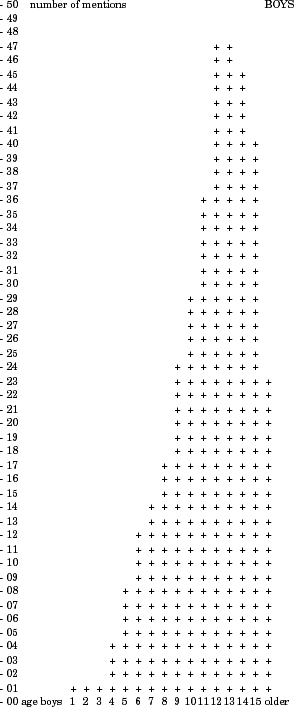 |
Chart 11 B
QUESTION: What age groups are you generally most interested in?
| Age preference | Percentage |
|---|---|
| prepuberty: up to 11 | 39 |
| puberty: 12, 13, 14, or | 44 |
| puberty: 12, 13, 14, 15 | 55 |
| post-puberty: older than 15 | 6 |
| Total | 100 |
Chart 12
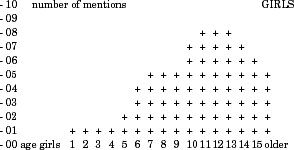
QUESTION: What age groups are you generally most interested in?
|
COMMENT: The following remarks should be noted in connection with Charts 11 A, 11 B and 12.
The questions about the preferred age-group asked for two ages to be indicated, being the lowest and the highest ages of interest. In the questionnaire the highest age given specifically was 15, and only a single combined response was provided for 'over 15'. The diagrams thus show the ages within these limiting values that can be considered to be preferred ages. One thing in the results is striking: in some cases, those who were still interested in 15-year-old and older children had a wide range that stretched to the younger (5 or 6 years) and youngest ages. One group showed an interest exclusively for the ages from 12 to 14. This group also provides the peak between these ages that is apparent (see also chart 13, which shows the lowest ages at which the subjects were interested).
The results are not given in detail above 15 years. In retrospect it is a pity that that is so, because an interesting light could thereby have been thrown on the cases in which paedophilia is combined with other forms of human sexual relationships.
Chart 13
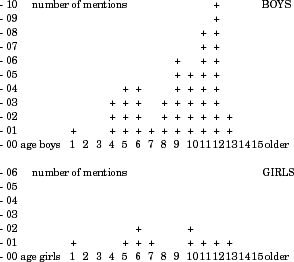
QUESTION: What is the minimum age of the children you are generally most interested in?
|
COMMENT: Chart 13 was set up according to the 'minimum ages', the ages where the testee's interests generally start. It shows that there's a peak at the age of 5 to 6 for boys as well as for girls, and another peak at the age of 11 to 12 for boys, and of 10 for girls.
Chart 14
QUESTION: Do you mainly like boys or mainly girls? Or have you no preference?
| Group | Percentage |
|---|---|
| prefer boys | 96 |
| prefer girls | 0 |
| like both equally | 4 |
| Total | 100 |
COMMENT: This enquiry does not confirm the thesis, oft heard, that paedophiles are quite often and no doubt generally bisexual. Our results clearly indicate a predominance of homophile interests in this group.
Chart 15
QUESTION: With how many boys have you had anal sexual contacts (sodomy)?
| It appears from the replies that 42% of the subjects had indeed had anal intercourse at least once. In general they are those who travel to countries where this form of intercourse is not so much taboo, unlike here. When the answers are taken together with the answers to chart 17 it is apparent that a very small percentage of all contacts are anal. This agrees closely with the results of another research project I have undertaken (Sex met kinderen) which show that paedophile contacts generally consist of masturbation or fondling. |
Chart 16
QUESTION: With how many girls have you had sexual intercourse (coition)?
| The number of vaginal sexual contacts (coition) with girls is even lower than that of anal contacts with boys. |
Chart 17
QUESTION: With how many children have you had sexual contact? One, some, many? Can you approximately indicate the number?
| Number of children | Percentage |
|---|---|
| none | 6 |
| between 1 and 10 children | 24 |
| between 10 and 50 children | 28 |
| between 50 and 100 children | 8 |
| between 100 and 300 children | 6 |
| some | 6 |
| many | 24 |
| Total | 100 |
| Number of children | Percentage |
|---|---|
| 0 | 6 |
| 1 | 2 |
| 2 | 0 |
| 3 | 6 |
| 4 | 2 |
| 5 | 2 |
| 6 | 4 |
| 7 | 0 |
| 8 | 2 |
| 9 | 2 |
| 10 | 4 |
| 15 | 8 |
| 20 | 10 |
| 25 | 6 |
| 50 | 4 |
| 70 | 2 |
| 75 | 4 |
| 100 | 2 |
| 175 | 2 |
| 200 | 2 |
| 300 | 2 |
| some | 6 |
| many | 24 |
| Total | 100 |
Chart 18
QUESTION: How many paedophile relationships do you have at this moment? Number of regular contacts; number of occasional contacts.
| Number of contacts | Percentage | |
|---|---|---|
| regular | occasional | |
| none | 34 | 46 |
| 1 | 30 | 6 |
| 2 | 10 | 14 |
| 3 | 14 | 4 |
| 4 | 0 | 4 |
| 5 | 0 | 0 |
| 6 | 0 | 0 |
| 7 | 0 | 0 |
| 8 | 0 | 0 |
| 9 | 2 | 0 |
| not classified | 4 | 2 |
| not answered | 6 | 24 |
| Total | 100 | 100 |
Chart 19
QUESTION: How many times per year do you travel abroad in order to have paedophile contacts? What countries do you go to?
| Times per year | Percentage |
|---|---|
| never | 46 |
| once or several times | 50 |
| not answered | 4 |
| Total | 100 |
| Destination of 50% | Percentage |
|---|---|
| Mediterranean countries of Europe | 40 |
| North Africa | 36 |
| Western Europe | 18 |
| Far East | 6 |
| Total | 100 |
Chart 20
QUESTION: Do you collect cinefilms, photographs, drawings of entirely or partially naked children? Do you regularly make such films, photographs or drawings yourself for your own use?
| Collection item | Percentage |
|---|---|
| Cinefilms: | |
| yes | 22* |
| no | 68 |
| not answered | 10 |
| Total | 100 |
| Photographs: | |
| yes | 74** |
| no | 20 |
| not answered | 6 |
| Total | 100 |
| Drawings: | |
| yes | 40*** |
| no | 48 |
| not answered | 12 |
| Total | 100 |
| entirely naked | 12 |
| partially naked | 4 |
| entirely and partially naked | 50 |
| not answered | 34 |
| Total | 100 |
|---|
COMMENT: (*) of which 8% (also) make films themselves; (**) of which 44% (also) make photographs themselves; (***) of which 8% (also) make drawings themselves.
In these questions the following hypothesis is implicit: Do the subjects who have no paedophile relationships compensate for this lack by collecting pictorial material? When these questions are considered together with those about contacts (charts 17 and 18), this hypothesis is seen to be unfounded.
The replies to the question about the collection of pictorial material by paedophiles are not completely unambiguous, in the sense that the taking of photographs, filming and/or the purchase of pictorial publications is practically always expensive. Also, the paedophile must know an address where he can entrust his material, or he must cross a threshold (come out into the open) in order to buy the material. Besides, a collection of photographs and films (taken by oneself) forms a real danger for both adult and child in the case of discovery. Finally, to a lesser extent, the presence of paedophile pictorial material is in many cases risky for the social status of the possessor. The figures given here could thus be increased if the taboo (also expressed by high prices) were to become less significant.
Chart 20 A
QUESTION: If you have no collection, what is the reason?
Answers:
|
Chart 21
QUESTION: Do you buy or borrow or exchange 'pornographic' photo magazines? No, sometimes, regularly.
| Acquisition | Percentage |
|---|---|
| regularly | 26 |
| sometimes | 54 |
| no | 20 |
| Total | 100 |
Chart 22
QUESTION: Have you ever read books about paedophilia?
| Read a book | Percentage |
|---|---|
| yes | 96 |
| no | 4 |
| Total | 100 |
COMMENT: The question posed in chart 22 is intentionally framed so as to make no distinction between fiction and non-fiction in which paedophilia plays a part. The principal aim of this question is to examine the concern of the paedophile for his own situation. The results speak for themselves.
Chart 23
QUESTION: Have you ever been sentenced for paedophile contacts?
| Group | Percentage |
|---|---|
| have been sentenced | 54 |
| have not been sentenced | 46 |
| Total | 100 |
Chart 24
QUESTION: Have you ever had a psychiatric treatment?
| Group | Percentage |
|---|---|
| have had treatment | 38 |
| have not had treatment | 62 |
| Total | 100 |
COMMENT: Approximately half those who have been convicted had undergone psychiatric treatment, but only 20% of those who had not been convicted. It is not improbable that, among those who had been convicted, the treatment was imposed as a condition by the Court. The treatment was thus not voluntary.
Chart 25
QUESTION: Would you--if that were possible--like to get rid of your paedophilia? Yes. No. Don't know.
| Group | Percentage |
|---|---|
| want to get rid | 8 |
| don't want to get rid | 90 |
| don't know | 2 |
| Total | 100 |
COMMENT: The foregoing question is highly significant. Only on the basis of self-acceptance can a personality achieve real development in the strict sense. Saying 'yes' in this way, accepting what one is (intimate roletaking) opens the way to being in harmony with oneself and other people. It is evident from the data that only 8% wish to cease being paedophile, which however does not mean that the vast majority has achieved real self-acceptance. It may also mean resignation (negative adaptation).
Review of the more important results
| The testees are
generally young.
| They were often
the youngest of the children in the family.
| Most of them are
not married.
| The testee's level
of education is higher than that of the average population of the
Netherlands.
| The testees have
all kinds of occupations.
| Their occupational
satisfaction is somewhat lower than that of the average Dutchman.
| They became aware
of their paedophilia at an early age (puberty).
| The first
paedophile contacts usually take place before the age of twenty.
| There is more
openness (often involuntarily) towards the parents than towards other
relatives.
| There's an almost
exclusive preference for boys in this group.
| Even though a
large percentage (42) of the testees have had anal contacts, this
represents only a small fraction of the total number of contacts.
| This is even more
true of coital contacts with girls.
| The majority of
the testees have had paedophile contacts in the past.
| About half of the
testees had a paedophile relationship at the time of this enquiry.
| About half of the
testees go abroad once or several times a year, mainly to Mediterranean
countries.
| Those who have
relationships as well as those who haven't find a substitute in pictorial
material, mostly photographs; films and drawings come second.
| The interest in
pictorial magazines is about equal to that for photographs.
| Most of the
testees have read a book about the subject.
| About half of the
testees state being previously sentenced.
| A major number of
psychiatric treatments was probably not started voluntarily, but as a
consequence of a sentence.
| Very few want to
get rid of their paedophilia. | |
What age ranges do paedophiles prefer? What are the results if we compare these ranges with the ages of consent prescribed by Law, with the age ranges of non-paedophiles (homosexuals) and with the sexual development of the child? Are there inside the paedophile age-preferences further limits to be distinguished?
The following material was used for the research:
The Breda enquiry was undertaken during a conference on paedophilia. There were 50 paedophiles participating in the study, and it was thus the first large scale research of its kind. The results obtained from it have been published in the Netherlands and abroad. The question that is relevant to our investigation was phrased as follows: 'In which age-group do you in general have the most interest? From ... to ...'
The data obtained from the replies to this question have been reprocessed for this research, and displayed graphically.
Supplementary material obtained from various sources (in particular a postal enquiry) has not been taken into account. It confirmed the results of the Breda enquiry.
Only the homophile-paedophile material was processed; the scanty heterophile-paedophile material was not included in this analysis. It may, however, be said that it was indeed included in the preliminary research, and that it confirms the results of the Lolita study in 1977.
The Britain PIE (Paedophile Information Exchange) undertook an important research survey in 1975 and 1976, the result of which was given in the Survey of Members (London, August 1976). Tom O'Carroll's Paedophilia: The Radical Case, London, 1980, p. 58 reports about this Survey. Starting in July 1975, all new members were sent a questionnaire which in many respects corresponded to that of the Breda (1973) enquiry. The question relevant to our research was phrased: What is the exclusive or predominant age range of children which attracts you most? From ... to ...
PIE completed its research on 29th August 1976, by which time a total of 96 paedophiles had replied: 64 of them were attracted by boys, 18 bisexually oriented, 12 heterosexual and there were 2 female paedophiles.
In its report, PIE recorded only the numbers replying, just as was the case in the Breda enquiry (giving a cumulative curve). The data from PIE confirms the picture given by the Breda enquiry to a large extent.
The PIE data give exact details of the decline of interest above the age of fifteen. No exact indication above fifteen years was requested in the Breda enquiry. From the agreement between the data from the PIE and Breda (1973) enquiries, and from the parallels in the Lolita-study, it may however be concluded that the vast majority of paedophile relationships are never prolonged beyond the age of seventeen. (See also Glenn D. Wilson and David N. Cox: The Child-Lovers. A Study of Paedophiles in Society, London 1983, p. 17-18)
The British researchers show the agreement between Kinsey's histogram (= percent of males involved at sex-play at each preadolescent age) and Bernard's and PIE's own results.
With regard to relationships with girls, the PIE data confirms the picture given in the Lolita study.
In both the above-mentioned enquiries the paedophiles attracted to girls are in the minority. In Breda, there were 10 (20%) bisexual paedophiles. And the PIE data show that among a total of 94 male paedophiles, nearly 20% were bisexually oriented.
In Breda, there were no really heterophile paedophiles. PIE, on the other hand, included some 13% heterophile paedophiles (12 in the 94). With such a small number, one would be inclined to underrate the number of heterosexual paedophiles in society. But the real proportion may well be quite different. A sex-magazine like Lolita (Chick) must indeed have a big print-run if its almost monthly publication with a coloured cover is profitable. And anyone who examines the other particularly-well printed heterophile/paedophile sex-magazines, which are printed in full colour, will suspect that the market for them is quite different from that for the still mainly black-and-white homophile/paedophile magazines.
Lolita (Wilhelmus) Magazine reached its thirtieth issue in the summer of 1977. In every issue of this magazine advertisements are published. They may be divided into 'wanted' advertisements and 'offers'. In many of the former cases the advertiser does mention the minimum and maximum ages of the girls in which he is interested. The 'wanted' advertisements can thus also be interpreted as unconstrained replies for the question from the Breda (1973) enquiry: For which age-group do you in general have the most interest?
This material can therefore provide a particularly useful indication, provided that the advertisements are not fictional. That this is indeed the case might be concluded from the following points:
| they are written
in exceptionally different styles, and
| after a delay in
the publication of issue 28, the number of advertisements in the following
issue increased considerably, and
| the graphical
presentation of the data collected in this way gives a picture that is
congruent with the one we have compiled up till now. | |
For the research the last ten issues of Lolita (Wilhelmus) were examined; that is from no. 20 (published in September 1975) to no. 30 (published in July 1977), inclusive. All the 'wanted' advertisements that mentioned both the lowest and highest ages of interest were selected. This gives a number of 198 suitable advertisements.
It is significant that the relatively limited material with which we must work (N = 344) is none the less the most extensive available at present. The results of the research described on the following pages can be considered to give a valid indication, particularly because the material has been obtained from different sources and the results all point in the same direction.
Chart 26 A
Age preferences of paedophiles: Boys: Breda Enquiry 1973 N = 50
Histogram
showing the minimum and maximum ages at which a boy is interesting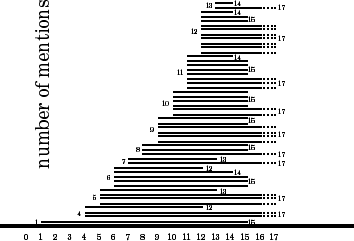 |
Chart 26 B
Age preferences of paedophiles: Girls: Lolita Research 1977 (N = 198)
Histogram
showing the minimum and maximum ages at which a girl is interesting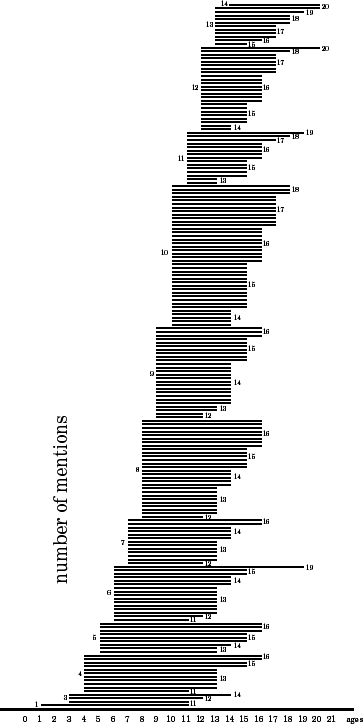 |
In European countries, the age of consent is
generally set at one of three values: fourteen, sixteen or eighteen
years. Those adopting lower values include Japan, with thirteen
years; in England and Wales, on the other hand, it is twenty-one
years for homosexual acts by males. In certain cases a threshold is included
regarding contacts and relationships with children under twelve
years, such that a heavier punishment may be inflicted in those cases. To what
extent do the age-limits of twelve, fourteen, sixteen, eighteen and twenty-one
years coincide with the real age-ranges experienced by paedophiles as revealed
by the research?
The following conclusions can be drawn from the diagram of preferred age-ranges:
Except in the case of the age 21 years (at which all paedophile interest in our research is over) it may be said that none of the ages of consent set by Penal legislation is related to the preferred age-ranges of paedophiles. If the exclusion of paedophile activity is intended, then the age of 18 is very effective. The age-limit of 16 years still intercepts the preferred age-ranges of a number of paedophiles, but is much more suitable because it does not interfere with the spheres of interest of other orientations (starting at 16 years and more). According to our results, an age of consent of 14 is not appropriate for paedophiles. The fields of interest of a very large group of paedophiles would be limited or excluded by such a threshold. The threshold at the age of 12 would solve this problem for a minority of paedophiles (18% for Lolita; 24% for Breda). The majority would, however, still be limited by that threshold. It is therefore understandable that many paedophiles advocate the abolition of all age-limits in morality legislation. For them, that is the only real solution.
The supposition that homosexuals may also 'seduce'
young boys into homosexuality persists. It is evident that this is essentially
discriminatory against homosexuals, as one never hears accusations that
heterosexuals (in general) seduce young girls into heterosexuality. To what
extent does the material we have collected confirm that in general there is a
distinction based on age between homosexual and heterosexuals one hand, and
paedophiles on the other hand?
The upper limit of the range of maxima is rendered uncertain in the case of the Breda enquiry because the question was given as 'over fifteen'. This lacuna was filled by the PIE-enquiry; the age of eighteen was given by 4.7% and that of twenty by 1.6% of the respondents.
The results of the research into heterophile paedophiles based on Lolita (Wilhelmus) show that 4.0% can go up to eighteen years, 1.0% to nineteen, and 1.5% to twenty. That is again the highest age. The lower limit of this range of maxima lies around puberty: twelve, thirteen or fourteen years.
It appears from the research that the vast majority of paedophiles lose interest before the age of seventeen, though a small percentage continue to eighteen and an even smaller proportion reach twenty. This could confirm that paedophiles are in a category in itself.
Do the collected data show that there is a dominant group amongst the paedophiles of those who love exclusively boys having reached puberty, from 14-18, 12 to 21 from 12 to 17, 18 years?
With regard to the group 14-21 years old, the question can be given in a negative answer. The proportion of preferred age-ranges beginning at 14 is insignificant in our data.
With regard to the group 12-18, the question can be given a positive answer. In the case of the Breda (1973) enquiry, the twelfth year is one at which the maximum number of preferred age-ranges for homophile paedophile begins. There is a reduction again at the age of thirteen. According to the PIE-enquiry only 4.7% are still interested at the age of eighteen. One may therefore speak of a 'group' interested in those aged between about twelve and about sixteen years, with a small number extending to eighteen years old. The group is not, however, dominant; it consists of 24% of the total of homophile paedophiles in Breda. Nor is this group distinct; it overlaps with that of those 62% of the total whose interest starts before the age of twelve and ceases above that age.
The data from the Lolita (1977) study (girls) confirms the image: the 14 to 21 year-old group is virtually absent. The 12 to 18 year old group is also a minority here, and coincides with the main group of those whose interest begins at less that 12 years old.
Conclusions: A number of paedophiles--both heterophile and homophile--are oriented exclusively towards sexually mature youngsters, according to this research. This group is however not dominant on the whole. There is no question of it being a distinct group. The close agreement between the results of the Breda (1973) enquiry and those of the PIE survey suggests that it may be the same in Britain.
Does it appear from the material at our disposal
that a group exists which is interested exclusively in very young children
(under 6 years old), or in the young child (between 6 and 10)? What is the
numerical relationship between this group and the remaining paedophiles?
For convenience we will consider first only the groups of those whose range of interest begins at less than 6 years old. The upper limit of interest in no case falls below 11 years (girls) or 12 years (boys). The majority of those in this group have an upper limit of well above 12 years. There is no separate group of paedophiles who are exclusively interested in children under six years.
Let us now consider the whole of those whose interest starts at under 10 years and over six years. Here again we see the same minimum upper limits (though to a lesser extent) of 11 and 12 years respectively. And here the majority once more has upper limits of (well) above 12 years. A small minority of those whose interest begins at less than ten years old (about 4% of the total, both in the case of boys and that of girls) are oriented exclusively towards children under the age of puberty. Their interest ceases at puberty, but not before.
Conclusion: There is a minority of 4% of the total that are interested exclusively in the sexually immature child. No further subdivision with regard to children under the age of puberty is found, such as for example paedophiles that are interested only in toddlers. All the remaining paedophiles in this group (in other words the majority of all of the paedophile subjects) have a range of interest that begins at less than twelve and continues in many cases to well over the age of twelve.
Age-limits can also be shown to occur in the
development of the child and the young person. That of the onset of puberty is
clearly apparent. At present, it occurs at about 11.5 years old in the case of
girls, and about a year later at 12.5 in the case of boys (average). During
the past hundred and twenty years the onset of puberty has occurred about four
months earlier every decade; this is attributed to improvements in hygiene and
nutrition. Puberty is apparent as sexual maturity: ovulation in the case of
girls and ejaculation in the case of boys. The period starting at about ten
years old may be called 'prepuberty'. Adolescence comes after puberty. This
stage begins in general after the age of 16, and ends a few years later.
Considerable individual variations occur, however.
Here, the question is: To what extent do the preferred age-ranges apparent from the research correspond to the stages of development of the child?
The onset of puberty (11 or 12 years old) forms a threshold rather than a cut-off point. For a very small percentage of the total number of subjects (4%), it means the upper limit of the preferred age-range. For about a quarter of the paedophiles surveyed in the research, it signifies the beginning of the relationship. The majority all start before that threshold and cross it without much ado. These results correspond more of less closely with the starting ages for sex-play given by Kinsey, according to the PIE research. It appeared from the research at Breda that 76% of the paedophiles present there began to experience interest at less than twelve, and 24% of them experienced it at twelve or more. According to Kinsey, the age of onset of puberty varies widely. In the results of the Breda (1973) enquiry we find a commencement of interest at about the fifth year (the first possible age), and starting at the ninth year. The picture is again relatively similar there when it is presented as a histogram. The transition to adolescence (16-17) clearly defines a boundary. Around the age of 16 the age-preference curves are virtually all terminated.
The entry to adulthood, the completion of adolescence just means that the few paedophiles who have continued their preferences longer now also end them.
Conclusion: The onset of puberty around the age of 11 of 12 is in fact no more than a threshold in the preferred age-ranges. Adolescence is clearly a boundary.
The paedophile who is seeking a relationship is dependent on the standards and rules of his environment. That environment rejects paedophilia. What consequences does this have? Let us look at the results of the empirical research that I undertook in 1973.
The thesis investigated by this clinical-psychological approach is as follows: What is the influence of growing up in a society that reacts extremely negatively to paedophiles? In concrete terms: In our society, do paedophiles have more neurotic and/or functional complaints than non-paedophiles?
In order to be able to reply to these questions, I have undertaken research on a number of paedophiles with the aid of the ABV test. This test method was preferred because it is what is known as an objective method; in other words there are no differences of opinion about the manner of scoring.
Dr. G.J.S. Wilde's 'Amsterdam Biographic
Questionnaire' (ABV) consist of four parts with a total of 107 questions which
have symptomatic value. The test is structured; that is, the subjects are not
completely free to answer as they like, but must choose between a limited
number of possibilities. By means of extensive research the significance of a
definite series of replies has been established; this presents, of course,
great advantages for the research procedure. Because the ABV is also
standardised for the Dutch population, it is possible to compare the results
of my research with the national averages (control group). This is of course
interesting. When we get high scores in a particular part of the test, for
example, this means little by itself; only when the results differ from those
of the average or typical Dutchman can we see the relief.
In the ABV test, the subject is faced with a large number of statements, which are connected with the property to be evaluated. He has to indicate whether or not he agrees with each of them. In this way a definite number of points can be obtained (the score). The higher the score achieved, the greater is the presence of the property evaluated by the test.
The questionnaire provides an evaluation on four scales: N, NS, E and T, which correspond to the following diagnoses:
N: Neurotic instability. This is manifested by the presence of the complaints known as 'psychoneurotic' (incomplete adjustment to life, insomnia, restlessness, feelings of loneliness, irritability, worries, nightmares, nervousness, tenseness, agitation, long after-effects of events, being discontented, grumbling, indecision, lack of concentration, internal conflicts, compulsive thoughts, etc.)
NS: Neurotic instability manifested by the presence of functional (physical) complaints (being physically unfit, rapid sweating, clammy or moist hands, headache, constipation, palpitations, stomach-complaints, misty vision, tiredness upon rising, shortness of breath not following hard work, dizziness, diarrhoea, tremor, poor appetite, etc.)
E: Social extraversion (intercourse with other people, disturbance of contacts, orientation towards the exterior, etc.)
T: Test-attitude, in other words, a self defensive rather than self-critical attitude while completing the questionnaire (self-insight, self-knowledge, repression, honesty, etc.)
The scale of neurosis (N) and that of physical complaints (NS) are the most important for the present research. However, the test as a whole should be examined and interpreted in order to obtain a well-rounded picture.
The results of the ABV-test are expressed as a number that can vary between 1 and 100. The replies are assessed item by item (yes, ?, no) and scored according to the defined standards. Each item (reply) has its own 'weight', varying from 0 to 5 points. A total score is calculated for each of the four parts (N, NS, E and T).
Sixty-seven participants at the second
international meeting of the NVSH Work-Group, held at Breda on the 10th
November 1973, acted as subjects for my research. The questionnaire was
completed anonymously, in order to eliminate any anxiety among the subjects.
By coincidence, there were again exactly 50 paedophiles (all men) among the 67
participants. The other 17 non-paedophiles were not taken into consideration.
Two-third of these 50 subjects had participated in the research on 7th April
1973 which is dealt with in chapter III.
The ages of the subjects were distributed as follows:
Chart 27: Distribution of ages in ABV of 50 paedophiles
| Ages in years | number | percentage of subjects |
|---|---|---|
| 20-29 | 17 | 34 |
| 30-39 | 10 | 20 |
| 40-49 | 10 | 20 |
| 50-59 | 11 | 22 |
| 60-69 | 1 | 2 |
| not stated | 1 | 2 |
| Total | 50 | 100 |
COMMENT: Thus 54% of the group is under 40 years old, 44% is 40 years old and more, and 2% is of unknown age. The youngest subjects is 22, the oldest 63, and the median age is 38 years.
Chart 28: ABV-scores of 50 paedophiles
| Deciles | N | NS | E | T |
|---|---|---|---|---|
| 1 | 0 | 1 | 4 | 21 |
| 2 | 1 | 1 | 9 | 4 |
| 3 | 0 | 4 | 6 | 2 |
| 4 | 1 | 3 | 6 | 9 |
| 5 | 3 | 3 | 5 | 3 |
| 6 | 2 | 3 | 2 | 2 |
| 7 | 6 | 11 | 4 | 3 |
| 8 | 8 | 1 | 4 | 2 |
| 9 | 11 | 8 | 3 | 1 |
| 10 | 18 | 15 | 7 | 3 |
COMMENT: The following conclusions can be drawn from the data:
The N-scores divide 5:45 about the point between the 5th and 6th deciles. This point corresponds to a 50:50 division of the population, so that equal numbers (of Dutch people) score above and below it. A statistically significant difference is therefore found with the group: 10% score below it and 90% above it.
The distribution of the NS-scores is as follows: 12 subjects score less that the national average and 38 score higher than it, that is 24% against 76 (likewise a statistically significant difference).
The E-scores agree more with the distribution of the Dutch population; here we see a ratio of 30 to 20, in other words 60% against 40%.
The T-scores again clearly deviate from the national data. Here we find a ratio of 39 to 11, that is 78% below the midpoint and 22% above it.
Chart 29: N-scores of 50 paedophiles
Neurotic instability manifested by the presence of what we call psychoneurotic complaints
| Deciles | N | Number of subjects |
|---|---|---|
| 1 | 0 | |
| 2 | 1 | + |
| 3 | 0 | |
| 4 | 1 | + |
| 5 | 3 | +++ |
| 6 | 2 | ++ |
| 7 | 6 | ++++++ |
| 8 | 8 | ++++++++ |
| 9 | 11 | +++++++++++ |
| 10 | 18 | ++++++++++++++++++ |
COMMENT: We find a significant increase in the N-scores of the group. The hypothesis stated in framing the question, that paedophiles become neurotic in our society through the negative attitude of the environment in which they grow up, is supported by this research (assuming that the higher scores are not the result of other causes). There is a displacement of the scores in the expected direction.
R.S.H. Visser undertook research on a group of homophile students (Nederlands Tijdschrift voor de Psychologie--Netherlands Journal for Psychology, March 1971) and found no increased N-scores with that form of sexual orientation. He writes: 'It may be concluded that there are no indications that make one suppose that the group of homophile students show a higher degree of neurosis than other students. The data obtained clearly put a question mark to the so-generally assumed hypothesis "that homophilia is a form of neurosis".' If homophilia is no neurosis, it is then unlikely that (homophile) paedophilia is one either (where does the boundary between them lie?). It is also apparent from my research that about 25% of the paedophiles may be called psychologically healthy (on the basis of their N-scores) and 2% appear to be healthier than most Dutchmen (N and NS in decile 2). We do well to draw attention to some pathology among paedophiles: important in connection with public mental health.
Chart 30: NS-scores of 50 paedophiles
Neuotic instability manifested by e.g. having functional (physical) complaints
| Deciles | NS | Number of subjects |
|---|---|---|
| 1 | 1 | + |
| 2 | 1 | + |
| 3 | 4 | ++++ |
| 4 | 3 | +++ |
| 5 | 3 | +++ |
| 6 | 3 | +++ |
| 7 | 11 | +++++++++++ |
| 8 | 1 | + |
| 9 | 8 | ++++++++ |
| 10 | 15 | +++++++++++++++ |
COMMENT: The NS-scores also show a displacement in the same direction, to a lesser extent, however.
Chart 31: E-scores of 50 paedophiles
social extraversion
| Deciles | E | Number of subjects |
|---|---|---|
| 1 | 4 | ++++ |
| 2 | 9 | +++++++++ |
| 3 | 6 | ++++++ |
| 4 | 6 | ++++++ |
| 5 | 5 | +++++ |
| 6 | 2 | ++ |
| 7 | 4 | ++++ |
| 8 | 4 | ++++ |
| 9 | 3 | +++ |
| 10 | 7 | +++++++ |
COMMENT: The E-scores are distributed rather more regularly. One might say that introversion and extraversion are more or less in equilibrium.
Chart 32: T-scores of 50 paedophiles
Test attitude, i.e. self-defensive versus self-critical orientation while answering the questionnaire
| Deciles | T | Number of subjects |
|---|---|---|
| 1 | 21 | +++++++++++++++++++++ |
| 2 | 4 | ++++ |
| 3 | 2 | ++ |
| 4 | 9 | +++++++++ |
| 5 | 3 | +++ |
| 6 | 2 | ++ |
| 7 | 3 | +++ |
| 8 | 2 | ++ |
| 9 | 1 | + |
| 10 | 3 | +++ |
COMMENT: The results of the T-scale are interesting, because here the scores are significantly low, which may reveal, a self-critical attitude of the subjects. The lower the score, the more self-critical is the subject; the higher the score, the more self-defensive he is. The frustrating circumstances have probably led the paedophile to develop a certain self-insight. It is assumed that social success is not only a consequence of a high degree of psychological stability, but rather, among other characteristics, the presence of a self-critical attitude. One can thus be psychologically unstable (high N and/or NS score) and still be adjusted and have social success, provided that one is self-critical (low T-score). For this reason it is perhaps understandable that this group is in general still socially successful.
For the sake of completeness, the average scores
of the group under examination are given below, expressed as percentiles. The
raw scores are given afterwards in brackets:
N percentile 85 (74)
NS percentile 81 (22)
E percentile 46 (51)
T percentile 27 (36)
What else do these results mean? According to the
author of the ABV test, the following classification can be employed:
Chart 33: Classification of ABV-scores
| Classification | deciles | percentiles |
|---|---|---|
| Low score | 1 | 1-10 |
| Lower than average score | 2-3 | 11-30 |
| Average score | 4-7 | 31-70 |
| Higher than average score | 8-9 | 71-90 |
| High score | 10 | 91 and over |
COMMENT: Up to and including percentile 70 can be called normal in the case of N and NS; higher scores are pathological. The cases of E and T are different. An E-score of more than 70 percentiles means a higher degree of extraversion, whereas with T it means, among other aspects, a lower critical attitude towards oneself (defensive, etc.). A low E score can indicate a high degree of introversion.
Chart 34: Descriptive presentation of the N and NS scores of 50 paedophiles
| Classification | deciles | (numbers) and % | psychiatric definition | |
|---|---|---|---|---|
| N | NS | |||
| Low score | 1 | not neurotically unstable (healthy) | ||
| Lower than average | 2-3 | (13) 26% | (26) 52% | |
| Average score | 4-7 | |||
| Higher than average | 8-9 | (19) 38% | (9) 18% | slightly neurotic |
| High score | 10 | (18) 36% | (15) 30% | neurotically unstable |
| TOTAL | (50) 100% | (50) 100% | ||
COMMENT: This table provides a summary of the descriptive analysis of the psychoneurotic and functional complaints of the subjects. Deciles 1-7 are not neurotically unstable (healthy); 8-9 slightly neurotic; 10 neurotically unstable.
The results described above are remarkable. A
second, smaller research project was undertaken with this in mind. This
control-experiment took place in Bakkum on 24th November 1973, during a
weekend organised by the NVSH Work-Group, Amsterdam branch. There were 19
participants, 10 of which had not been subjects in the earlier research with
the ABV test. The control group consisted of these 10 persons.
Chart 35: Distribution of ages in ABV of 10 paedophiles
| Ages in years | number | percentage of subjects |
|---|---|---|
| 20-29 | 5 | 50 |
| 30-39 | 2 | 20 |
| 40-49 | 1 | 10 |
| 50-59 | 1 | 10 |
| 60-69 | 1 | 10 |
| Total | 10 | 100 |
COMMENT: 70% of the group is under 40 years old: 30% is older than 40; the youngest subject is 23 years old and the oldest is 60.
This material was separately processed, and
deliberately not added to that of the first study initially; the aim
was to be able to establish the differences, if any.
Chart 36: ABV-scores of 10 paedophiles
| Deciles | N | NS | E | T |
|---|---|---|---|---|
| 1 | 0 | 0 | 3 | 2 |
| 2 | 0 | 0 | 1 | 0 |
| 3 | 1 | 0 | 1 | 1 |
| 4 | 0 | 1 | 1 | 1 |
| 5 | 0 | 1 | 1 | 1 |
| 6 | 1 | 0 | 2 | 2 |
| 7 | 0 | 1 | 0 | 1 |
| 8 | 0 | 1 | 0 | 0 |
| 9 | 2 | 1 | 0 | 2 |
| 10 | 6 | 5 | 1 | 0 |
COMMENT: The N scores divide 1:9 around about the decile 5-6 threshold. The division by chance would be 50% below and 50% above, in other words 5 below and 5 above with this group. But, here, 10% are below and 90% above. In the first (50 paedophiles) study 10% were similarly below and 90% above.
Two subjects lie below the corresponding threshold for the NS scores, and 8 above; i.e. 20% below and 80% above. In the first (50 paedophiles) study 24% were below and 76% above.
In the case of the E scores, 7 subjects have scores on one side of the threshold and 3 on the other; that is a ratio of 70% to 30% (60% to 40% in the other study).
Finally, regarding the T score, we have 5 below and 5 above, i.e. 50% to 50%. The first (50 paedophiles) study gave 78% to 22%. Clarification of the fact that there are divergences with regard to the large group is provided by further analysis. This is shown in Chart 41. The second group is more neurotic than the first (see N and NS scores). However, the subjects are more introverted (E) and the self-insight (T) is less, but that still corresponds to the average of the Dutch population.
Chart 37: N-scores of 10 paedophiles
Neurotic instability manifested by the presence of what we call psychoneurotic complaints
| Deciles | N | Number of subjects |
|---|---|---|
| 1 | 0 | |
| 2 | 0 | |
| 3 | 1 | + |
| 4 | 0 | |
| 5 | 0 | |
| 6 | 1 | + |
| 7 | 0 | |
| 8 | 0 | |
| 9 | 2 | ++ |
| 10 | 6 | ++++++ |
Chart 38: NS-scores of 10 paedophiles
| Deciles | NS | Number of subjects |
|---|---|---|
| 1 | 0 | |
| 2 | 0 | |
| 3 | 0 | |
| 4 | 1 | + |
| 5 | 1 | + |
| 6 | 0 | |
| 7 | 1 | + |
| 8 | 1 | + |
| 9 | 1 | + |
| 10 | 5 | +++++ |
COMMENT: I do indeed have an explanation here. The NVSH Work-Group, as well as with providing information and undertaking scientific research, is also occupied with the reception of paedophiles who have need of help (because they have come out of prison or are suffering from strain with their surroundings). In a certain sense, this may called a form of therapy.
Chart 39: E-scores of 10 paedophiles
Social extraversion
| Deciles | E | Number of subjects |
|---|---|---|
| 1 | 3 | +++ |
| 2 | 1 | + |
| 3 | 1 | + |
| 4 | 1 | + |
| 5 | 1 | + |
| 6 | 2 | ++ |
| 7 | 0 | |
| 8 | 0 | |
| 9 | 0 | |
| 10 | 1 | + |
COMMENT: Now, a greater percentage of problem-cases are encountered at meetings in private homes and on weekends--people who are looking for adjustment, who want to speak out for once, who (unconsciously) want to know themselves better--than, for example, at national contact days or at official meetings. It is just here that the NVSH Work-Group has been able to do useful and indispensable work. No other institution or organisation can offer help in this form. The Work-Group is in a really unique situation. Paedophiles can exchange ideas with people who share their orientation. The value of this cannot be underestimated. By itself it justifies the existence of the Work-Group.
Chart 40: T-scores of 10 paedophiles
Test attitude, i.e. self-defensive versus self-critical orientation while answering the questionnaire
| Deciles | T | Number of subjects |
|---|---|---|
| 1 | 2 | ++ |
| 2 | 0 | |
| 3 | 1 | + |
| 4 | 1 | + |
| 5 | 1 | + |
| 6 | 2 | ++ |
| 7 | 1 | + |
| 8 | 0 | |
| 9 | 2 | ++ |
| 10 | 0 |
Chart 41: Descriptive presentation of the N and NS scores of 10 paedophiles
| Classification | deciles | (numbers) and % | psychiatric definition | |
|---|---|---|---|---|
| N | NS | |||
| Low | 1 | not neurotically unstable (healthy) | ||
| Lower than average | 2-3 | (2) 20% | (3) 30% | |
| Average | 4-7 | |||
| Higher than average | 8-9 | (2) 20% | (2) 20% | slightly neurotic |
| High | 10 | (6) 60% | (5) 50% | neurotically unstable |
| TOTAL | (10) 100% | (10) 100% | ||
COMMENT: This table provides a summary of the descriptive analysis of the psychoneurotic and functional complaints of the subjects. Deciles 1-7 are not neurotically unstable (healthy); 8-9 slightly neurotic; 10 neurotically unstable.
In conclusion, I give the following general review
of the combined results of both research studies (Breda: 50 subjects and
Bakkum: 10 subjects).
Chart 42: Average ABV-scores of 50 + 10 paedophiles
| Percentiles: | N | NS | E | T under 49 years | T up to 78 years |
|---|---|---|---|---|---|
| 1 (50) | 85 | 81 | 46 | 27 | 10 |
| 2 (10) | 87 | 89 | 32 | 49 | 26 |
| 3 (10 + 50) | 86 | 85 | 39 | 36 | 18 |
COMMENT: The average range of the Dutch population is 31-70.
When it is realised that the average number of
days of sick leave taken by men in the Netherlands, according to the Dutch
Institute for Preventive Medicine TNO, was 17 days per annum (women 13) in
1972, the paedophile groups do not compare badly. The average of the second
group of 10 subjects is 7.9 and that of the first of 50 subjects 15. These
data are calculated on the basis of the last ABV-question (No. 107). It should
be mentioned that three subjects in the large group are invalids or
chronically ill (365 days). These were omitted from the calculation.
Very generally, we have been dealing here with two
groups of people who, simply because they are paedophiles, are living in a
situation of conscious or unconscious chronic stress, and it seems that a
(shorter or longer) duration of this can lead to overstrain. If one has
regular conflicts with society, then that is a continuous psychological load.
The threat can also play a role, too. It is not unthinkable that the
continuous danger of being rejected is one of the most important factors for
rendering such people neurotic. This supposition receives support when the
life-stories of the subjects are combined with the results of the ABV test
given here.
The results of the ABV test, which show a clear displacement of the N and NS scores towards the neurotic state, justify the conclusion mentioned here of a 'state of tension' (hyperaesthetic-emotional syndrome) among one third of the subjects. This means that reference is made to 'an excessive load' (the non-achievement of their desires and continuous real anxiety about actions by society).
What is asked of these subjects (namely the adjustment to standards that are impossible to them and undesired norms) is not feasible without getting out-of-balance psychologically and/or physically. A relatively large number of paedophiles (about two thirds of the first sample (N = 50) still fall within the normal range. This is positively remarkable; do we deal in these cases with basically sthenic personalities? Or are their integration abilities and adjustment capacities especially good? In essence, this depends on the relationship between the load and the carrying capacity. We are dealing here with the tolerance for frustration, which is different from one person to another and is not necessarily constant during the life of the individual.
Are there significant personality differences between the tested group of paedophiles and other Dutchmen? What resemblances are there? What could be the cause of any significant differences and resemblances?
On 30th March 1974, during the third international
NVSH Work-Group meeting in Breda, I undertook research into the personality
aspects of the paedophiles present that day. I chose for this purpose the SIW
test (Scale of interpersonal values) produced by Prof. Dr. J.D. Drenth and Dr.
L.J. Kranendonk (based on L. V. Gordon's 'Survey of Interpersonal Values',
Chicago 1960), which measures a number of aspects in the field of social
intercourse, namely what the individual considers to be important in
relationships with others, and the value to which he gives priority. When one
knows what the individual considers to be important, one can also get an idea
about his behaviour. Indeed, objectives that are considered to be important
call up motivated behaviour.
The test was undertaken anonymously. Subjects were, however, requested to put the letter 'P' on the form if they considered themselves to be paedophile. All the 79 Dutchmen present completed the text. There appeared to be 56 paedophiles among the 79. Three forms from them were discarded because they were not completed fully. The material thus consisted of 53 completed SIW forms. The test was given in the conference room.
The SIW test consists of thirty sets of three
statements (triads). From each set, the subject has to choose the statement
that expresses what he considers to be the most important. Then, he must
choose which of the two remaining statements he considers to be the less
important. One statement is then left. The social desirability-influences are
reduced by means of the constrained choice.
The SIW test measures the following aspects:
S: Social support: being treated with understanding, getting encouragement from other people, receiving friendship.
C: Conformity: doing what is considered right by society, painstakingly abiding by rules and regulations, doing what is generally accepted, conforming.
R: Recognition: enjoying esteem and being admired, being considered to be important, being well-known, receiving recognition.
I: Independence: having the right to do what you want, being free to take one's own decisions, being in a position to do things one's own way.
B: Benevolence: doing things for other people, feeling sorry for other people, helping unfortunate people, being friendly.
L: Leadership: having leadership over other people, dominating others, holding a commanding or powerful position.
Chart 43: Average SIW scores of 678 men (standard group) and of the group of 53 paedophiles
| Group | S | C | R | I | B | L |
|---|---|---|---|---|---|---|
| SG: 678 | 15.94 | 11.77 | 6.95 | 22.74 | 18.80 | 13.77 |
| PG: 53 | 19.73 | 9.28 | 8.98 | 22.75 | 18.43 | 10.66 |
| SG - PG | -3.79 | 2.49 | -2.03 | -0.01 | 0.37 | 3.11 |
COMMENT: It can be seen from the above table that no differences are found between the paedophiles and the SIW standard group from the aspects of Independence (I) and Benevolence (B), but significant differences are found from the aspects of Social Support (S), Conformity (C), Recognition (R) and Leadership (L).
In other words, the paedophiles in the group that was tested have a greater need of being treated with understanding, they are less inclined to conform to what is generally accepted, they seek recognition more than other people and feel themselves less attracted to positions of leadership, according to these results.
These subjects are no different in their need of independence and they are just as altruistic as the standard group.
There does indeed occur an explanation why the value of Social Support (S) is found to be so high among these subjects. Their not being accepted by their surroundings may be the cause of their having so great a need for being treated with understanding. This might also be the explanation for the high score in the category 'need for Recognition' (R).
Through this lack of acceptance the paedophile is constrained to set himself independent with regard to the norms that the society surrounding him takes as absolutes. This may possibly contribute to the fact that these subjects have shown a lower need for Conformity (C). That this attitude is to a greater or lesser extent imposed may be deduced from the finding that the paedophiles do not wish to isolate themselves. There is no significant variation in the Independence (I) factor.
The fourth international NVSH Work-Group meeting
was held at Breda on the 2nd November 1974, and the fifth on 14th June 1975.
Research into the participants' characters was undertaken on the last occasion
by means of a test-method developed by the Nederlands Instituut voor
Preventieve Geneeskunde (Netherlands Institute for Preventive Medicine) TNO.
The results for our subjects do not differ significantly from those of the
average Dutchman.
Our random studies with the SIW and ABV tests and the enquiry at Breda were limited to those paedophiles who had dared to 'come out' into the open and to join together in a group. From the postal enquiry it was apparent that the social position (married or unmarried; convicted or unconvicted) could really influence whether one joined a group or not. Tests and enquiries thus cannot yet lead to a rounded picture of the paedophile in general.
I have, in a still greater number of cases that were available to me through the tests and enquiry, been able to collect data from paedophiles who are not members of paedophile groups. Psychological research, and especially observation of these approximately two hundred cases, indeed confirms, in outline, the opinion already formed, but we still cannot say that this research joined to the results of that mentioned previously, produces a picture that can be representative.
A completely rounded picture of 'the' paedophile? One should be able to get an answer to this question by means of an enquiry into a representative section of the population. Only in that way would we be able to know how many paedophiles there really are. And if we were to add a series of subdivided (stratified) questions, whereby great reliability should be able to be achieved by means of the contributions of many possible facets, we should then be able to get a more rounded opinion of the personality of the paedophile. But such research is doomed to failure. How, indeed, could it be expected that people would dare to give an honest answer to questions concerning their being paedophile?
For the present, we will content ourselves with the material that is already available to us. First of all, let us establish that the external appearance of the paedophiles I met does not differ from that of other people to the extent that--even when we live for many years in close proximity to one--we cannot identify him as such. A paedophile is thus an ordinary human being.
The psychological average picture of the paedophiles that were subject to my research also does not differ from that of the population, apart from their being continuously frustrated.
The available material can be used to draw a provisional picture of the average paedophile who is participating in the Work-Groups. A natural cheerfulness seems to be innate in this paedophile. He does not become depressive quickly. He appears to be able to develop harmoniously in spite of all oppression--especially the psychological oppression after his childhood ('a paedophile is disgusting, therefore I am disgusting'). His liberality and friendly nature is apparent again and again in psycho-diagnostic research. Sadism and masochism seem to occur extremely rarely in paedophiles. The average image also reveals that the adaptability of a number of paedophiles is high, and that they are mostly persevering. It is possible that the surprisingly high proportion of paedophiles with an academic education in the sample I studied may be explained by an (unconscious) wish to show himself and the world what he is capable of. For the rest, the paedophile is not the prototype of the social climber. Due to the fact they are different they become more detached. Their opinion of others is thereby often moderated and made less severe. Some see that everything is largely relative.
I have been able to see non-paedophiles who suffer an intense internal conflict when confronted with a case of paedophilia in their own circle of acquaintances. They were unable to make up their minds about it freely: the gap between theory and reality was too wide. I myself saw judges struggling with problems of this kind in trials for sexual offences at which I was appearing as an expert.
A portrait of the paedophile? Probably it does not exist. Ultimately, it all boils down to the relationship between one person and another. Whether the partners in the relationship are now of similar ages, or whether they have very different ages, is essentially irrelevant so long as the relationship or single contact is experienced as positive by both partners.
A portrait of the paedophile? Perhaps this is an irrelevant question, because it seems on the whole that a paedophile is a person like you and me.
Bernard, F.: La protección de menores en Holanda, in: Boletín de Actividades de la Junta Provincial de Protección de Menores 3:10, 1947, p. 5-7.
Bernard, F.: El valor práctico de la psícologia normal para el derecho. Barcelona 1948.
Bernard, F.: La psicología y sus aplicaciones (con un estudio preliminar por el Dr. Oliver Brachfeld), segunda edición, Barcelona 1949.
Servatius, V.: Ephebophilie en Wetenschap I. Stand van zaken, in: Vriendschap 15, March 1960, p. 34-35.
Servatius, V.: Ephebophilie en Wetenschap II. Onderzoek, in: Vriendschap 15, April 1960, p. 50-51.
Servatius, V.: Ephebopilie en Wetenschap III. Slot, in: Vriendschap 15, May 1960, p. 66-68.
Servatius, V.: Ephebophilie en Wetenschap. Enclave, Rotterdam 1960.
Servatius, V.: Vervolgde Minderheid, met een wetenschappelijk nawoord: Homosexualiteit en wetenschap; eerste Nederlandse druk, Enclave, Rotterdam 1960.
Servatius, V.: Costa Brava, eerste Nederlandse druk, Enclave, Rotterdam 1960.
Servatius, V.: Carl Gustav Jung overleden, in: Vrienschap 16, Sept.-Oct. 1961, p. 149.
Servatius, V.: Ephebophilie en Wetenschap, in: COC-Periodiek, nr. 2, eerste kwartaal 1961.
Servatius, V.; XIVe International Congress of Applied Psychology, in: Vriendschap 16, December 1961, p. 189.
Servatius, V.: Phenomenologische beschouwingen over bisexualiteit, in: Vriendschap 16, January 1961, p. 9.
Servatius, V.: Phenomenologische beschouwingen over bisexualiteit. Enclave, Rotterdam 1961.
Servatius, V.: Phenomenologische beschouwingen over bisexualiteit, in: COC-Periodiek, nr. 3, vierde kwartaal 1961.
Servatius, V.: Schlegel's analytisch constitutie-onderzoek, in: Vriendschap 16, February 1961, p. 34-36.
Servatius, V.: Schlegel's analytisch constitutie-onderzoek. Enclave, Rotterdam 1961.
Servatius, V.: Schlegel's analytisch constitutie-onderzoek, in: COC-Periodiek, nr. 2, eerste kwartaal 1961.
Servatius, V.: Vijftig jaar artikel 248bis, in: Vriendschap 16, december 1961, p. 186.
Servatius, V.: Wetenschappelijk nieuws, in: Vriendschap 16, december 1961, p. 196.
Servatius, V.: Wetgevingen en sexueel gedrag, in: Vriendschap 16, July 1961, p. 101-103.
Servatius, V.: Wetgevingen en sexueel gedrag. Enclave, Rotterdam 1961.
Servatius, V.: Wetgevingen en sexueel gedrag, in: COC-Periodiek, nr. 3, vierde kwartaal 1961.
Servatius, V.: Holland: 50 Jahre Paragraph 248bis, in: Der Weg zu Freundschaft und Toleranz, December 1961, p. 264-265.
Bernard, F.: Athletic-Asthenic and Andromorph-Gynaecomorph Variations, in: Japanese Psychological Association, University of Tokyo, 1862.
Servatius, V.: Een centrum voor pedofielen?, in: Vriendschap 17, Febr. 1962, p. 32-33.
Servatius, V.: Over pedofilie--Een centrum voor pedofielen--Zin der pedofilie. Enclave, Rotterdam 1962.
Servatius, V.: Zin der pedofilie, in: Vriendschap 17, April 1962, p. 92.
Servatius, V.: Der Sturm, in: Der Weg zu Freundschaft und Toleranz, 13:2, February/March 1963, p. 443-446.
Servatius, V.: Der Gefangene, in: Der Weg zu Freundschaft und Toleranz, 13:3, March/April 1963, p. 563-566.
Servatius, V.: Preface to Brunoz, O.: La pédophilie. l'Amour des garçons. Enclave, Rotterdam 1964.
Servatius, V.: Een onderzoek onder homofielen--Uitkomsten van een in 1961 gehouden enquête (I), in: Vriendschap 19, January 1964, p. 6-9.
Servatius, V.: Een onderzoek onder homofielen--Uitkomsten van een in 1961 gehouden enquête (II), in: Vriendschap 19, February 1964, p. 26-33.
Servatius, V.: Een onderzoek onder homofielen--Uitkomsten van een in 1961 gehouden enquête (III), in: Vriendschap 19, April 1964, p. 80-82.
Servatius, V.: Een onderzoek onder homofielen--Uitkomsten van een in 1961 gehouden enquête (IV), in: Vriendschap 19, May 1964, p. 101-107.
Servatius, V.: Een onderzoek onder homofielen--Uitkomsten van een in 1961 gehouden enquête (V), in: Vriendschap 19, June 1964, p. 120-122.
Servatius, V.: Een onderzoek onder homofielen--Uitkomsten van een in 1961 gehouden enquête (VI), in: Vriendschap 19, July-August 1964, p. 156-159.
Servatius, V.: Een onderzoek onder homofielen--Uitkomsten van een in 1961 gehouden enquête: algemene conclusies en samenvatting (VII), in: Vriendschap 19, September 1964, p. 176-177.
Servatius, V.: Een onderzoek onder homofielen--Uitkomsten van een in 1961 gehouden enquête: slot en een nabeschouwing, in: Vriendschap 19, October 1964, p. 189.
Servatius, V.: Der Servatius-Bericht. Die wichtigsten Ergebnisse und ein Gesamt-Überblick, in: Der Weg, Oct. 1964, p. 214-217.
Servatius, V.: Victimogene en criminogene factoren, in: Vriendschap 19, March 1964, p. 65-67.
Bernard, F.c.s.: Sex met Kinderen, Den Haag 1972.
Bernard, F.: De gevolgen voor het kind, in: Sex met Kinderen, Den Haag 1972, p. 63-89.
Bernard, F.: Neue Untersuchungen in den Niederlanden, in: Pikbube, juli/aug. 1972.
Bernard, F.: Pädophilie--Eine Krankheit? Folgen für die Entwicklung der kindlichen Psyche, in: Sexualmedizin 1:9, dec. 1972, p. 438-444.
Bernard, F.: Nouvelle enquête aux Pays-Bas, in: Arcadie. Revue Littéraire et Scientifique 233, May 1973, p. 238-239.
Bernard, F.: Een onderzoek van een groep pedofielen. Uitkomsten van een in 1973 gehouden enquête. Rotterdam 1973.
Bernard, F.: Onderzoek van een groep pedofielen. Uitkomsten van een in 1973 gehouden enquête, in: Informatie Wetenschappelijk Bureau NVSH 77, September 1973.
Bernard, F.: Onderzoek van een groep pedofielen. Uitkomsten van een in 1973 gehouden enquête, in: NVSH-Documentatiemap Pedofilie, Den Haag 1973.
Bernard, F.: Pädophilie--eine Krankheit?, in: Betrifft Erziehung 6, 2 april 1973, p. 21-23.
Bernard, F.: Thema: Pädophilie, in: Betrifft: Erziehung 6, June 1973, p. 12.
Bernard, F.: Verbotene Kinderliebe, in: Beilage der National Zeitung für Familie, Gesellschaft, Umwelt, 2 June 1973.
Bernard, F.: Der Sturm, in: BEN Nr. 2/1973.
Bernard, F.: Pedofilie--een nieuw Nederlands onderzoek, in: Billy 1, May 1974, p. 37.
Bernard, F.: Paedophilia: The Phenomenon, in: Follow-Up, 2:2, 1974, p. 34-36.
Bernard, F.: Le phénomène de la pédophilie, in: Arcadie. Revue Littéraire et Scientifique 249, Sept. 1974, p. 407-412.
Bernard, F.: Het verschijnsel pedofilie, in: Billy 2, 1974, p. 6-12.
Bernard, F.: Kinderlokker doodt in paniek, in: Billy 3, 1974.
Bernard, F.: An enquiry among a group of pedophiles, in: The Journal of Sex Research 11:3, Aug. 1975, p. 242-255.
Bernard, F.: Inchiesta nei Paesi Bassi. Il fenómeno della pedofilia, in: Ompo: Organo del Movimento Politico degli Omosessuali 1:2, May 1975, p. 9-13.
Bernard, F.: Onderzoek van een groep pedofielen. Uitkomsten van een in 1973 gehouden enquête, in: Medisch Contact 30, 21 Febr. 1975, p. 206-208.
Bernard, F. Paedophilia erotica van verschillende kanten bekeken. Een fenomenologische benadering, in: Medisch Contact, 6 June 1975.
Bernard, F.: Pädophilie und Neurotizismus. Ergebnisse einer empirischen Studie, in: Sexualmedizin, 4 July, 1975, p. 441-445.
Bernard, F.: Pedofilie. Aquarius, Bussum 1975.
Bernard, F.: Pedofilie--een exploratief onderzoek, in: Tijdschrift Sociale Geneeskunde 53, 1975, p. 306-310.
Bernard, F.: Persönlichkeitsqualitäten, in: Sexualmedizin 7, 1975, p. 460.
Bernard, F.: Persoonlijkheidsaspecten bij pedofielen. Uitkomsten van een empirisch onderzoek, in: Medisch Contact, 14 March 1975, p. 313-314.
Bernard, F.: Inchiesta sulla Pedofilia. Risultati di un inchiesta svolta nel 1973, in: Ompo. Mensila di politica, cultura e attualitá 15, June 1976, p. 7-23.
Bernard, F.: The phenomenon of pedophilia, in: Better Life Monthly 3:1, Jan.-Febr. 1976.
Bernard, F.: The phenomenon of pedophilia, in: CSC Nusletter, June 1976.
Bernard, F.: Sexological Research in the Netherlands, in: Newsletter PIE, Febr.-March 1976, p. 2.
Bernard, F.: Weshalb Pädophile sich organisieren. Studie einer Niederhändischen Arbeitsgruppe, in: Sexualmedizin 5, 1976, p. 567-570.
Bernard, F.: Paedophilie, eine Krankheit? Special offprint with the title Kindersexualität, in: Sonderheft Betrifft Erziehung, Weinheim und Basel 1976.
Bernard, F.: Wetgeving in het buitenland, in: Pedofilie en Samenleving, rapport Nationaal Centrum voor Geestelijke Volksgezondheid (NCGV), Utrecht, en Instituut voor preventieve en sociale psychiatrie Erasmus Universiteit Rotterdam; Utrecht 1976, p. 204-208.
Bernard, F.: Kindersexualität. Pädophilie, Strafrecht. Ein internationaler Vergleich, in: Sexualmedizin 6, 1977, p. 847-849.
Bernard, F.: Kindersexualiteit, pedofilie en strafrecht, in: Naar Integratie Kindersexualiteit NIKS. Orgaan van de NVSH-Landelijke Werkgroep Pedofilie 6, July-Aug. 1977, p. 70-72.
Bernard, F.: Pedofilie--waar spreken we over, in: Naar Integratie Kindersexualiteit NIKS. Orgaan van de NVSH-Landelijke Werkgroep Pedofilie 1, January 1977, p. 3.
Bernard, F.: Pedofilie--waar spreken wij over?, in: Jeugdwerk Nu, 26 Jan. 1977.
Bernard, F.: Paedophilia--what are we talking about?, in NAFP-Bulletin 3:4, 1977, p. 9.
Bernard, F.: Paedophilia--what are we talking about?, in Magpie. The Journal of the Paedophile Information Exchange 7, Sept. 1977, p. 5.
Bernard, F.: Pädophilie oder Kindersexualität?, in: Rundbrief Deutsche Studien- und Arbeitsgemeinschaft Pädophilie DSAP, 1977, p. 4.
Bernard, F.: Pädophilie--was bedeutet das?, in: Sexualmedizin 7, 1977, p. 611.
Bernard, F.: Pedophilia: the consequences for the child. Paper presented at the International Conference on Love and Attraction, Swansea, Sept. 9, 1977 (CBC-Reprint 90).
Bernard, F.: Bernard pa reise. Chronicle of my world tour, in: NAFP Bulletin 4:4, 1978, p. 8-12.
Bernard, F.: Dutch research on child sex, in: Sexual Freedom, November 1978, p. 4.
Bernard, F.: Kindersexualität, Pädophilie, Strafrecht, in: Gay Journal, Jan. 1978, p. 24.
Bernard, F.: Kindersexualiteit, pedofilie en strafrecht. Een vergelijking tussen landen, in: Medisch Contact 33:12, 24 March 1978, p. 369-370.
Bernard, F.: Pedophile groups. A psychological analysis, in: CSC-Nusletter, an educational publication of Childhood Sensuality Circle 4:2, June 1978, p. 6-7.
Bernard, F.: The phenomenon of pedophilia, in: NAFP-Bulletin 2, 1978, p. 6-7.
Bernard, F.: Psychology, Paedophilia erotica and Science, in: Magpie 10, March 1978.
Bernard, F.: Bernard Stichting, in: Tijdschrift voor Sociale Geneeskunde 1979, p. 572.
Bernard, F.: Chronicle of my world tour, in CSC Nusletter 4:6, Febr. 1979, p. 3-5.
Bernard, F.: The Foundation, in: CSC Nusletter, 1979, p. 9-10.
Bernard, F.: Kindersexualität. Pädophilie, Strafrecht: ein internationaler Vergleich, in: AKP-Rundbrief 2, June/July 1979, p. 14-15.
Bernard, F.: Pedofilie--enkele stellingen, in: Maandblad over relatie en sexualiteit GG, uitgave Protestantse Stichting voor Verantwoorde Gezinsvorming PSVG, Den Haag Dec. 1979, p. 15.
Bernard, F.: Der Gefangene, in: Hohmann, J.S. (Ed.): Der heimliche Sexus. Homosexuelle Belletristik im Deutschland der Jahre 1920-1970. Erste Auflage, Foerster-Verlag, Frankfurt 1979.
Bernard, F.: Der Gefangene, in: Hohmann, J.S. (Ed.): Männerfreundschaften. Die schönsten homosexuellen Liebesgeschichten. Foerster-Verlag, Frankfurt 1979, p. 192-197.
Bernard, F.: Costa Brava, Geschichte einer jungen Liebe, mit einem Nachwort von J.S. Hohmann: Die panische Furcht vor Zärtlichkeit. Foerster-Verlag, Frankfurt 1979.
Bernard, F.: Pädophilie, in: Karin Albrecht-Désirat, Klaus Pacharzina (Ed.): Sexualität und Gewalt, Päd. extra Buchverlag, Bensheim 1979, p. 77-86.
Bernard, F.: Paedophile liberation in Holland. An interview. in: Pan 1, June 1979, p. 14-18.
Bernard, F.: Paedophilia--The consequences for the child, in: Mark Cook, Glenn Wilson (Ed.): Love and attraction. An International Conference, Pergamon, Oxford/New York 1979.
Bernard, F.: Paedophilia--What it means to the child, in: Pan 3, Nov. 1979, p. 12-17.
Bernard, F.: Pädophilie--Von der Liebe mit Kindern. Mit einem Nachwort von Dr. Joachim S. Hohmann. Lollar, Verlag Andreas Achenbach, 1979.
Bernard, F.: Weshalb Pädophile sich organisieren--Studie einer niederländischen Arbeitsgruppe, in: AKP-Rundbrief, April/May 1979, p. 10-12.
Bernard, F.: Im Anfang war die Furcht, in: Hohmann, J.S. (ed.): Pädophilie Heute, Foerster-Verlag Frankfurt/Berlin 1980, p. 63-70.
Bernard, F.: Das Kind: Kann Sex mit Erwachsenen ... ? in: Propädophile Informationsblätter 22, 1980.
Bernard, F.: Kindersexualität und Strafrecht. Rechtsprechung in einigen Ländern, in: Hohmann, J.S. (ed.): Pädophilie Heute, Frankfurt/Berlin 1980, p. 181-188.
Bernard, F.: Pädophilie--Von der Liebe mit Kindern. Mit einem Nachwort von Dr. Joachim S. Hohmann. Zweite Auflage. Lollar, Verlag Andreas Achenbach, 1980.
Bernard, F.: The paedophile. Some aspects of personality, in: Pan 7, Dec. 1980, p. 15-16.
Bernard, F.: Das pädophile Dasein. Möglichkeiten und Beispiele sexueller Beziehung, in: Hohmann, J.S. (ed.): Pädophilie Heute, Frankfurt/Berlin 1980, p. 119-136.
Bernard, F.: Pädophilie, was bedeutet das?, in: Sapi. Informationsblatt Schweitzerische Arbeitsgemeinschaft Pädophilie 1980.
Bernard, F.: Verfolgte Minderheit, ein pädophiler Roman, mit einem Nachwort von Joachim S. Hohmann: Die Furcht der (verhinderten) Mütter--Das Bild des Pädophilen. Erste Deutsche Ausgabe, Foerster-Verlag, Frankfurt/Berlin 1980.
Bernard, F.: Gedanken zum 10-järigen Bestehen der Niederländischen Arbeitsgruppe Pädophilie, in: Befreite Beziehung 2:3, 1981, p. 6.
Bernard, F.: Ein gewisser Einfluss. Gedanken zum zehnjährigen Bestehen der Niederländischen Arbeitsgruppe Pädophilie, in: Gay Journal 1981/6, p. 12.
Bernard, F.: Kann Sex mit Erwachsenen?, in: Lolita 48, 1981.
Bernard, F.: NL--10 Jahre Pädo-Arbeit lohnte, in: Befreite Beziehung (Deutsche Studien- und Arbeitsgemeinschaft Pädophilie e.V. DSAP), 1981, p. 6.
Bernard, F.: Pädophilie--Was ist das?, in: Gay Journal, February 1981, p. 26-27.
Bernard, F.: Sexualität akzeptieren lernen: Pädophilie--Erkenntnisse und Ausblick, in: Kontiki 32, Jan. 1981, p. 3-4.
Bernard, F.: Untersuchung einer Gruppe von Pädophilen. Ergebnisse einer Enquête, in: Kontiki 38:4, 1981, p. 16-17.
Bernard, F.: Costa Brava, Geschichte einer jungen Liebe, Volksausgabe. Frühlingserwachen, Pinneberg 1981 (Raubdruck).
Bernard, F.: Internationales Institut für Pädophilieforschung, in: Kontiki 5:49, June 1982.
Bernard, F.: Kinderschänder?--Pädophilie: Von der Liebe mit Kindern. Dritte, verbesserte und ergänzte Auflage. Berlin, Foerster Verlag, 1982.
Bernard, F.: Pädophilie. Die Haltung der Gesellschaft wirkt sich negativ aus, in: Kontiki 46:5, 1982.
Bernard, F.: Pedofilie: enkele stellingen, in: Groot en klein. Informatie over pedofilie. Eindhoven, Stichting JEP, 1982, p. 25.
Bernard, F.: La pédophilie--Les conséquences pour l'enfant, in: Le Petit Gredin 2, Winter 1982, p. 13-17.
Bernard, F.: Costa Brava (with a comment), in: Gay Fiction Anthology, edited by Winston Leyland. Gay Sunshine Press, San Francisco, Ca. 1982, p. 8-40.
Bernard, F.: Der Gefangene, in: Hohmann, J.S. (Ed.): Der heimliche Sexus. Homosexuelle Belletristik im Deutschland der Jahre 1920-1970. Zweite Auflage, Foerster-verlag, Frankfurt 1982, p. 192-197.
Bernard, F.: Verfolgte Minderheit, ein pädophiler Roman, mit einem Nachwort von Joachim S. Hohmann: Die Furcht der (verhinderten) Mütter--Das Bild des Pädophilen. Zweite Deutsche Ausgabe, Foerster-Verlag, Frankfurt/Berlin 1982.
Bernard, F.: The Psychological consequences for the child, in: Constantine, L.L., Martinson, F.M. (ed.): Children and sex: New findings, new perspectives. Little and Brown, Boston 1982, p. 189-199.
Bernard, F.: Condamner la pédophilie? in: L'Espoir 7, Aug.-Sept. 1983, p. 6-7.
Bernard, F.: Gibt es eine Lösung?, in: Kontiki 6:66, November 1983.
Bernard, F.: Heterophile Pädophilie--Eine Verdeutlichung, in: Gay Journal, July 1983, p. 2.
Bernard, F.: Pädophilie 1962-1983, in: Kontiki 59, April 1983.
Bernard, F.: Pädophilie nicht immer strafbar, in: Adonis 8, 1983, p. 27.
Bernard, F.: Pädophilie nicht immer strafbar, in: Kontiki 6:62, July 1983.
Bernard, F.: Wenn Kinder mit Erwachsenen ... z.B. Holland, in: Adonis 9, 1983, p. 24.
Bernard, F.: Wenn Kinder mit Erwachsenen ... z.B. in Holland, in: Sexualmedizin 12:6, 1983, p. 277.
Bernard, F.: Wir vergessen unsere Kinder. Das Gebiet der Pädophilie ist sozial begrenzt und durch die Sittengezetzgebung eingeschränkt, in: Kontiki 64:6, September 1983.
Bernard, F.: Alterspräferenzen von 50 Pädophilen, in: SAPI 1984/1.
Bernard, F.: Kinderschänder? Pädophilie 1962-1984, in: Don 9-10, Sept.-Oct. 1984.
Bernard, F.: Pädophilie nicht immer strafbar, in: SAPI 1984/2, p. 7.
Bernard, F.: Vervolgde Minderheid/Costa Brava, met kanttekeningen. Tweede Nederlandse druk, in één band, Enclave, Rotterdam 1984.
Bernard, F.: Pedofilie en psychodiagnostiek, in: Martijn, maandblad over ouderen-jongeren-relaties, 25, January 1985, p. 13.
Interviews
Kinderlokker doodt in paniek, in Algemeen Dagblad, 8 Aug. 1974 (interview by Louis Sinner); also in Billy 3, 1974.
Arnhemse kindersekszaak vraagt deskundige aandacht, in: Arnhemse Courant, 6 May 1975; also in other newspapers.
Bernard, F.: Paedophile Liberation in Holland. An Interview, in: PAN 1, June 1979, p. 14-18.
Note: Victor Servatius is the nom-de-plume of Frits Bernard.
Places of publication of the journals and periodicals included in this bibliography.
| Boletin de Actividades de la Junta Provincial de Protección de Menores: Barcelona (Spain); |
| Vriendschap: Amsterdam (Netherlands); |
| COC-Periodiek: Amsterdam (Netherlands); |
| Der Weg: Hamburg (Germany-W); |
| Pikbube: Berlin-W; |
| Sexualmedizin: Wiesbaden (Germany-W) and Basel (Switzerland); |
| Arcadie: Paris (France); |
| Betrifft Erziehung: Weinheim (Germany-W) and Basel (Switzerland); |
| National Zeitung: Basel (Switzerland); |
| Billy: Ridderkerk (Netherlands); |
| Follow-Up: London (UK); |
| The Journal of Sex Research: New York (USA); |
| Ompo: Rome (Italy); |
| Medisch Contact: Utrecht (Netherlands); |
| Tijdschrift voor Sociale Geneeskunde: Leiden (Netherlands); |
| Better Life: Beverly Hills, Ca. (USA); |
| CSC Nusletter: San Diego, Ca. (USA); |
| Newsletter PIE: London (UK); |
| NIKS: Rotterdam (Netherlands); |
| Jeugdwerk Nu: Amsterdam (Netherlands); |
| NAFP-Bulletin: Oslo (Norway); |
| MAGPIE: London (UK); |
| Rundbrief Deutsche Studien- und Arbeitsgerneinschaft Pädophilie DSAP: Krefeld (Germany-W); |
| Sexual Freedom: San Diego, CA (USA); |
| Gay Journal: Wiesbaden (Germany-W); |
| AKP Rundbrief: Duisburg and Hamburg (Germany-W); |
| Maandblad over relatie en sexualiteit: The Hague (Netherlands); |
| PAN: Amsterdam (Netherlands); |
| Propädophile Informationsblätter: Tegelen (Netherlands); |
| Sapi: Bern (Switzerland); |
| Befreite Beziehung: Krefeld (Germany-W); |
| Lolita: Dordrecht (Netherlands); |
| Kontiki: Zürich (Switzerland); |
| L'Espoir: Brussels (Belgium); |
| Le Petit Gredin: Paris (France); |
| Adonis: Frankfurt/M (Germany-W); |
| DON: Frankfurt/M (Germany-W); |
| Martijn: Hoogeveen (Netherlands); |
| Algemeen Dagblad: Amsterdam (Netherlands). |
The Author is a Clinical Psychologist and a member of the board of directors of the Association for the Advancement of Social Scientific Sex Research, Düsseldorf; member of the German Society for Sex Research, Frankfurt/Main; member of the board of directors of the Association for Humane Sexuality, Berlin; advisor of the Netherlands Association for Sexual Reform, The Hague; and member of the Association for Sexology, Utrecht.
Pedofilie (Paedophilia) was first published in Dutch by Aquarius, Bussum 1975; an extended German edition Pädophilie--von der Liebe mit Kindern (Paedophilia--on loving children) was published by Achenbach, Lollar, first print 1979, second print 1980; and a third up dated version Kinderschänder? Pädophilie--von der Liebe mit Kindern (Child Molesters?) by Foerster, Berlin and Frankfurt 1982.
This first concise English version contains the quintessence (in a nutshell) of the research and is therefore not a full translation of the Dutch and German texts. For the first time an extensive bibliography of publications by the author is added.