
;
Paedophiles in Society: Reflecting on Sexuality, Abuse and Hope;
243 pp
This book is not like any other book you may have read on paedophiles, or adult sexual attraction to children, or child protection. It is not about the medical, forensic, psychological, psychiatric, legal or criminological aspects of these phenomena.
Those issues are adequately dealt with in other texts. Instead, this book is about ordinariness, about culture and society around us and about how people in everyday life think about and make sense of men being sexually attracted to children
(the book says something too about women sexually attracted to children but the focus is predominantly on men).

;
How can we prevent child abuse if we don't understand paedophilia?;
Independent Voices (UK),
Jan 07 2013
If we want to keep children safe from sexual harm, then surely knowing what we’re dealing with would be a good first step. [...]
What gets a bit more complicated is distinguishing between paedophilia (the sexual attraction) and child sexual abuse (adult sexual contact with children below the legal age of consent). Paedophilia is, strictly speaking, in a separate conceptual category to child sexual abuse, although in everyday life the word ‘paedophile’ is typically taken to mean a person (usually a man) who has sexually offended against a child. [...]
The first step is to try and work out how many paedophiles there are.
[...] we would be therefore looking at around one in five of all the men we know having some degree of sexual attraction to children. [...]
Some people experience such sexual desires but don’t act upon them. Perhaps, for them, in a sex-saturated society, that’s quite an achievement. We need to be able to acknowledge and understand their self-control.
Independent Voices is the Independent newspaper's online blogging site. The article didn't actually appear in the paper (as fas as I know).
;
Finding Children Sexually Attractive,
Mar 01 2013
This booklet is for anyone who finds that they are sexually attracted to children. In it, people talk in their own words about their own experiences and provide advice on how to handle this situation.
I hope you will find this booklet encouraging, helpful and inspiring! [...]
This booklet will provide you with a route-map for handling this situation, with examples of people who have been dealing competently with their sexual feelings for many years.
This booklet is based on research.
;
A Secular Trend toward Earlier Male Sexual Maturity
Evidence from Shifting Ages of Male Young Adult Mortality
Improved nutrition and disease environments have generated substantial increases in human body size over recent centuries. A decline in the age of menarche, the measuring point for the onset of female sexual maturity, has also been well documented.
A similar shift to earlier ages of sexual maturity for males has been hypothesized, but evidence of a long-term trend has been elusive. The secular trend toward younger menarche can be documented because individual health records recording first menstruation can be compared over time.
For males, however, no such comparable medical evidence exists.
The research reported here takes an indirect approach to measuring males' age of sexual maturity.
;
False memory syndrome: As women bring lawsuits, therapists are having to pay for their mistakes.
Valerie decided to enter therapy. ...
By the end of the first hypnotherapy session, Jenks came to believe that she'd been sexually abused not only by her family but also by friends and strangers. ...
Over the course of six months, Jenks was led through a series of so-called repressed childhood memories that included specific details of being sexually molested. ...
The doctor then drew out further memories, including one of her being a member of her grandparents' satanic cult. She was led to believe she had helped torture and kill babies and children. ...
;
Thoughts on NAMBLA
Alan Ginsberg describes the reason why he joined NAMBLA. He also describes the task NAMBLA has to fulfil.
Alan Ginsberg describes the reason why he joined NAMBLA. He also describes the task NAMBLA has to fulfil.
;
JM Barrie now seen as "a monster",
Aug 10 2008
Comment on (the review of) Faber's book about J M Barrie.
The author refers to the era and the culture J M Barrie lived in. In 'Peter Pan' he broke with the dominant culture that saw children only as angels.
Comment on (the review of) Faber's book about J M Barrie.
The author refers to the era and the culture J M Barrie lived in. In 'Peter Pan' he broke with the dominant culture that saw children only as angels.
;
Chemical interventions and ethical side-effects: from pedophilia to depression. Where are the ethical boundaries of treating mental illness by neurochemical means?
Increasing biochemical knowledge of sexual functionality and attraction has allowed researchers to tentatively deduce a chemical cause for pedophilia and initiate various biochemical treatments for this condition. The availability of such knowledge, along with the development of new pharmaceutical treatment options, opens up new legal and ethical questions regarding how to chemically treat sexual criminality and how we, as a society, should reflect upon the use of chemicals in the treatment for other forms of deviant behaviour.
[... D]espite the early evidence of effectiveness in treatment, it is unclear how SSRIs work in relation to the treatment of pedophilia. [...]
A further dilemma raised by the chemical treatment of pedophilia is the expectation of a permanent cure for this form of sexuality. Studies have demonstrated that pharmacological interventions do not change the pedophile's basic sexual orientation toward children. [...]
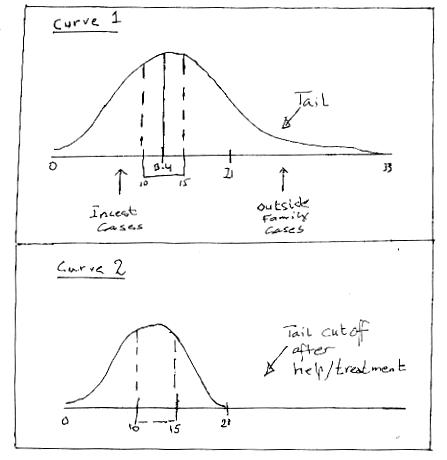
However, caution is required to make sure that we do not find ourselves dis-enhancing or normalising traits that are simply the tail ends of a normal range of personality traits
;
The tail end of a dachshund
In May 2011, the Martijn Association decided to set up an Ethics Commission. Ethics is concerned with the question of what is good and what is bad; with values, norms and guidelines. [...]
In this article, I aim to place these guidelines in a broader context, namely that of the debate which has taken place in the Netherlands – and far beyond its borders – since the 1990s. The commission does not come up with any revolutionary, new advice, but follows up on a long-standing discussion, like the tail end of a long dachshund.
It shows that, as long as people with paedophilic feelings are allowed to enter into serious discussion, far from ending up in ‘raunchy suggestions’ the end result is an actual ethical code – and a fairly strict one at that.
;
Turning Points and Chains of Changings …
I will highlight some turning points and the changes that have followed within the Netherlands during the last ten decades.
First: liberalization. Then: some severe incidents > Moral Panic > magnifying the incident > more rules and laws > gradually fading out the panic.
More and more severe rules and laws followed.
Pro- and Contra Groups appeared.
Two contrasting trends are visible. Contra groups, but also more nuanced ideas of professional helpers, researchers and even the popular press: the difference between pedophilia (feeling) and pedosexuality (acts) is acknowledged. The ‘pedophiles’ themselves have developed a new ethical code [...]
Here appears [...] the “NOMAP”, the Non Offending Minor Attracted person. He or she might become welcome in society, no longer as a ‘distorted patient’, but as a person with a less common (sexual) orientation, which is not dangerous as long as the person has the self-discipline to control his or her impulses, just as every (sexual) orientation demands to every person.
;
Born as a pedophile?
A critical comment on
“Minor Physical Anomalies as a Window into the Prenatal Origins of Pedophilia”, by Fazio, Rachel L., Dyshniku Fiona, Murray Michelle E., Lykins Amy D., & Cantor James M.; Archives of Sexual Behavior; Jun 10 2015.
These authors report that they have found correlations between specific physical anomalies that are supposed to date from an early stage in utero, and what they call "pedophiles".
The conclude that the origins of 'pedophilia' also must date from that early stage in utero.
Tha author of this Comment argues the weakness of that study, and thus of its conclusion.
In an Epilogue he argues an alternative way to cope with the phenomenon 'pedophilic feelings', for person and for society.
;
A Comment on Seto's "Is Pedophilia a Sexual Orientation?",
Jun 29 2015
Seto's proposal to view pedophilia as 'being attracted to ..', thus as a feeling -- as an orientation similar to heterosexuality, bisexuality, and homosexuality -- may be a first step towards humanizing those of our fellow human beings who have such feelings.
However ...
Thus ...
Moreover ...
Seto's proposal to view pedophilia as 'being attracted to ..', thus as a feeling -- as an orientation similar to heterosexuality, bisexuality, and homosexuality -- may be a first step towards humanizing those of our fellow human beings who have such feelings.
However ...
Thus ...
Moreover ...
;
Not 50% but 0,4% … Summarized,
Sep 22 2021
An English short summary of:
0,4 Prozent, nicht 50 Prozent Anteil der „pädophilen“ Männer an allen „Tätern“ des „sexuellen Kindesmissbrauchs“, by Filip Schuster,
by Frans Gieles, PhD, webmaster of Ipce.
Open this summary to see the link to Schuster's article in German language.
An English short summary of:
0,4 Prozent, nicht 50 Prozent Anteil der „pädophilen“ Männer an allen „Tätern“ des „sexuellen Kindesmissbrauchs“, by Filip Schuster,
by Frans Gieles, PhD, webmaster of Ipce.
Open this summary to see the link to Schuster's article in German language.
;
Ambivalence
The author sees a 'blind spot' in quantitative research, a.o. of Rind c.s.
In the quantitavie research, there is a line between +1 and -1, with zero between both figures: 'neutral' between 'positive' and 'negative.
In the qualitative view, there are two positions possible between positive and negative: neutral and ambivalent: positive and negative both.
The ambivalent feelings may be felt during the act, thus empirically, but also may have came up by influences later by other people: 'It was nice, but I have learned that is was bad, thus morally wrong'.
The latter view is quite often given by a psychologist with a blind eye for attachment problems within the family: 'That dirty man have caused all your problems', or even 'has destroyed your life', whereafter the parents think: 'We are OK'.
;
Short Explanation, short comment, questions
About:
Pornography Use and Sexual Aggression: The Impact of Frequency and Type of Pornography Use on Recidivism Among Sexual Offenders
Drew A. Kingston, Paul Fedoroff, Philip Firestone, Susan Curry, and John M. Bradford. AGGRESSIVE BEHAVIOR, Volume 34, pages 1–11 (2008).
It is a quite difficult article, at least for the average student and Ipce reader.
Thus: Explanation of the used statistics, some comments and some questions.
;
Sympathetic research in the wrong frame
A renewing view on people with pedophile feelings who massively are willing and able to control themselves … is seen through the spectacles or within the frame of the more familiar ‘good old’ offender-model, just the people that could not control themselves.
A renewing view on people with pedophile feelings who massively are willing and able to control themselves … is seen through the spectacles or within the frame of the more familiar ‘good old’ offender-model, just the people that could not control themselves.
;
Fear of Relapse,
Mar 21 2012
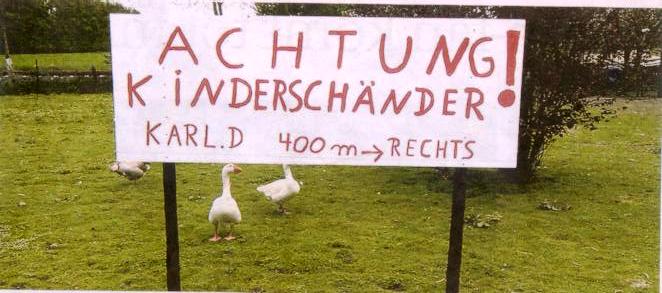
What moved the inhabitants? Fear of relapse of the man Karl.
Is this fear realistic?
Are there figures about relapse? Yes.
[...]
These figures represent cases of child sexual abuse, of which every case is one too much, so they are a cause for concern, but not a cause to panic - at least not a cause to attack people, to ban people from the community and by doing so increasing their feelings of anxiety and stress, thus increasing the chance of relapse. The same figures are a cause to find other ways of acting.

;
Forget the four percent - Remember the one percent,
Aug 08 2017
Now and then, I have said that the research of Rind c.s. should prove that a sexual experience during childhood in only four percent should result in lasting harm, and only for girls and only for cases of incest and force. This is not correct.
I discovered this in a shock after someone said that this was only one percent. In my text to correct this into 4%, I wanted to place a link to this cipher in Rind’s meta-analysis. This 4% cannot be found there! ...
The 1% can be found in Rind’s meta=analysis, but this cipher has another meaning.
... Explanation ... Snakes in the grass ... Contemplation ...
;
Pedophilia and the American Psychiatric Association: Mental Illness vs. Aberration
... The APA said that the discussion about diagnostic criterion for pedophilic disorder contained an error; it should have read, “sexual interest,” instead of “sexual orientation.” ...
The APA classifies pedophilia as a type of paraphilia, or an atypical sexual interest. In its notes about changes in the definitions of paraphilia, the APA clearly states that most people with atypical sexual interests do not have a mental disorder. ...
The APA’s notes explain that they did not change the definition of pedophilia in its new edition of the DSM; instead it only changed the name of the disorder from “pedophilia” to “pedophilic disorder.” ...
in order to be diagnosed with Pedophilic Disorder, people must not only have thoughts of attraction to children, they must act on the attraction as well.
A Comment of PhD Frans Gieles is added to this article by Ipce.
;
Interview: Hollida Wakefield & Ralph Underwager;
Paidika # 9, pp 2-12, 1993;
pp 2-12
Quotes:
"Paedophiles can boldly and courageously affirm what they choose. They can say that what they want is to find the best way to love."
"Paedophiles can make the assertion that the pursuit of intimacy and love is what they choose. With boldness they can say, "I believe this is in fact part of God's will."
"Paedophiles need to become more positive and make the claim that paedophilia is an acceptable expression of God's will for love and unity among human beings."
;
Are there women paedophiles?,
Apr 29 2009
Paedophiles are invariably thought of as men and they mostly are. But do women commit sexual abuse against children, and if so, why is it rarely discussed?
However, a Comment of Ipce says about this article:
This article is a textbook example of disinformation. From the title it purports to be about pedophilia, then nearly all the cases it discusses are of incest, something which is bound to have more serious sequelae. The effect is to sensationalize the concept of pedophilia in the mind of the reader.
;
The Abused/Abuser Hypothesis of Child Sexual Abuse: A Critical Review of Theory and Research;
488-509
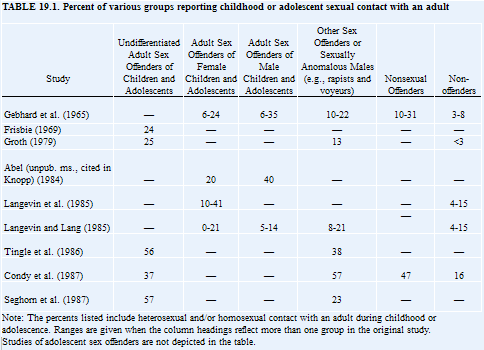
A widespread belief among the general public and professionals alike is that “sexual abuse causes sexual abuse”. That is, sexually abused children and adolescents who have engaged in sexual behavior with an adult (or a significantly older adolescent) are commonly thought to be at risk in later years of themselves becoming sexually involved with children and adolescents. This belief is referred to here as the “abused/abuser hypothesis of child and adolescent sexual abuse.”
Given the popularity of the abused/abuser hypothesis, it is perhaps surprising to find that there is a dearth of evidence supporting it. This is not to say that there is a substantial body of contradictory evidence. Rather, only a handful of studies have actually investigated the presumed association, and the designs and methods of these studies have been less than ideal. Most of the relevant data come from retrospective studies of adults that do not allow for direct causal analysis.
"The conclusion that seems warranted from the review is that childhood and adolescent sexual contact with adults is neither a necessary nor a sufficient cause for becoming an adjudicated sex offender of children or adolescents."
"Thus, sexual contact with an adult during childhood or adolescence is not a necessary cause for becoming an adjudicated adult sex offender of children and adolescents. Sexual contact with an adult during childhood or adolescence also does not appear to be a sufficient cause for becoming an adjudicated sex offender of children and adolescents."
"In summary, the abused/abuser hypothesis — the belief that sexual behavior between adults and children or adolescents causes those children and adolescents, as adults, to become sexually involved with other children and adolescents — is inadequate and incorrect."
"The belief that sexual abuse causes sexual abuse, the so-called “abused/abuser hypothesis,” is simplistic and misleading."
"The conclusion reached is that sexual contact with an adult during childhood or adolescence is neither a necessary nor a sufficient cause of adult sexual interest in children or adolescents."


;
The Sex-Abuse Time-Line Diagrams;
IPT Journal, Vol 6, 3-5, 1994
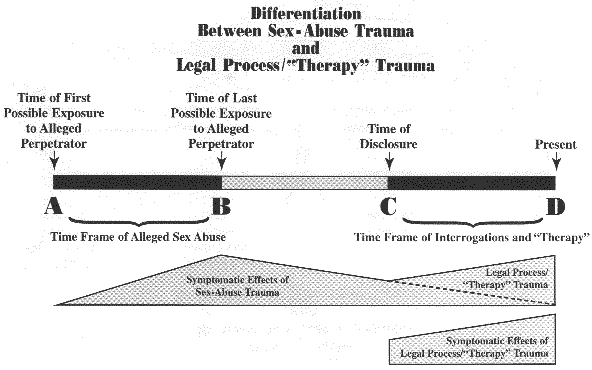
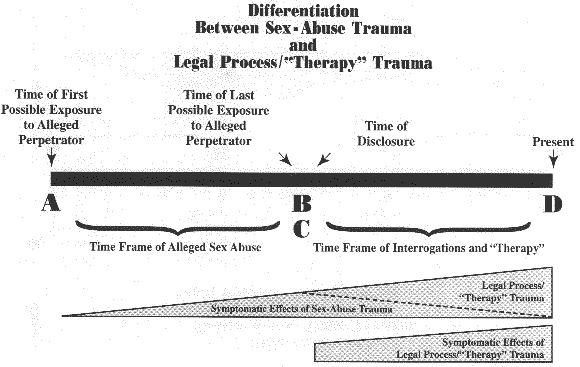
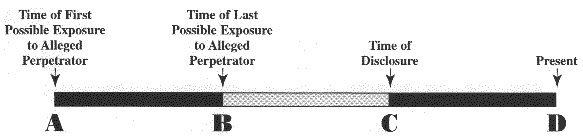
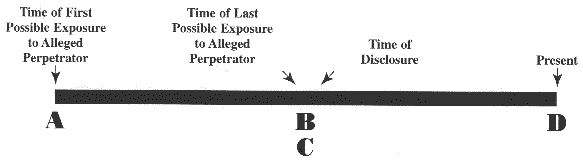
When evaluating sexual abuse allegations it is extremely important to differentiate between symptoms that arose prior to disclosure and those that arose afterwards. Symptoms arising after the disclosure and cessation of abuse can be caused by sexual abuse therapy, multiple interrogations, and other aspects of the legal process. Therefore, in a sex-abuse examination it is necessary to inquire as to the timing of the development of any claimed symptoms. Diagrams are presented to facilitate this inquiry.
When evaluating sexual abuse allegations it is extremely important to differentiate between symptoms that arose prior to disclosure and those that arose afterwards. Symptoms arising after the disclosure and cessation of abuse can be caused by sexual abuse therapy, multiple interrogations, and other aspects of the legal process. Therefore, in a sex-abuse examination it is necessary to inquire as to the timing of the development of any claimed symptoms. Diagrams are presented to facilitate this inquiry.
;
The Pedophile's Guide into Developmental Traumatology,
Mar 16 2020
Filmmakers like Ramsey and Scorsese urge war veterans to brain “pedophiles” and save children from PTSD (post-traumatic stress disorder) ....
Symptoms of PTSD in chronically traumatized children are usually not prominent ...
Hence, the Vietnam syndrome and “childhood sexual trauma” are totally different kinds of PTSD that cannot be compared! ...
What symptoms can be invented for the invisible forms of PTSD? ...
While some scientists tell us the rest of the “victims” of CSA have less cortisol in their urine ... another scientists tell us they have more cortisol in their plasma ...
Normal and even lower cortisol levels?! ...
When put together, all these scientific data make absolutely no sense. ...
Thus, scientists cannot agree upon whether the “victims” of CSA have elevated, normal or low levels of cortisol, and scientists cannot convince us that one “victim” can be both poisoned with and deprived of cortisol. ... ...
The idea that willing sex causes PTSD is far from being proved.
;
Hello Susan Clancy
Hello, Susan
I am a paedophile and I've read your book ["The Trauma Myth"]. ...
But despite of your wit you write really stupid things about the question. Your prejudice against the child lovers does not allow you to understand simple things. If you are real scientist, not moralist, you would be able to answer the next topics: ... ... ...
So, Susan, I disproved all ideological stratification on your scientific work. ...
And if "victims need to hear the truth" tell them truth.