
;
Myths and misconceptions about sex offenders.;
The Canadian Journal of Human Sexuality.;
6(4), ,
Sep 01 1997
One of the clearest articles addressing the current sad state of affairs regarding valid research on the topic of pedophilia.
Individuals who commit sex crimes present problems for everyone who deals with or is affected by them. Among those who commit such crimes, some are caught, some are convicted, and some are eventually sent to mental health care providers. Although many are never caught and never get help, a growing number seek help through such avenues as: self-help groups like Sex and Love Addicts Anonymous; chat-rooms on the internet; reading books and watching afternoon talk shows; or presenting with vague or unusual complaints (e.g., "Doc, I think I like sex too much"). They are, by definition, criminal and they are always in hiding, despised even by other criminals. They are the subject of increasing media attention which is at once salacious, superficially probing, and almost universally condemning. Victims of sex crimes have become increasingly vocal and have lobbied for the attention of politicians who, in turn, have become convinced that sex crimes are a new epidemic which cries out for corrective legislative countermeasures.
With so many powerful interest groups converging on the issue of sex offenders and what to do with them, it is important that the scientific community be sure of what it is saying. It is important that mental health experts make clear how much of what they are saying is opinion and how much is known scientifically. When a statement is communicated as a fact, it is important that the reasons for believing it and the limitations of evidence supporting the "fact" be stated.
The topic of treatment of sex offenders is a "hot potato" that, if not handled correctly, will damage the reputation of the mental health field. Unfortunately, this is among the most complex, controversial, and political topics faced by mental health care professionals. There seems to be something about sex that makes even scientists stop thinking logically.
[...]
Statements that are poorly supported by the scientific literature are made daily about the nature of sex offenders, even by experts. The purpose of this paper is to alert those who deal with sexual offences and sex offenders to some common assumptions that are poorly supported by scientific evidence.

;
Minor Physical Anomalies as a Window into the Prenatal Origins of Pedophilia;
Archives of Sexual Behavior;
2015(564), ,
Jun 10 2015
Evidence is steadily accumulating to support a neurodevelopmental basis for pedophilia. This includes increased incidence of non-right-handedness, which is a result primarily of prenatal neural development and solidified very early in life. Minor physical anomalies (MPAs; superficial deviations from typical morphological development, such as un-detached earlobes) also develop only prenatally, suggesting them as another potential marker of atypical physiological development during the prenatal period among pedophiles.
This study administered the Waldrop Physical Anomaly Scale to assess the prevalence of MPAs in a clinical sample of men referred for assessment following a sexual assault, or another illegal or clinically significant sexual behavior.
Significant associations emerged between MPA indices and indicators of pedophilia, including penile responses to depictions of children, number of child victims, and possession of child pornography. Moreover, greater sexual attraction to children was associated with an elevated craniofacial-to-peripheral anomalies ratio. The overall sample demonstrated a greater number of MPAs relative to prior samples of individuals with schizophrenia as well as to healthy controls.
;
Perversion or personal preference?;
http://www.mcgilldaily.com,
Nov 10 2008
Short essay with short history of 'pedophilia' and 'pederasty' in society and literature.
Especially Mann's Death in Venice and Nabokov’s Lolita are summarized and commented.
Short essay with short history of 'pedophilia' and 'pederasty' in society and literature.
Especially Mann's Death in Venice and Nabokov’s Lolita are summarized and commented.
;
Child Abuse,
Oct 03 2003
Defining Abuse in Historical Context, Innocence and Abuse, Preventing and Prosecuting Child Abuse
Entry from Gale Encyclopedia of Children and Childhood in History and Society
Child abuse, as a historical subject, is deeply problematic, since the concept of abuse is inevitably relative and can be only very tentatively applied across cultures and across centuries.
The watershed in the history of child abuse must be dated as recently as 1962, when child abuse received its modern formulation by the American medical establishment as the battered-child syndrome.
The attribution of innocence implied the possibility of violation, and the necessity of protection.
A full generation after "The Battered-Child Syndrome" was first published, there is general public recognition that various forms of child abuse are pervasive – but also an awareness that abuse may remain largely concealed within the domestic walls that protect family privacy.
Furthermore, just as treatment of children in the historical past may appear abusive by current standards, so there is also a divergence of perspectives within contemporary society about what exactly constitutes abuse.
For all these reasons, child abuse is a social problem that has been recognized but by no means resolved.
;
Why Queers Should Care About Sex Offenders
Although I studied many subjects in college, my interest especially aligned with the radical thinking of my queer theories coursework. Queer theory obliterates the idea of good and bad sex and what should and should not be deemed deviant.
[...]
In treatment, lawmaking, and cultural discourse, sex offenders are referred to as participating in deviant sexual behavior, having deviant sexual fantasies, and being inherently "deviant" themselves. [...]
The term means that, according to the rules of a powerful few, something is inherently wrong with you if you are not like everybody else. In other words, deviance becomes a viral social construct that serves as a moral imperative to dictate and intimidate people into behaving.
Queer theory has well documented how those in power have employed the terminology of deviance to oppress queers. [...]
There is a widespread assumption that all sex offenders are child molesters, pedophiles, and violent rapists. This is not true. A large spectrum of acts are considered sex offenses. [...]
the public perception of the sex offender, and of the laws violated to become a sex offender, is inaccurate. [...]
It is a misconception that the majority of sex offenders reoffend, as the actual number is around 2 to 5 percent for recidivism from a sex crime. [....]
"Deviant" sexual desire is thereby equated with criminal sexual activity. This is a dangerous stance ...
;
Yo conozco un pederasta ...;
El Correo Catalan,
Aug 25 2007
Como sabes, yo conozco un pederasta. No tiene mayor mérito: cosas del oficio. [...]
Entre los pocos pederastas hay un pequeñísimo porcentaje de criminales que utiliza la violencia para satisfacer su deseo. Otra obviedad igualmente insulsa, pero imprescindible, dado que así como la violación no se identifica con el comportamiento sexualmente habitual de los adultos tampoco la inclinación pederasta debe identificarse con la violación y el asesinato. Es más, la atracción sexual por los niños no deriva siempre en una conducta que castiguen las leyes: las leyes no castigan la naturaleza, sino la conducta de las personas. [...]
Mi pederasta se distinguía nítidamente de los asesinos, de los violadores y de los psicópatas. Todo ello, te lo repito, sin que dejara nunca de saber quién era: un hombre que no podía amar a los adultos.
;
American Sexual Behavior and The Kinsey Report (excerpts);
Several excerpts
Excerpts from: American Sexual Behavior and The Kinsey Report; New York: Greystone Press, 1948.
The same factors which governed the development of our actual sexual behavior seem to have set up the psychological blocks which have been the obstacles to our knowledge.
Observation and a reading of history show that not all people at all times and in all lands have the same attitudes toward sex. Yet the pattern of Western civilization has been established - and Westerners have sought to impose it upon the rest of the world - as if only one set of sexual customs was either desirable or natural.
The sexual behavior of people is based on a great many different traditions, superstitions, impulses and individual experiences. But our attitudes toward sex are not even as reasonable as our behavior.
Homosexual experience before adolescence was more frequent [than heterosexual] among the subjects studied for the Kinsey Report ...
These statistical data may shock many parents.
The Report has set forth the facts.
Only after the fear of parental displeasure has been removed can we find out what that taboo can do to the child's mind. Perhaps the silliest attitude parents can take is the peremptory order "Stop!" ....
;
The Kindergarchy - Every child a dauphin.;
The Weekly Standard,
Jun 09 2008
A comparison between the style of child-rearing before and after the 1970s.
Critical questions for the new style: the burden of (too much?) attention and too much pressure to the children, especially at school.
A comparison between the style of child-rearing before and after the 1970s.
Critical questions for the new style: the burden of (too much?) attention and too much pressure to the children, especially at school.
;
The consumption of Internet child pornography and violent and sex offending;
BMC Psychiatry, Jul 14 2009;
July 14, 2009,
There is an ongoing debate on whether consumers of child pornography pose a risk for hands-on sex offenses. Up until now, there have been very few studies which have analyzed the association between the consumption of child pornography and the subsequent perpetration of hands-on sex offenses.
The aim of this study was to examine the recidivism rates for hands-on and hands-off sex offenses in a sample of child pornography users using a 6 year follow-up design.
Conclusion:
Consuming child pornography alone is not a risk factor for committing hands-on sex offenses – at least not for those subjects who had never committed a hands-on sex offense. The majority of the investigated consumers had no previous convictions for hands-on sex offenses. For those offenders, the prognosis for hands-on sex offenses, as well as for recidivism with child pornography, is favorable.
;
Dominance, Submission, and Love: Sexual Pathologies from the Perspective of Ethology;
150 - 175
In human sexual behavior, strata of different phylogenetic origins can be distinguished. Sexuality based upon the mechanisms of male dominance and female submission, which characterizes the reptiles, also constitutes the basic layer of human sexuality. This reptilian heritage is superimposed, however, by a more recently acquired sexuality characterized by affiliation and love. The new potentiality to act in a friendly manner evolved with the development of parental care independently in birds and in mammals.
In normal human sexual behavior, the archaic agonal sexuality is controlled by affiliative sexuality and, therefore, is characterized by love. Agonal sexuality is still with us, however, as indicated, among other features, by the phallic male-dominance displays, by a male hormonal response linked to dominance achievement, and by the sexual fantasies of submission that are experienced by females. Agonal sexuality normally is under the control of affiliative sexuality, and therefore, humans correctly associate sex with love. Certain forms of sexuality, such as sadomasochism and a particular form of male homosexuality, are explained as being a regression to the archaic agonal sexuality.
Pedophilia and pedosexual behavior are explained within the regression context, too. Children have characteristics, such as small size, that facilitate adult males' feeling dominant to them, as occurs in pedosexual behavior.
Since human adult/adult romantic love is derived by phylogeny from parental caregiving behavior, it is easily seen how, in some adult humans, the feeling of love toward children has been retained and eroticized, which is the true meaning of the term "pedophilia."
;
Making Punishments Fit the Most Offensive Crimes,
Oct 23 2008
;
Social Stigma
Social stigma is the extreme disapproval of (or discontent with) a person or group on socially characteristic grounds that are perceived, and serve to distinguish them, from other members of a society. Stigma may then be affixed to such a person, by the greater society, who differs from their cultural norms.
Social stigma can result from the perception of mental illness, physical disabilities, diseases such as leprosy (see leprosy stigma), illegitimacy, sexual orientation, gender identity, skin tone, education, nationality, ethnicity, ideology, religion (or lack of religion) or criminality. Attributes associated with social stigma often vary depending on the geopolitical and corresponding sociopolitical contexts employed by society, in different parts of the world.
According to Goffman there are three forms of social stigma:
Overt or external deformations, such as scars, physical manifestations of anorexia nervosa, leprosy (leprosy stigma), or of a physical disability or social disability, such as obesity.
Deviations in personal traits, including mental illness, drug addiction, alcoholism, and criminal background are stigmatized in this way.
"Tribal stigmas" are traits, imagined or real, of ethnic group, nationality, or of religion that is deemed to be a deviation from the prevailing normative ethnicity, nationality or religion.
;
Other People's Eroticism, an essay;
From the Semiotexte website & http://denniscooper-theweaklings.blogspot.com.es
During the controversy provoked by pornographic productions, someone quoted this sentence:
"Pornography is other people's eroticism." ...
Since majority eroticism has beauty for its principal trait, any ugliness, vulgarity, stupidity, gratuitous obscenity, in the representation of sexuality, is our signal that it is not ours, but that of the X's. ...
I have said how the two genres were distinguished: since majority eroticism has beauty for its principal trait, any ugliness, vulgarity, stupidity, gratuitous obscenity, in the representation of sexuality, is our signal that it is not ours, but that of the X's. ...
It is up to us to emancipate ourselves from the clichés, the illusions that our sexual conditioning and our frustrations have produced. The expression of sexuality need not be either beautiful or ugly, cultivated or crude, brilliant or idiotic: but it must become the free discourse of desire authentically expressed and no longer the staging of an eroticism we dream up for ourselves when we are deprived of the right to experience any at all.
;
El erotismo de los demás
Durante el debate que han provocado las producciones pornográficas, alguien citó esta frase, cuyo autor desconozco: «La pornografía es el erotismo de los demás». ...
El erotismo mayoritario, al tener como rasgo principal su belleza, todo fealdad, vulgaridad, necedad, obscenidad sin fundamento, en la representación de la sexualidad, nos advierte de que no se trata de la nuestra, sino de la de los X. ...
Nos toca a nosotros emanciparnos de los clichés y de las ilusiones que nuestro adiestramiento sexual y nuestras frustraciones han producido. La expresión de la sexualidad no tiene por qué ser bonita o fea, elaborada o inculta, genial o idiota, sino que ha de convertirse en el libre discurso del deseo auténticamente experimentado, y no ya la escenificación del erotismo con el que soñamos cuando nos privan del derecho a experimentar ninguno.
;
Hikind Retreating On Tough Tactics Against Molesters;
,
Mar 25 2009
Assemblyman Dov Hikind of Brooklyn, a leading voice in the fight to end child sexual abuse in Orthodox communities, is backing down from some of his previous claims and backing away from one of his most confrontational stands against an alleged pedophile.
Assemblyman Dov Hikind of Brooklyn, a leading voice in the fight to end child sexual abuse in Orthodox communities, is backing down from some of his previous claims and backing away from one of his most confrontational stands against an alleged pedophile.
;
Childhood sexual experiences and the perception of abuse among Latino men who have sex with men;
The Journal of Sex Research;
39(3, 2002),
This paper is based on interviews with men who have had childhood sexual experiences with an older partner (CSEOP). At the time of the interview, some of these men felt that their experiences were childhood sexual abuse (CSA) and some did not.
There is a substantial amount of sexual activity at a young age with older partners that is not perceived to be abusive by the men who experienced it. For this sample of men, a perception of abuse is associated with coercion and the age of the child.
;
The spectacular achievements of media control
Update of this article: 2024:
When most Americans think about aggression in our society, our first thoughts are apt to include children being abused and/or killed by sick or outrightly criminal adults. We usually don't consider the somewhat broader context of what is going on behind the use of these issues, or the time periods in which they are most emphasized; in fact, in not seeing this we miss out on a crucial issue that comes down to what kind of society we want to live in.
;
Essay: The Trauma Myth - An Analysis Of The Susan Clancy Interview,
Sep 11 2011
This essay concerns an article on [...] Salon.com about the sex abuse industry, this time an interview that columnist Thomas Rogers conducts with controversial author Susan Clancy regarding her extraordinary 2009 book, "The Trauma Myth". This book [...] dispels one of society's most fervent myths about adult interaction with youths: that such interactions are always traumatic for the young person and will transform all such youth participants into emotionally "damaged goods" for the rest of their lives.
A section of this essay, headed as "Not women, but men" - True?" gives much information about the role of womenin sexual ans other abuse of children.
;
Politics of fear,
Mar 01 2006
Fear is a pervasive part of everyday life. We buckle seat-belts, lock doors, get physicals, and stop at red lights. Listening to or reading the news, one could
conclude that the country, the world, is full of calamities and "listener beware!" Well-meaning interest groups want their message out: [....]
Interest groups compete for attention and money in order to promote
their causes.
Politicians are no different. [...]
The use of fear to control behavior has been a recognized political tool since the publication of Thomas Hobbes' The Leviathan in l7th century England.
[... ... ... ...]
Only a positive, deliberative approach can
effectively respond to the emotional panic created by the politics of fear.

;
Pornography and Sex Crimes in the Czech Republic;
Archives of Sexual Behavior;
2010 Nov 30,
Pornography continues to be a contentious matter with those on the one side arguing it detrimental to society while others argue it is pleasurable to many and a feature of free speech. The advent of the Internet with the ready availability of sexually explicit materials thereon particularly has seemed to raise questions of its influence.
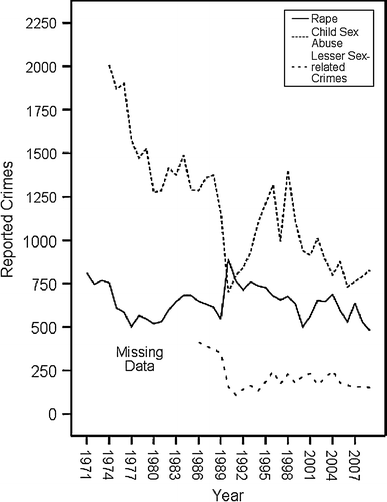
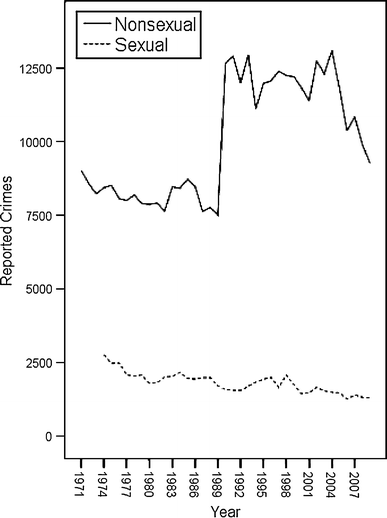
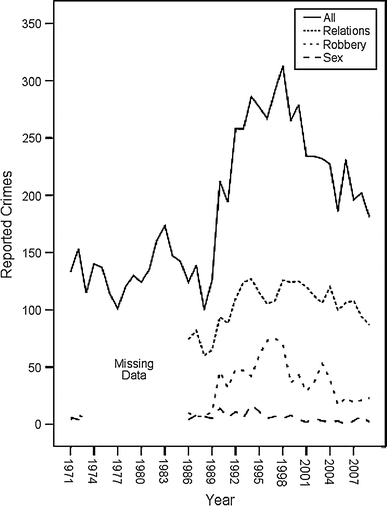
Following the effects of a new law in the Czech Republic that allowed pornography to a society previously having forbidden it allowed us to monitor the change in sex related crime that followed the change.
As found in all other countries in which the phenomenon has been studied, rape and other sex crimes did not increase. Of particular note is that this country, like Denmark and Japan, had a prolonged interval during which possession of child pornography was not illegal and, like those other countries, showed a significant decrease in the incidence of child sex abuse.
;
Selected Cross-Generational Sexual Behavior in Traditional Hawai’i: A Sexological Ethnography
Published in: J. Feierman (Ed.), Pedophilia: Biosocial Dimensions (pp. 422-443)
Introduction
Anthropological studies of human sexual behavior traditionally are difficult to conduct and to interpret because so much of any sexual behavior is private and must be understood through reporting by others rather than through direct observation. Sexual behavior between adults and nonadults is especially difficult to study, but an understanding can be facilitated if one looks at that behavior across time, species, and societies. Hawai’i1 has several characteristics that make it a useful society in which to view such behavior.
Hawai’i was one of the first South Pacific societies to be visited and written about by Westerners (Cook, 1773). What it currently lacks in cultural purity, as a consequence of long association with foreigners, is partly compensated for by 200 years of contact and observation. Furthermore, over the years since Cook’s visit, published comparisons have been drawn between Hawai’i and lesser known societies in other parts of Oceania and Polynesia (e.g., Marshall and Suggs, 1971).
This author has spent more than 20 years living and working in Hawai’i as an academic sexologist. This chapter is written mainly for readers who will benefit from seeing aspects of selected cross-generational sexual behavior in the context of a non-Judeo-Christian and non-Western society.
;
Early Childhood Sex Education;
How Do Dutch Parents Educate Their Young Children About Sex, Sexuality, and Pedophilia?,
Nov 01 2007
In this research study, parents from in and around Amsterdam were
interviewed and filled out surveys about how they educate or have educated their young children about sex, sexuality and pedophilia. Seven parents were interviewed in 40 minute to hour sessions and 20 parents of primary school students filled out two-page surveys about the topic of early sex education. It was found that most Dutch parents educate their young children openly about sex; however, they do not discuss sexuality and sexual feelings and desires with their children. They speak with their children about sexuality during or after puberty. Many parents speak with their young children about pedophilia, but limit their conversation to talking about the danger of strangers.
;
Warped Desire: Inside the mind of a child pornographer
The article gives a view within the mind of a man convicted inthe USA to 35 years of prison because child sexual abuse and child pornography making, posessing and viewing, as well in the mind of the morther of the child, and indirectly the mind of the child.
... In a jailhouse interview, the undocumented, Mexican-born Cardenas prefers to characterize the abuse as “consensual sex.” He says he didn’t understand how society would see such acts until U.S Attorney prosecutor Carol Dain told him he had repeatedly raped the child. “When she said that, that gave me an idea what people were thinking out there,” he says. “I did not rape that kid. I never did anything against his will.” ...
;
Bemerkungen zur strafrechtlichen Behandlung der Pädosexualität
Gewaltlos pädosexuelle Begegnungen und Beziehungen sind, trotz der im letzten Absatz erhobenen kritischen Einwände, nichts Monströses. [...]
Die Pönalisierung verstärkt ferner die Schuldgefühle der Erwachsenen, mit denen sich das Kind identifiziert. Unbestreitbar führt das zu zusätzlichen psychischen Belastungen der Kinder, die eine sexuelle Beziehung mit einem Erwachsenen haben.
* Russian translation added.
;
New mental health 'bible' will lead to almost everyone having a disorder, warn experts,
Jul 28 2010
British experts have warned the trend of diagnosing yet more mental health disorders was 'leaking into normality'.
An updated edition of a mental health bible for doctors could mean that soon no-one will be classed as normal, experts warned today.
Diagnoses for 'disorders' could be based on symptoms including toddler tantrums, mild mood swings and binge eating.
Sweeping changes are being made to the U.S Diagnostic and Statistical Manual of Mental Disorders (DSM), which influences practitioners around the world.