
;
References at Pedophilia and Conflict
References at Pedophilia and Conflict - R. Padding, 2015
References at Pedophilia and Conflict - R. Padding, 2015
;
Pedophilia and Conflict
This research is centered on pedophiles and their place in Dutch society and based on the question: To what extent is there a conflict due to the presence of pedophiles in Dutch society?
Data was gathered and analyzed through
a qualitative content analysis of newspaper articles and
semi-structured interviews with pedophiles.
In this research pedophiles are defined as people with a sexual age orientation directed towards children younger than sixteen years old. A sexual orientation does not only revolve around sexual feelings, but romantic feelings as well.
Two main results were found.
First, newspapers present a generalized image of pedophiles as people who have engaged or are likely to engage in a form of pedosexuality. This overgeneralization leads to the formation of a stigmatized stereotype, that of a criminal sexual child abuser.
Second, the respondents experience that stigma in their daily life, since they do not feel accepted by society. Instead they experience structural conflict to some extent in the form of unequal life chances. The fact that they are unable to speak out about their sexual identity can lead to difficulties in the social life, in asking for protection and professional help, and in living without fear of discovery. The latter is a form of latent violence.
This research builds further on both classic and recent literature, yet is innovating in the sense that it connects conflict studies to the concept of pedophilia. Conflict is being used as a fluid and broad concept, instead of keeping it static and narrow. This research shows how conflict studies can be relevant in addressing conflict that is not directly visible, since it helps in understanding societal developments and structures.
This research is centered on pedophiles and their place in Dutch society and based on the question: To what extent is there a conflict due to the presence of pedophiles in Dutch society?
Data was gathered and analyzed through
a qualitative content analysis of newspaper articles and
semi-structured interviews with pedophiles.
In this research pedophiles are defined as people with a sexual age orientation directed towards children younger than sixteen years old. A sexual orientation does not only revolve around sexual feelings, but romantic feelings as well.
Two main results were found.
First, newspapers present a generalized image of pedophiles as people who have engaged or are likely to engage in a form of pedosexuality. This overgeneralization leads to the formation of a stigmatized stereotype, that of a criminal sexual child abuser.
Second, the respondents experience that stigma in their daily life, since they do not feel accepted by society. Instead they experience structural conflict to some extent in the form of unequal life chances. The fact that they are unable to speak out about their sexual identity can lead to difficulties in the social life, in asking for protection and professional help, and in living without fear of discovery. The latter is a form of latent violence.
This research builds further on both classic and recent literature, yet is innovating in the sense that it connects conflict studies to the concept of pedophilia. Conflict is being used as a fluid and broad concept, instead of keeping it static and narrow. This research shows how conflict studies can be relevant in addressing conflict that is not directly visible, since it helps in understanding societal developments and structures.

;
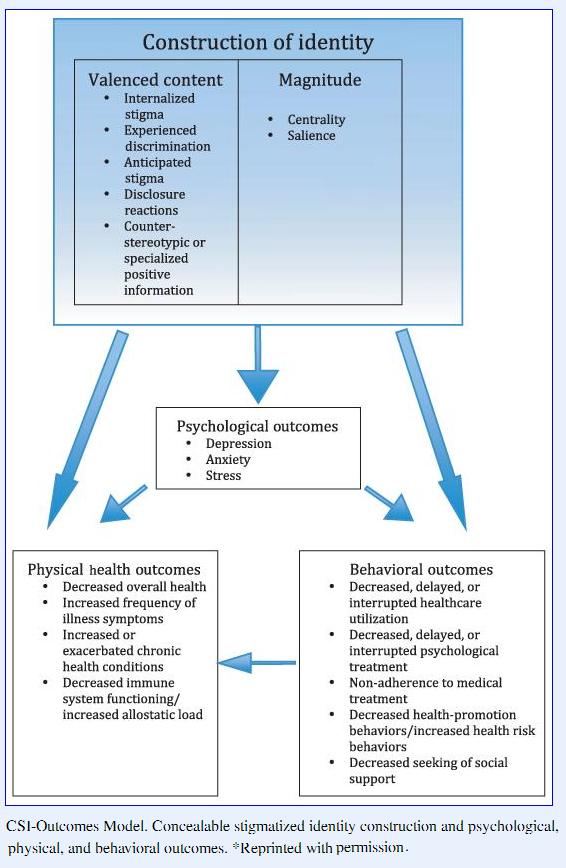
The Psychological Implications of Concealing a Stigma: A Cognitive–Affective–Behavioral Model;
Psychological Bulletin;
133(2), 328–345
Many assume that individuals with a hidden stigma escape the difficulties faced by individuals with a visible stigma. However, recent research has shown that individuals with a concealable stigma also face considerable stressors and psychological challenges. The ambiguity of social situations combined with
the threat of potential discovery makes possessing a concealable stigma a difficult predicament for many individuals. The increasing amount of research on concealable stigmas necessitates a cohesive model for integrating relevant findings. This article offers a cognitive–affective–behavioral process model for
understanding the psychological implications of concealing a stigma. It ends with discussion of potential points of intervention in the model as well as potential future routes for investigation of the model.
- - -
Ipce remarks that several stigma's are mentioned here, but just not having pedophilic feelings and desires - clearly even here a taboo that still might be kept in mind. Also, several examples of secrets that must be kept hidden are mentioned, but just not the secret of a child or teenager who has had sexual experience with an adult.
The first taboo might be deminished if the feelings will not be lead to acts, and thus ever might be accepted as human feelings. The second taboo, the secret to be kept hidden, should be avoided by the same: feelings that do not lead to an act.
Many assume that individuals with a hidden stigma escape the difficulties faced by individuals with a visible stigma. However, recent research has shown that individuals with a concealable stigma also face considerable stressors and psychological challenges. The ambiguity of social situations combined with
the threat of potential discovery makes possessing a concealable stigma a difficult predicament for many individuals. The increasing amount of research on concealable stigmas necessitates a cohesive model for integrating relevant findings. This article offers a cognitive–affective–behavioral process model for
understanding the psychological implications of concealing a stigma. It ends with discussion of potential points of intervention in the model as well as potential future routes for investigation of the model.
- - -
Ipce remarks that several stigma's are mentioned here, but just not having pedophilic feelings and desires - clearly even here a taboo that still might be kept in mind. Also, several examples of secrets that must be kept hidden are mentioned, but just not the secret of a child or teenager who has had sexual experience with an adult.
The first taboo might be deminished if the feelings will not be lead to acts, and thus ever might be accepted as human feelings. The second taboo, the secret to be kept hidden, should be avoided by the same: feelings that do not lead to an act.

;
Of Goode and evil - Review of "Paedophiles in Society: Reflecting on Sexuality, Abuse and Hope" By Sarah D. Goode
Sociologist Sarah Goode’s latest book is not primarily a work of research within her discipline; rather, it takes us on an ambitious grand tour in a bid to situate paedophilia historically and cross-culturally.
“We have got ourselves into a pickle sexually”, she says, proposing a way out of it that many will regard as both bold and humane. As will be seen, I beg to differ.
The new book can be read independently. It should be noted, though, that only the first volume considers the harm that is intrinsic, or is allegedly so, to every adult-child sexual contact, no matter how loving and non-coercive it might be. This is a crucial issue, to which I shall return.
Goode begins the Preface to Paedophiles in Society with the large claim that this will be unlike “any other book you may have read on paedophiles, or adult sexual attraction to children, or child protection”; instead of focusing on medical, forensic, psychological, psychiatric, legal or criminological aspects, it promises to be “a book about ordinariness, about culture and society around us”.
It is not, in fact, unique in this regard as it follows several such works
Sociologist Sarah Goode’s latest book is not primarily a work of research within her discipline; rather, it takes us on an ambitious grand tour in a bid to situate paedophilia historically and cross-culturally.
“We have got ourselves into a pickle sexually”, she says, proposing a way out of it that many will regard as both bold and humane. As will be seen, I beg to differ.
The new book can be read independently. It should be noted, though, that only the first volume considers the harm that is intrinsic, or is allegedly so, to every adult-child sexual contact, no matter how loving and non-coercive it might be. This is a crucial issue, to which I shall return.
Goode begins the Preface to Paedophiles in Society with the large claim that this will be unlike “any other book you may have read on paedophiles, or adult sexual attraction to children, or child protection”; instead of focusing on medical, forensic, psychological, psychiatric, legal or criminological aspects, it promises to be “a book about ordinariness, about culture and society around us”.
It is not, in fact, unique in this regard as it follows several such works
;
Childhood ‘Innocence’ is Not Ideal: Virtue Ethics and Child–Adult Sex;
Sexuality & Culture;
April 2018,
Malón (Arch Sexual Behav 44(4):1071–1083, 2015) concluded that the usual arguments against sexual relationships between adults and prepubertal children are inadequate to rule out the moral permissibility of such behaviour in all circumstances.
Malón (Sex Cult 21(1):247–269, 2017) applied virtue ethics in an attempt to remedy the postulated deficiency. The present paper challenges the virtue ethics approach taken in the second of Malón’s articles by:
(1) contesting the view that sex is an exceptional aspect of morality, to which a virtue approach needs to be applied;
(2) contesting the view that virtue ethics succeed, where other arguments fail, against the moral admissibility of child–adult sexual relations;
(3) proposing that such relations can be seen as virtuous in the context of an alternative view of what constitutes virtue.
Note / Anmerkung: Sehen Sie im Datei: Uebersetzung.
Malón (Arch Sexual Behav 44(4):1071–1083, 2015) concluded that the usual arguments against sexual relationships between adults and prepubertal children are inadequate to rule out the moral permissibility of such behaviour in all circumstances.
Malón (Sex Cult 21(1):247–269, 2017) applied virtue ethics in an attempt to remedy the postulated deficiency. The present paper challenges the virtue ethics approach taken in the second of Malón’s articles by:
(1) contesting the view that sex is an exceptional aspect of morality, to which a virtue approach needs to be applied;
(2) contesting the view that virtue ethics succeed, where other arguments fail, against the moral admissibility of child–adult sexual relations;
(3) proposing that such relations can be seen as virtuous in the context of an alternative view of what constitutes virtue.
Note / Anmerkung: Sehen Sie im Datei: Uebersetzung.
;
Fear: The Emotional Outcome Of Mass Media In America;
Hohonu;
2, 49-52
The mass media in America serves many functions that have had an array of effects on those exposed. Throughout time, technological innovations have given rise to the mass communications and media, leading to an escalation of its effects on the world’s people. The most important effect has been a psychological shift to a constant state of fear due to media exposure.
Fear of black men,
fear of airplane crashes,
fears of violence amongst children, and
fears of cultural domination
The mass media in America serves many functions that have had an array of effects on those exposed. Throughout time, technological innovations have given rise to the mass communications and media, leading to an escalation of its effects on the world’s people. The most important effect has been a psychological shift to a constant state of fear due to media exposure.
Fear of black men,
fear of airplane crashes,
fears of violence amongst children, and
fears of cultural domination
;
Memory and Eye Movement Desensitization and Reprocessing Therapy ...;
Memory;
August 2021,
Does Eye Movement and Desensitization and Reprocessing (EMDR) therapy affect the accuracy of memories? This recurrent issue in recent memory research bears relevance to expert witness work in the courtroom. In this review, we will argue that several crucial aspects of EMDR may be detrimental to memory.
Does Eye Movement and Desensitization and Reprocessing (EMDR) therapy affect the accuracy of memories? This recurrent issue in recent memory research bears relevance to expert witness work in the courtroom. In this review, we will argue that several crucial aspects of EMDR may be detrimental to memory.
;
Sexual experiences in early childhood: 18‐Year longitudinal data from the UCLA family lifestyles project;
THE JOURNAL OF SEX RESEARCH ;
34 - 4(JANUARY 1997), 339-347
We present results of the first longitudinal study of long-term outcome correlates of sexual experiences in early childhood ("sex play"). Two hundred children participated in the UCLA Family Lifestyles Project (FLS), beginning at birth to the current wave of data collection at ages 17-18. ...
These results converge on earlier cross-sectional retrospective work, suggesting that the experience of childhood sex play in itself is unrelated to long-term adjustment.
We present results of the first longitudinal study of long-term outcome correlates of sexual experiences in early childhood ("sex play"). Two hundred children participated in the UCLA Family Lifestyles Project (FLS), beginning at birth to the current wave of data collection at ages 17-18. ...
These results converge on earlier cross-sectional retrospective work, suggesting that the experience of childhood sex play in itself is unrelated to long-term adjustment.
;
Early childhood exposure to parental nudity and scenes of parental sexuality and scenes of parental sexuality;
Archives of Sexual Behavior;
27(4, August 1998),
As part of the UCLA Family Lifestyles Project (FLS), 200 male and female children participated in an 18-year longitudinal outcome study of early childhood exposure to parental nudity and scenes of parental sexuality ("primal scenes").
At age 17-18, participants were assessed for levels of self-acceptance; relations with peers, parents, and other adults; antisocial and criminal behavior; substance use; suicidal ideation; quality of sexual relationships; and problems associated with sexual relations.
No harmful "main effect" correlates of the predictor variables were found.
As part of the UCLA Family Lifestyles Project (FLS), 200 male and female children participated in an 18-year longitudinal outcome study of early childhood exposure to parental nudity and scenes of parental sexuality ("primal scenes").
At age 17-18, participants were assessed for levels of self-acceptance; relations with peers, parents, and other adults; antisocial and criminal behavior; substance use; suicidal ideation; quality of sexual relationships; and problems associated with sexual relations.
No harmful "main effect" correlates of the predictor variables were found.
;
Perpetual Panic;
Federal Sentencing Reporter;
21(2), pp. 69–77
The account of recent developments that unfolds in these pages may be viewed as yet another chapter in the story of a child sex abuse panic that is now well into its third decade - [Especially in the USA]
The account of recent developments that unfolds in these pages may be viewed as yet another chapter in the story of a child sex abuse panic that is now well into its third decade - [Especially in the USA]
;
Child Pornography : Crime, Computers and Society;
xii, 259 pp.
;
References at Childhood ‘Innocence’ is Not Ideal: Virtue Ethics and Child–Adult Sex, Tom O'Carroll;
Sexuality & Culture
References at "Childhood ‘Innocence’ is Not Ideal: Virtue Ethics and Child–Adult Sex" by Tom O'Carroll.
References at "Childhood ‘Innocence’ is Not Ideal: Virtue Ethics and Child–Adult Sex" by Tom O'Carroll.
;
The Consequences of Sexual Abuse of Minors;
Chapter, summarized
The Consequences of Sexual Abuse of Minors - On behalf of the Commission for Examination of Sexual Abuse of Minors in the Roman-Catholic Church [* in the Netherlands]; In: Rapport Commissie Deetman, Balans, 2011, Part 2. Summary and conclusions in English by Frans E J Gieles, PhD.
In this essay, sexual abuse is, conform the scientific and juridical mores, defined as "... sexual-genital manipulation of a child below the age of sixteen, by an adult of whom the child is dependent or with whom he or she has a relationship of confidence, with the aim of satisfaction of the sexual need of the first. [...] There is an age difference, and/or a difference in power, by which the child is not able to refuse the sexual contact, which is not consensual."
Research of the later consequences of sexual abuse is done in three phases or generations of research.
The most recent research explores what has appeared to be the most central factor: disturbance of the stress regulation.
There is consensus about harm for the physical and emotional health, especially the attachment and sexuality, even if the consequences are invisible at first sight. They are just like a time bomb, that explodes as soon as, in adulthood, the impact of the events becomes significant.
The Consequences of Sexual Abuse of Minors - On behalf of the Commission for Examination of Sexual Abuse of Minors in the Roman-Catholic Church [* in the Netherlands]; In: Rapport Commissie Deetman, Balans, 2011, Part 2. Summary and conclusions in English by Frans E J Gieles, PhD.
In this essay, sexual abuse is, conform the scientific and juridical mores, defined as "... sexual-genital manipulation of a child below the age of sixteen, by an adult of whom the child is dependent or with whom he or she has a relationship of confidence, with the aim of satisfaction of the sexual need of the first. [...] There is an age difference, and/or a difference in power, by which the child is not able to refuse the sexual contact, which is not consensual."
Research of the later consequences of sexual abuse is done in three phases or generations of research.
The most recent research explores what has appeared to be the most central factor: disturbance of the stress regulation.
There is consensus about harm for the physical and emotional health, especially the attachment and sexuality, even if the consequences are invisible at first sight. They are just like a time bomb, that explodes as soon as, in adulthood, the impact of the events becomes significant.
;
Pedophilia from the Chinese perspective;
Archives of Sexual Behavior;
31, 491–492
In traditional Chinese medicine, there has never been a mental disease called pedophilia (or an equivalent term), or homosexuality, or most of the other so-called sexual variations for that matter. Depictions of “child-romance” in ancient or modern Chinese literature are not difficult to find. Children are usually described as natural sexual beings and erotic stimulation and sex-play are seen as beneficial to their healthy development.
[...]
Some writers very vehemently question the capacity of children to give valid consent to sexual activity with adults. Despite their arguments, to the Chinese [...] the focus of discussions on the child consent issue in pedophilic activities is blatantly irrelevant and hypocritical.
[...]
There are certain occasions when the adults do respect the children’s wishes and ask for their consent, but only when the choices are within the adult acceptable range. [...]
Indeed, when it comes to a child’s sexual activity, the debate begins ...
In traditional Chinese medicine, there has never been a mental disease called pedophilia (or an equivalent term), or homosexuality, or most of the other so-called sexual variations for that matter. Depictions of “child-romance” in ancient or modern Chinese literature are not difficult to find. Children are usually described as natural sexual beings and erotic stimulation and sex-play are seen as beneficial to their healthy development.
[...]
Some writers very vehemently question the capacity of children to give valid consent to sexual activity with adults. Despite their arguments, to the Chinese [...] the focus of discussions on the child consent issue in pedophilic activities is blatantly irrelevant and hypocritical.
[...]
There are certain occasions when the adults do respect the children’s wishes and ask for their consent, but only when the choices are within the adult acceptable range. [...]
Indeed, when it comes to a child’s sexual activity, the debate begins ...
;
Reconstructing Paedophilia;
133 pp
There is a growing need for research to facilitate a better understanding of paedophilia. This study aims to make a contribution in this regard by providing an analysis of current discourses in paedophilia research as well as a phenomenological exploration of how the male paedophile constructs his close relationships with children.
In an attempt to circumvent these obstacles, it is argued that the psychological need to form close relationships is a universal one. On this basis the central components of close relationships are presented as a conceptual framework. These components are then applied to an exploratory phenomenological investigation and analysis of the ways in which three paedophilic men interpret, understand and construct their relationships with children.
There is a growing need for research to facilitate a better understanding of paedophilia. This study aims to make a contribution in this regard by providing an analysis of current discourses in paedophilia research as well as a phenomenological exploration of how the male paedophile constructs his close relationships with children.
In an attempt to circumvent these obstacles, it is argued that the psychological need to form close relationships is a universal one. On this basis the central components of close relationships are presented as a conceptual framework. These components are then applied to an exploratory phenomenological investigation and analysis of the ways in which three paedophilic men interpret, understand and construct their relationships with children.
;
United Nations Convention on the Rights of the Child (20 November 1989),
Nov 20 1989
Text of the Declaration of Children's Rights by the UN Convention on the Rights of the Child, 20 November 1989
Text of the Declaration of Children's Rights by the UN Convention on the Rights of the Child, 20 November 1989
;
Child porn: real or virtual?;
Personal Blog,
Apr 30 2008
Debbie Nathan writes a personal blog about a conference about (child) pornography on the Internet. The main theme was how to see the differences of virtual images (permitted in the USA as a form of Free Speech) and images of real children (not permitted). It appeared to be quite difficult to make this difference.
Debbie Nathan writes a personal blog about a conference about (child) pornography on the Internet. The main theme was how to see the differences of virtual images (permitted in the USA as a form of Free Speech) and images of real children (not permitted). It appeared to be quite difficult to make this difference.
;
In a Philippine Town, Child Prostitution, Despite Protests, Is a Way of Life;
New York Times,
Feb 05 1989
Parents come out in support of pedophiles.
Parents come out in support of pedophiles.
;
Low reoffending risk found for child porn users,
Mar 11 2012
REOFFENDING rates by child pornography users are far below rates for assaults, drink-driving or property damage, with fewer than one in 10 people who download sexual images of minors later convicted of the crime again.
Despite community concern about the dangers posed by convicted child pornography users, new Corrections Victoria figures reveal only about 7.5 per cent are found to reoffend.
REOFFENDING rates by child pornography users are far below rates for assaults, drink-driving or property damage, with fewer than one in 10 people who download sexual images of minors later convicted of the crime again.
Despite community concern about the dangers posed by convicted child pornography users, new Corrections Victoria figures reveal only about 7.5 per cent are found to reoffend.
;
Problems with Ascertainment;
Archives of Sexual Behavior;
39(6), 1225–1227
;
A Generation Silenced: The Role of Children as Seen Through the Discourse on Age ofConsent Legislation;
Psychology Department,
Dec 03 2007
Age of consent laws have been the source of a major debate between those that
believe children need to be protected from predators, and those that believe children should have rights, and that the harm caused by a sexual relationship between a child and an adult has been dramatically sensationalized.
However, among those involved in this dispute, no children can be found arguing for either perspective.
This study was initially intended to reveal the opinions of children on the issue
of age of consent laws. Then I was informed that this was next to impossible given the various types of legal authorization I would be required to get. The issue of authorization is what ultimately led to the focus of this study – questioning what devices are put in place by society to prevent children from expressing their opinions?
Also in this study, I examine whether there is a prevalent feeling that children should be able to express their opinions, and finally, in what forms would this expression be considered acceptable?
To explore these questions, the views of university students as well as
professionals were utilized as tools by which to understand the societal constructs that have silenced children, relating specifically to the Netherlands, but relevant outside of the Netherlands as well.
Finally, there is a discussion of whether or not it is necessary that these constructs exist, and the ways in which it would possible to transcend them.
Age of consent laws have been the source of a major debate between those that
believe children need to be protected from predators, and those that believe children should have rights, and that the harm caused by a sexual relationship between a child and an adult has been dramatically sensationalized.
However, among those involved in this dispute, no children can be found arguing for either perspective.
This study was initially intended to reveal the opinions of children on the issue
of age of consent laws. Then I was informed that this was next to impossible given the various types of legal authorization I would be required to get. The issue of authorization is what ultimately led to the focus of this study – questioning what devices are put in place by society to prevent children from expressing their opinions?
Also in this study, I examine whether there is a prevalent feeling that children should be able to express their opinions, and finally, in what forms would this expression be considered acceptable?
To explore these questions, the views of university students as well as
professionals were utilized as tools by which to understand the societal constructs that have silenced children, relating specifically to the Netherlands, but relevant outside of the Netherlands as well.
Finally, there is a discussion of whether or not it is necessary that these constructs exist, and the ways in which it would possible to transcend them.
;
Pedophilia: A Specific Instance of New Phylism Theory ...;
18 pp
In society and in the criminal justice system, there are the prevalent assumptions that pedophilia is a voluntary orientation and a product of jaded depravity and that the next step will be sadistic assault and molestation ending up in lust murder. These assumptions are faulty and are based on rare and sporadic cases in which there is an overlapping of pedophilia, which is a paraphilia of the eligibilic/stigmatic type, with a paraphilia of the sacrificial/expiatory type. Pedophilia, both androphilic and gynephilic, is its own syndrome, unaccompanied by sacrificial or expiatory cruelty.
. . .
The pedophile's attachment to a child represents a merger of parental and erotic love.
. . .
Based on its roots in the Greek language, "pedophilia" means "child love." Two meanings of love are telescoped into the one word. One meaning is love as in parental love and pairbonding between parent and child. The other meaning is love as in making love and the sexual bonding of two partners, one of which is a juvenile. The two meanings share in common the reciprocality of bonding between two people.
In society and in the criminal justice system, there are the prevalent assumptions that pedophilia is a voluntary orientation and a product of jaded depravity and that the next step will be sadistic assault and molestation ending up in lust murder. These assumptions are faulty and are based on rare and sporadic cases in which there is an overlapping of pedophilia, which is a paraphilia of the eligibilic/stigmatic type, with a paraphilia of the sacrificial/expiatory type. Pedophilia, both androphilic and gynephilic, is its own syndrome, unaccompanied by sacrificial or expiatory cruelty.
. . .
The pedophile's attachment to a child represents a merger of parental and erotic love.
. . .
Based on its roots in the Greek language, "pedophilia" means "child love." Two meanings of love are telescoped into the one word. One meaning is love as in parental love and pairbonding between parent and child. The other meaning is love as in making love and the sexual bonding of two partners, one of which is a juvenile. The two meanings share in common the reciprocality of bonding between two people.
;
Juvenile, Pedophile, Heterophile: Hermeneutics of Science, Medicine and Law in Two Outcome Studies;
Medicine and Law;
1983(2), 39 - 54
Two young men, aged eighteen and twenty respectively, had a history of a juvenile and early adolescent relationship with an older male pedophilic lover. The eroto-sexual component of the relationship ended when the younger partner became too sexually mature, at which time each had a pair-bonded love affair with a girl. Subjectively and behaviorally they were neither homosexual nor pedophilic in orientation. They evaluated themselves as having not been traumatized by having had a history of a relationship with a pedophile.
Two young men, aged eighteen and twenty respectively, had a history of a juvenile and early adolescent relationship with an older male pedophilic lover. The eroto-sexual component of the relationship ended when the younger partner became too sexually mature, at which time each had a pair-bonded love affair with a girl. Subjectively and behaviorally they were neither homosexual nor pedophilic in orientation. They evaluated themselves as having not been traumatized by having had a history of a relationship with a pedophile.
;
The ethics of pedophilia;
Nordic Journal of Applied Ethics ;
9(1), 111-124
Pedophilia is bad. But how bad is it? And in what ways, and for what reasons, is it bad? This is a thorny issue, and sadly, one seldom discussed by ethicists. I argue in this article that pedophilia is bad only because, and only to the extent that, it causes harm to children, and that pedophilia itself, as well as pedophilic expressions and practices that do not cause harm to children, are morally all right. I further argue that the aim of our social and legal treatment of pedophilia should be to minimize harm to children, and that current practices are often counterproductive in this respect.
Pedophilia is bad. But how bad is it? And in what ways, and for what reasons, is it bad? This is a thorny issue, and sadly, one seldom discussed by ethicists. I argue in this article that pedophilia is bad only because, and only to the extent that, it causes harm to children, and that pedophilia itself, as well as pedophilic expressions and practices that do not cause harm to children, are morally all right. I further argue that the aim of our social and legal treatment of pedophilia should be to minimize harm to children, and that current practices are often counterproductive in this respect.