- Die Deutsche Version dieses Artikels; ist hier:
< https://www.ipce.info/de/library/miscellaneous/22-prozent-der-maenner-pedaophile >
References are given in PDF Dokument < literatur_schuster_22_prozent.pdf >
[Introduction]
To clarify the question, what percentage of men are sexually excited stronger or just as strong by children up to 13 years as by adults, the authors conducted a systematic literature review (*1) as possible, all meaningful studies.
- (*1). In many articles and books on the subject of pedophilia there are notes
on studies of dissemination pedosexual sensations in the "normal"
population (see for example, Green (2002) and Norlik (2010)).
By analyzing these publications, by evaluating the studies listed there and through the follow-up of these publications and studies with Google Scholar initially were 10 studies found on sexual arousal of "normal" men (not sex offenders, etc.) by children and adult stimuli.
Subsequently, it was investigated which cite publications in the databases PsycINFO and SSCI these studies and cite which studies the studies found itself or describe. Newly found, the search criteria described above in the text corresponding studies were again analyzed in the same manner in the two databases. This could be a total of 26 determines the search criteria corresponding studies.
Where possible, the authors of the studies found were emailed and asked for further matching the search criteria studies, which did not lead to finding further studies. The performed literature search should therefore probably all or nearly all have found matching the search criteria studies.
Wanted was after all published studies that met the following criteria:
* Time of Release: from 1970 to the present (March 2013)
* Language of publication: English or German
* Type of measurement: was conducted by a phallometric measurement of sexual arousal of men by child and adult stimuli. (*2)
*
Type of sample: The examined men are not only sex offenders (*3) or
exclusively homosexual, but are selected from the general population,
such as students, newspaper readers, military personnel or job. (*4)
* Minimum sample size: 10 people (*5)
- (*2) the study by Quinsey, inter alia, was not taken into account (1988) because the stimuli non-consensual sex between children and adults represented, but reproductions of violence against children, or at least passive defense of children.
- (*3) Most of phallometric studies have been and are conducted on incarcerated sex offenders, but they are not representative of the overall population in terms of their sexuality. These studies therefore not be considered here as well as the few studies that have examined only men in state treatment programs for people with sexual difficulties.
- (*4) The degree of long inter alia (1980) was excluded because the relevant here volunteer group of men were excluded with a sexual interest in children.
- (5) For a sample size of five men such as in Quinsey, inter alia, (1976) has examined each man has a weight of 20 percent, which could result in strong assay results for the question raised here by chance.
[Six Studies]
A total of 26 studies were identified that met the criteria listed. (*6) In 6 of these 26 studies is given, how much percent of surveyed men are excited stronger or just as strong sexually by children and by adults (*7).
- (*6) See Firestone et al (2000), Hall et al (1995), Marshall et al (1986); Fedora i.a. (1992), among others friend (1991a); Seto et al (2000), among others friend (1970), Marshall et al (1988); Quinsey i.a. (1975), Rice et al (2012), among others friend (1972); Frenzel et al (1989), Renaud et al (2010), Haywood et al (1990), among others friend (1973); Kuban et al (1999), among others friend (1991b); Grossmann et al (1992), Chaplin et al (1995), Harris et al (1992), et al Barsetti (1998), among others Lalumière (1992), Friend (1989), Renaud et al (2013), Wilson (1998) Earl et al (1987).
- (*7) The six studies include, without limitation Firestone (2000), Hall et al (1995), Marshall et al (1986); Fedora i.a. (1992), among others friend (1991a) and Seto et al (2000). Perhaps you were the 16 of Seto et al (2000) studied men part or all a part of, inter alia, 50 of Friend (1991a) studied men. Seto told the author in an email from 15.07.2013 with that he, among other things, the extent of overlap without him not to present data of the study by friend (1991a) could not be determined. Without the study by Seto et al (2000), the given above in the text below average percentage of men who are excited stronger or just as strong sexually by children and by children, but only 22.2% would decrease to 21.7%, so that the inclusion or non-inclusion the study by Seto, among others (2000) for the specified test result of 22% is not critical.
The details of these six studies shows the following listing:
Study 1: Firestone et al (2000):
Differentiation of Homicidal Child Molesters, Nonhomicidal Child
Molesters, and Nonoffenders by Phallometry
- Percentage of men who are
excited stronger or just as strong sexually by children and by adults:
28%
- Country: Canada
- Number of men examined: 47
-
Average age of men: 33 years old
- the type of stimuli: Audio Stories
-
age of the children on the stimuli: Unspecified
- Age of adults on the
stimuli: Unspecified
Study 2: Hall et al (1995):
Sexual Arousal and Arousability to pedophilic stimuli in a community
sample of normal men
- Percentage of men who are excited stronger or
just as strong sexually by children and by adults: 29% (see footnote *8)
-
Country: USA
- Number of
the examined men: 80
- Average age of men 38 years
- the type of
stimuli: photos and audio stories
- age of the children on the stimuli:
Prepubescent girls or announcement "child under 12 years"
- age of the
adults on the stimuli: No specification
- (*8) 29% is the average of the percentage specified in the publication for the excitation by images (32.5%) and audio stories (26.25%).
Study 3: Marshall et al (1986):
Sexual offenders against female children: Sexual preferences for age of
victims and type of behavior
- the percentage of men who are excited
stronger or just as strong sexually by children and by adults: 14% (see
footnote *9)
- Country: Canada
-
Number of men examined: 22
- Average age of men: 34 years old
- the
type of stimuli: photos and audio stories
- age of the children on the
stimuli: Photos (see footnote 23) 12, 13 and 14 years
- Audio Stories:
Men should imagine preferred age (3-14 years) or it was a different age selected
- Age of adults on the stimuli 16 to 24 years
- (*9) The specified percentage of 14% refers to the 3 of the 22 subjects of this study, by 12 - were more sexually aroused and 14-year-old children than by adults - 13. This value is displayed for the question raised here position more powerful than a test subject (equivalent to 5%), who at the age of "3 to 11 years in 2-year intervals" is energized more by children than by adults.
Study 4: Fedora et al (1992):
Sadism and other paraphilias in normal controls and nonaggressive sex
offenders
- the percentage of men who are excited stronger or just as
strong sexually by children and by adults: 18%
- Country: Canada
-
Number of men examined: 60
- Average age of the Men:
31 years old
- the type of stimuli: Photos
- age of the children on the
stimuli, "pre-pubescent"
- age of the adults on the stimuli:
Unspecified
Study 5: Friend et al (1991a):
Assessment of the sensitivity and specificity of a phallometric test:
An update of Phallometric diagnosis of pedophilia
- the percentage of
men who are excited stronger or just as strong sexually by children and
by adults: 19%
- Country: Canada
- Number of
the examined men: 50
- Average age of men: 26 Years
- type of stimuli:
Film Clips
- age of the children on the stimuli: 5 to 8 years 8 to 11
years, and pubescent (probably 12 to 13 years)
- Age of adults on the Stimuli: Unspecified
Study 6: Seto et al (2000):
The Discriminative Validity of a Phallometric test for pedophilic
Interests Among Adolescent Sex Offenders Against Children
- Percentage
of men who are excited stronger or just as strong sexually by children
and by adults: 25% (see footnote *10)
- Country: Canada
-
Number of men examined: 16
- Average age of men: 20 years
- the type of
stimuli: Film Clips
- age of the children on the stimuli: 5 to 13 years
old
- the age of the adults on the stimuli: mid 20's
- (*10) In Table 2 (Seto et al (2000) p 325) it is stated that 3 of the 16 subjects at highest risk of 12 - to 13-year-old boys will be sexually aroused - to 13-year-old girl and a subject most by 12 .
[Discussion]
The percentages calculated from the six trials are 28, 29, 14, 18, 19 and 25 percent. According
to the average of the present six studies thus 22 percent of men are
stronger or as strong sexually aroused by children up to 13 years as by
adults.
The calculated average value of 22 percent is, for various reasons, not the accuracy of such an extrapolation on election day. (*11)
- (*11)
- First, five of the six trials were performed in Canada and the sixth study in the USA. It is unclear whether the sexual arousal is smaller or larger by children in other continents.
- Second,
the reliability and validity of the phallometric method is
controversial (see O'Donohue and others (1992), Hanson and others
(1998), Kingston et al (2007), McAnulty and others (1992), McConaghy
(1989), McConaghy (1992) and Quinsey and others (1990)).
However, the largest part of the (justified) criticism does not apply to the measurements of the six studies in Table 1, since the participation of the control groups was truly voluntary and the Messergennisse really had no consequences for the subjects.
For example, if one voluntarily participating students triggered by children's picture erections are always greater than the induced by adult images erections, then it is hard to doubt that this measurement result says something about the nature of the sexual excitability of the students. The internal scientific criticism often refers to the fact that measurements e.g. because of the possibility of cheating are not valid, so that individual decisions about layoffs on detention thereof should not be made dependent. - Third,
the studies have calculated in different ways, how much percent of the
subjects stronger or just as strong sexually aroused by children and by
adults. Different calculation methods lead to different results.
For example, in one study, the percentage of men who are more sexually aroused by the children images than by the adult images (determined by the mean for the children and for adults pictures) differ significantly from the percentage of men in which the strongest excitation at one of the children images is greater than the strongest excitation at one of the adult images. Both calculation methods described are common in phallometric studies. - Fourth,
the subjects of the studies were not randomly selected and therefore it
remains unclear whether highly sexually excitable people are
under-represented in these studies or by children.
It is conceivable and appears due to the social ostracism of pedophilic men also likely that pedophiles have these studies are often removed in order not to reveal their sexual arousal by children.
However, one can not rule out that opted by children sexually highly excitable people than average for participation in these studies. Most subjects in the six studies were recruited through advertisements in which initially was not disclosed that the sexual arousal is to be measured by children. Therefore, it seems unlikely that the studies in a special way (nuclear) had pedophile people as participants, thus people are significantly over-represented with a strong sexual excitability by children in the studies.
In general, the voluntary participants in phallometric studies compared with non-participants sexually experienced, have more heterosexual sex partners, less sexual guilt and are sexually curious (see Plaud and others (1999), Strassberg et al (1995) and Wolchik et al (1985)).
Very important appears that in the study by Hall, among others (1995) 20% of the respondents indicated a smaller or larger pedophile interest. This value is typical for such surveys. 29% of inter alia by Hall (1995) respondents were again in the phallometric investigation by children stronger or just as strong as sexually aroused by adults.
This is a clear indication that the percentage of 22% described above does not fundamentally through an overrepresentation pedosexual people came, but actually reflects the pedosexual excitability of the men from the general population. - Fifth,
men are more sexually aroused by older, pubescent girls than by
younger, before pubertering girls (see friend and others (1970), pp. 17,
Blanchard (2009a), pp. 437, Blanchard et al (2009b), pp. 341-347 and
Seto et al ( 2000) p 325).
In the study by Seto et al (2000), for example, none of the 16 men is 8 - to 11-year-old children more sexually aroused than by adults, but four of the 16 men by 12 - to 13-year-old children.
If it had been so recorded in all six studies, the percentage of men are more sexually aroused by up to 13-year-old girls than by adults, would probably result in an even greater sexual arousal than 22%.
On the other hand, arrived at the study of Marshall, among others (1986) in addition to younger children and 14-year-old girl as stimuli for use. The calculated percentage of this study, however, was 14% below average compared to the weighted average cost of 22%.
Future studies should make a random selection of the sample in the ideal case, and also examine whether, and if necessary, deny how much children by strongly sexually excitable people participating more or less often.
One can not rule out that the percentage of men who are excited stronger or just as strong sexually by children up to 13 years as by adults, in reality, for example, 15% or 40%. Probably the true percentage is but rather in the determined area of the six studies 14-29%.
Kurt Freund, inventor of the phallometric method, has told of his experience that generally around 20% of the examined him control groups are stronger or as strong sexually aroused by children and by adults. Currently, one can therefore assume that every fourth or every fifth man is stronger or just as strong sexually aroused by children up to 13 years as by adults.
In addition, a significant percentage of men also, which is a little weaker, but also significantly sexually aroused by children on average. In the study by Marshall et al , 13- and 14-year-old children's sexual arousal (defined by the volume increase of the penisses) divided by the through photos of 16 - (1986), for example, through photos of 12 was measured sexual arousal to 24 year old adults.
Who was sexually aroused more than adults by children, reached by this calculation called a pedophile index is greater than 1.0. But even with a pedophile index of 0.8 and 0.6 there is a significant sexual arousal by children.
Three of the 22 studied men reached in the study by Marshall, among others (1986) has a value greater than 1, a total of 5 of the 22 men reached a value greater than 0.8 and a total of 7 of the 22 men reached a value greater than 0.6.
Unfortunately, the remaining 5 of the values determined by the specified search criteria 6 studies do not indicate how many subjects achieved a pedophile index of 0.8 or 0.6.
Applying the size ratios between the pedophilia indices from the study by Marshall, among others (1986) to those identified in this average value of 22.2%, then 37% of the population could have a pedophilia index of at least 0.8 and 52% of the population pedophilia index of at least 0.6. So at least every third man shows a strong pedosexual excitability.
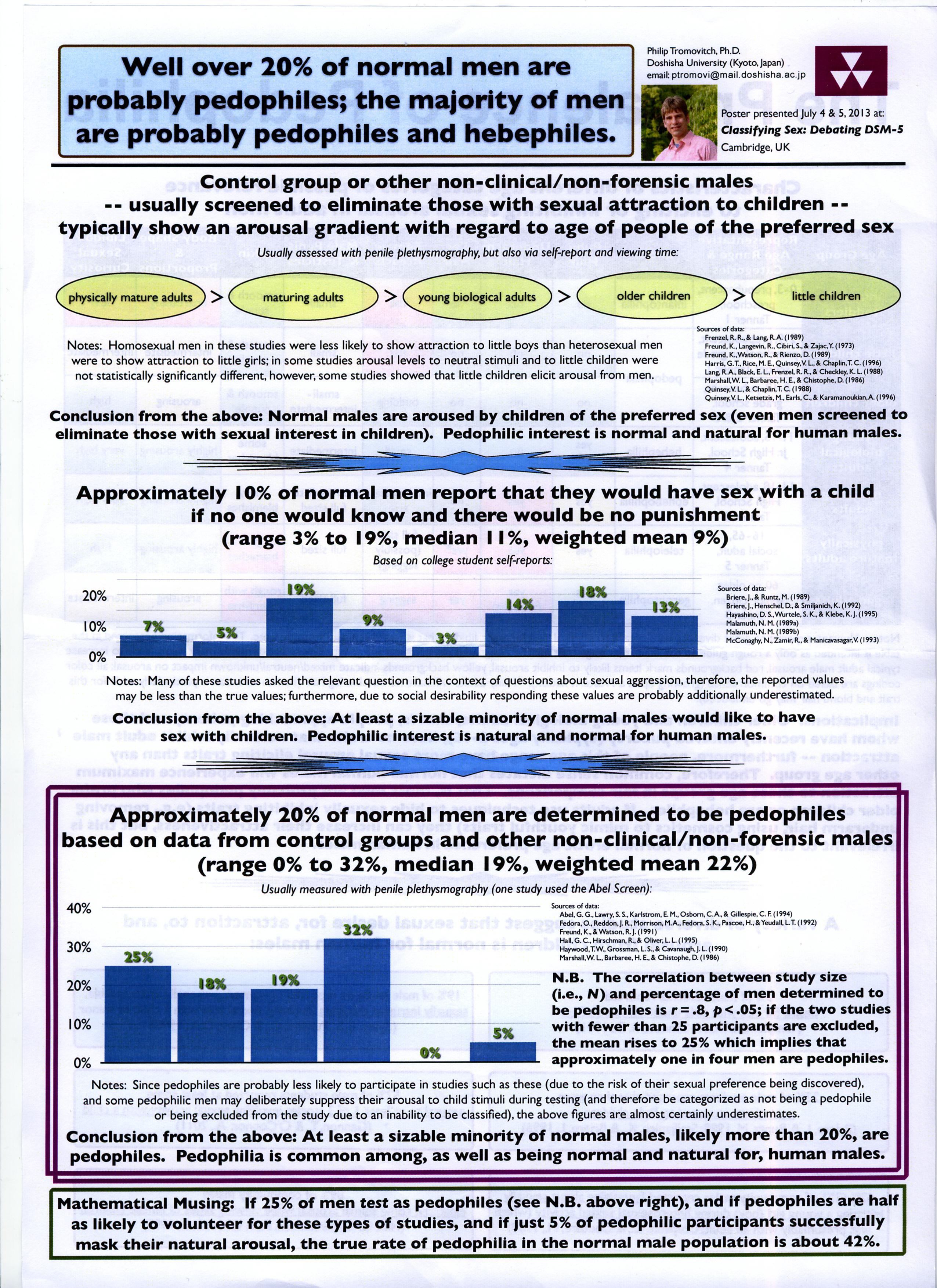
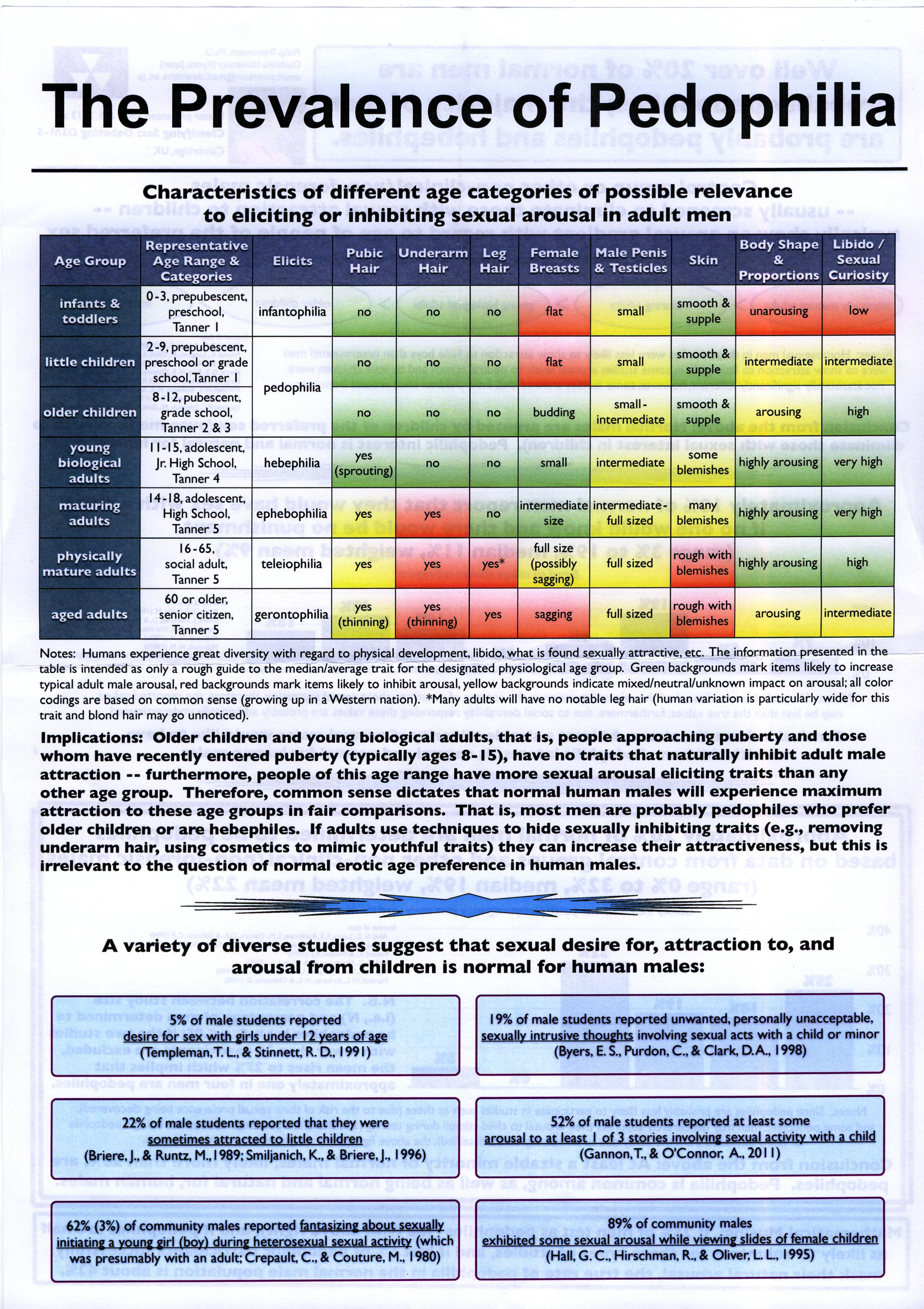
Philip Tromovitch, one of the three authors of the study suggested beef, as based on the results of the authors phallometrischer studies that significantly more than 20 percent of normal men are pedophiles:
- "Well over 20 percent of normal men are likely to be pedophiles, and the majority of men are probably pedophiles and lifting Audiophile (*12)
- (*12) Poster presented by Philip Tromovitch at the conference "Classifying Sex: Debating the DSM-5" on 4 and 5 July 2013 in Cambridge (UK), < https://www.ipce.info/sites/ipce.info/files/biblio_attachments/prevalence_-_trom_1.jpg >
, translation of the author.
Tromovitch even holds a far higher proportion of possible mathematical musings:
- "If 25% of men are detected in tests as a pedophile (...) and if the pedophile half as likely to these studies, participate, and if only 5% of pedophilic participants to conceal their natural excitement successful, then the true rate of pedophilia in the normal male population would be about 42%. " (*13)
- (*) Poster presented by Philip Tromovitch at the conference "Classifying Sex: Debating the DSM-5" on 4 and 5 July 2013 in Cambridge (UK), < https://www.ipce.info/sites/ipce.info/files/biblio_attachments/prevalence_-_trom_2.jpg >, translation by the author.