 English
 Français
 Deutsch
 Español
;
Book Review
Hubert Kennedy wrote a review of:
Sandfort, Theo, Brongersma Edward, & van Naerssen Alex; Review of: Male Intergenerational Intimacy: Historical, Socio-Psychological, and Legal Perspectives; Journal of Homosexuality:
< https://www.ipce.info/library/book/review-male-intergenerational-intimacy >.
Hubert Kennedy wrote a review of:
Sandfort, Theo, Brongersma Edward, & van Naerssen Alex; Review of: Male Intergenerational Intimacy: Historical, Socio-Psychological, and Legal Perspectives; Journal of Homosexuality:
< https://www.ipce.info/library/book/review-male-intergenerational-intimacy >.
;
Pedophilia: Diagnostic concept, treatment and ethical considerations
This paper serves to broaden the base of our knowledge in regard to an adult's sexual attraction to a child and helps us differentiate between the perpetrator and his offense. It is a conceptual work, exploring the nature of pedophilia, its etiology, manifestation, diagnosis, and treatment which encompasses both clinical and ethical considerations. ...
Dr. Berlin and Mr. Krout's paper brings clarity, order, understanding, and hope. It is only through understanding and with understanding that we will find the way to help perpetrators inhibit unwanted pedophilic inclinations. ...
This paper is an important contribution to the sparse literature on a serious subject.
[... ... ...]
Although it is not the pedophiles fault that he has the sexual orientation that he has, it is his responsibility to deal with his sexuality in a manner that does not put innocent children at risk. However, in order for him to be able to do this and to be held accountable by society, adequate treatment facilities must be made available, facilities where a person can seek help without fear of stigmatization, ridicule, retaliation, or unwarranted disdain. Only under such circumstances can one expect an individual to talk candidly about the innermost aspects of his own sexuality. This requires trust. The values that we try to in still in our children are important. [...] ...values such as compassion, understanding, forgiveness, and reformation. ... persons [should] be judged not simply by their behavior but with some appreciation for their humanity.
This paper serves to broaden the base of our knowledge in regard to an adult's sexual attraction to a child and helps us differentiate between the perpetrator and his offense. It is a conceptual work, exploring the nature of pedophilia, its etiology, manifestation, diagnosis, and treatment which encompasses both clinical and ethical considerations. ...
Dr. Berlin and Mr. Krout's paper brings clarity, order, understanding, and hope. It is only through understanding and with understanding that we will find the way to help perpetrators inhibit unwanted pedophilic inclinations. ...
This paper is an important contribution to the sparse literature on a serious subject.
[... ... ...]
Although it is not the pedophiles fault that he has the sexual orientation that he has, it is his responsibility to deal with his sexuality in a manner that does not put innocent children at risk. However, in order for him to be able to do this and to be held accountable by society, adequate treatment facilities must be made available, facilities where a person can seek help without fear of stigmatization, ridicule, retaliation, or unwarranted disdain. Only under such circumstances can one expect an individual to talk candidly about the innermost aspects of his own sexuality. This requires trust. The values that we try to in still in our children are important. [...] ...values such as compassion, understanding, forgiveness, and reformation. ... persons [should] be judged not simply by their behavior but with some appreciation for their humanity.

;
Adult Sex Offencer Recidivism: A Review of Studies
The article:
Sex offenders may reoffend, even after they have been convicted and imprisoned. This conduct is known as recidivism. Research on sex offender recidivism can help the public and policymakers understand the risks posed by convicted sex offenders. This paper summarizes the major research findings related to sex offender recidivism.
Only a few studies on sex offenders have been conducted with scientific precision. Thus, the conclusions that can be drawn from this literature are somewhat limited [...].
According to this classification, offenders who commit the offense of rape of a child are classified as pedophiles. In most studies, and in this paper, the term child molester is used for pedophile. [... ... ...]
While some studies have shown that particular treatment programs are associated with lower recidivism rates in certain types of sex offenders, there is a lack of solid scientific evidence (from controlled experimental studies) that clearly proves treatment programs reduce sex offender recidivism. [...]
Comment by Ipce:
[...] Classifying (a) raping of a child and child molester and (b) pedophile in one category is a great bias. Raping and molesting are criminal acts forbidden by law, but having pedophile feelings and desires without acting in a pedosexual way cannot be, and is not forbidden by any law in any country. [...]
The article:
Sex offenders may reoffend, even after they have been convicted and imprisoned. This conduct is known as recidivism. Research on sex offender recidivism can help the public and policymakers understand the risks posed by convicted sex offenders. This paper summarizes the major research findings related to sex offender recidivism.
Only a few studies on sex offenders have been conducted with scientific precision. Thus, the conclusions that can be drawn from this literature are somewhat limited [...].
According to this classification, offenders who commit the offense of rape of a child are classified as pedophiles. In most studies, and in this paper, the term child molester is used for pedophile. [... ... ...]
While some studies have shown that particular treatment programs are associated with lower recidivism rates in certain types of sex offenders, there is a lack of solid scientific evidence (from controlled experimental studies) that clearly proves treatment programs reduce sex offender recidivism. [...]
Comment by Ipce:
[...] Classifying (a) raping of a child and child molester and (b) pedophile in one category is a great bias. Raping and molesting are criminal acts forbidden by law, but having pedophile feelings and desires without acting in a pedosexual way cannot be, and is not forbidden by any law in any country. [...]
;
The Sex-Abuse Time-Line Diagrams;
IPT Journal, Vol 6, 3-5, 1994
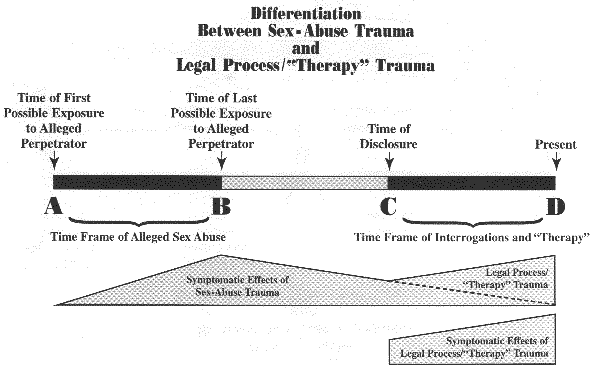
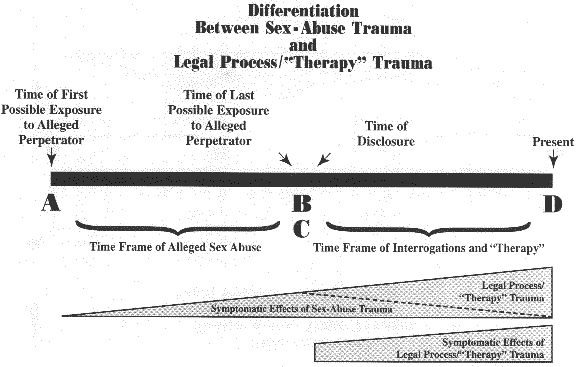
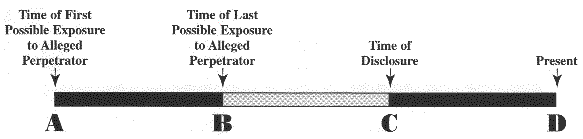
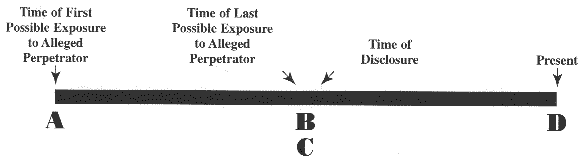
When evaluating sexual abuse allegations it is extremely important to differentiate between symptoms that arose prior to disclosure and those that arose afterwards. Symptoms arising after the disclosure and cessation of abuse can be caused by sexual abuse therapy, multiple interrogations, and other aspects of the legal process. Therefore, in a sex-abuse examination it is necessary to inquire as to the timing of the development of any claimed symptoms. Diagrams are presented to facilitate this inquiry.
When evaluating sexual abuse allegations it is extremely important to differentiate between symptoms that arose prior to disclosure and those that arose afterwards. Symptoms arising after the disclosure and cessation of abuse can be caused by sexual abuse therapy, multiple interrogations, and other aspects of the legal process. Therefore, in a sex-abuse examination it is necessary to inquire as to the timing of the development of any claimed symptoms. Diagrams are presented to facilitate this inquiry.

;
The Alleged Child Victim and Real Victims of Sexual Misuse
Conclusions
The real victims of sexual abuse of children include all of us, because the system we have set up to eliminate abuse of children may be doing more damage than good.
Children may be harmed by the intervention.
Families, including extended family members, may be destroyed.
Grandparents may never see their grandchildren again.
Occupations that involve work with children become suspect: Teachers, preachers, boy scout leaders, big brothers, athletic coaches, day care workers, counselors, mental health professionals, and others are watched suspiciously by a society that asks why they choose to work with children.
Lonely people learn quickly to avoid all friendly actions toward children (Weinbach 1987).
Men learn that in spite of twenty years of rhetoric telling them they can have feelings and be gentle, if they are affectionate with children they can go to prison.
[...]
It must be possible for all who are concerned with reducing the abuse of children to agree cognitively that increasing the accuracy of the process is both desirable and attainable. There is more credible and reliable information now than a few years ago. It is possible now to assert [...]that there is a general consensus in the scientific community about some basic facts. Potentially this information can be used to develop a more accurate and reliable way to make decisions about child sexual abuse which will result in greater protection of abused children and less harm to innocent persons.
Conclusions
The real victims of sexual abuse of children include all of us, because the system we have set up to eliminate abuse of children may be doing more damage than good.
Children may be harmed by the intervention.
Families, including extended family members, may be destroyed.
Grandparents may never see their grandchildren again.
Occupations that involve work with children become suspect: Teachers, preachers, boy scout leaders, big brothers, athletic coaches, day care workers, counselors, mental health professionals, and others are watched suspiciously by a society that asks why they choose to work with children.
Lonely people learn quickly to avoid all friendly actions toward children (Weinbach 1987).
Men learn that in spite of twenty years of rhetoric telling them they can have feelings and be gentle, if they are affectionate with children they can go to prison.
[...]
It must be possible for all who are concerned with reducing the abuse of children to agree cognitively that increasing the accuracy of the process is both desirable and attainable. There is more credible and reliable information now than a few years ago. It is possible now to assert [...]that there is a general consensus in the scientific community about some basic facts. Potentially this information can be used to develop a more accurate and reliable way to make decisions about child sexual abuse which will result in greater protection of abused children and less harm to innocent persons.
;
Misinterpretation of a Primary Prevention Effort;
Child Abuse Accusations, 6(2), 96-107. (1994).;
1994(6(2), ), 96-107.,
Jan 01 1994
In 1990, Ralph Underwager and Hollida Wakefield gave an interview to the editor of Paidika, The Journal of Paedophilia, a scholarly journal published in Holland. The interview was published in 1993.
Since that time, statements from the interview have been taken out-of-context and misinterpreted as indicating that RU and HW approve of pedophilia and child sexual abuse.
Here, they respond to these criticisms and accusations.
The authors add an Appendix: A Proposal: Primary Prevention Program for Child Sexual Abuse.
In 1990, Ralph Underwager and Hollida Wakefield gave an interview to the editor of Paidika, The Journal of Paedophilia, a scholarly journal published in Holland. The interview was published in 1993.
Since that time, statements from the interview have been taken out-of-context and misinterpreted as indicating that RU and HW approve of pedophilia and child sexual abuse.
Here, they respond to these criticisms and accusations.
The authors add an Appendix: A Proposal: Primary Prevention Program for Child Sexual Abuse.
;
Thoughts on NAMBLA
Alan Ginsberg describes the reason why he joined NAMBLA. He also describes the task NAMBLA has to fulfil.
Alan Ginsberg describes the reason why he joined NAMBLA. He also describes the task NAMBLA has to fulfil.