
;
A Generation Silenced: The Role of Children as Seen Through the Discourse on Age ofConsent Legislation;
Psychology Department,
Dec 03 2007
Age of consent laws have been the source of a major debate between those that
believe children need to be protected from predators, and those that believe children should have rights, and that the harm caused by a sexual relationship between a child and an adult has been dramatically sensationalized.
However, among those involved in this dispute, no children can be found arguing for either perspective.
This study was initially intended to reveal the opinions of children on the issue
of age of consent laws. Then I was informed that this was next to impossible given the various types of legal authorization I would be required to get. The issue of authorization is what ultimately led to the focus of this study – questioning what devices are put in place by society to prevent children from expressing their opinions?
Also in this study, I examine whether there is a prevalent feeling that children should be able to express their opinions, and finally, in what forms would this expression be considered acceptable?
To explore these questions, the views of university students as well as
professionals were utilized as tools by which to understand the societal constructs that have silenced children, relating specifically to the Netherlands, but relevant outside of the Netherlands as well.
Finally, there is a discussion of whether or not it is necessary that these constructs exist, and the ways in which it would possible to transcend them.
Age of consent laws have been the source of a major debate between those that
believe children need to be protected from predators, and those that believe children should have rights, and that the harm caused by a sexual relationship between a child and an adult has been dramatically sensationalized.
However, among those involved in this dispute, no children can be found arguing for either perspective.
This study was initially intended to reveal the opinions of children on the issue
of age of consent laws. Then I was informed that this was next to impossible given the various types of legal authorization I would be required to get. The issue of authorization is what ultimately led to the focus of this study – questioning what devices are put in place by society to prevent children from expressing their opinions?
Also in this study, I examine whether there is a prevalent feeling that children should be able to express their opinions, and finally, in what forms would this expression be considered acceptable?
To explore these questions, the views of university students as well as
professionals were utilized as tools by which to understand the societal constructs that have silenced children, relating specifically to the Netherlands, but relevant outside of the Netherlands as well.
Finally, there is a discussion of whether or not it is necessary that these constructs exist, and the ways in which it would possible to transcend them.

;
Gidean feminist scholarship and victim feminists,
Jan 01 2004
The unknown author criticizes in an unknown source the book of Naomi Segal about André Gide. He or she especially criticizes her view on Greek pedastery, as well on Gide's love and life.
The unknown author criticizes in an unknown source the book of Naomi Segal about André Gide. He or she especially criticizes her view on Greek pedastery, as well on Gide's love and life.
;
Glossary of Inappropriate Scientific and Professional Terms
Sexological research and training are often hampered by traditional terms that contain hidden value judgements or are even openly ideological. Originally, they were part of semantic strategies by which various religious, legal, medical, and pedagogic "experts" tried to impose their professional interests or moral convictions upon the general public. In addition, there are many imprecise and misleading terms still current in our field, so that it is often extremely difficult to describe sexual matters in an objective way. In any case, today the following terms should be avoided:
Sexological research and training are often hampered by traditional terms that contain hidden value judgements or are even openly ideological. Originally, they were part of semantic strategies by which various religious, legal, medical, and pedagogic "experts" tried to impose their professional interests or moral convictions upon the general public. In addition, there are many imprecise and misleading terms still current in our field, so that it is often extremely difficult to describe sexual matters in an objective way. In any case, today the following terms should be avoided:
;
Goodbye To All That
"The intimacy that frequently took place was very seldom between an older boy and the object of his affection - that would have spoiled the romantic illusion - but almost always between boys of the same age who were not in love, and used each other as convenient sex-instruments. So the atmosphere was always heavy with romance of a conventional early-Victorian type, complicated by cynicism and foulness."
"The school consisted of about six hundred boys, whose chief interests were games [sports] and romantic friendships."
"The intimacy that frequently took place was very seldom between an older boy and the object of his affection - that would have spoiled the romantic illusion - but almost always between boys of the same age who were not in love, and used each other as convenient sex-instruments. So the atmosphere was always heavy with romance of a conventional early-Victorian type, complicated by cynicism and foulness."
"The school consisted of about six hundred boys, whose chief interests were games [sports] and romantic friendships."
;
Harmful to Minors;
304 pp.
In the book, Levine lambastes US laws concerning child pornography, statutory rape, and abortion for minors using a variety of studies and interviews with teenagers and adults alike (see Acknowledgments). Levine also analyzes abstinence-only sex education, which Levine considers counter-productive and dangerous.
The book also examines the terms "harmful to minors" and "indecency," which Levine considers to be umbrella terms for censorship, ...
In the book, Levine lambastes US laws concerning child pornography, statutory rape, and abortion for minors using a variety of studies and interviews with teenagers and adults alike (see Acknowledgments). Levine also analyzes abstinence-only sex education, which Levine considers counter-productive and dangerous.
The book also examines the terms "harmful to minors" and "indecency," which Levine considers to be umbrella terms for censorship, ...
;
Hebephilia : Quintessence of Diagnostic Pretextuality;
Behavioral Sciences and the Law;
(online),
Hebephilia is an archaic term used to describe adult sexual attraction to adolescents. Prior to the advent of contemporary sexually violent predator laws, the term was not found in any dictionary or formal diagnostic system. Overnight, it is on the fast track toward recognition as a psychiatric condition meriting inclusion in the upcoming ?fth edition of the em>Diagnostic and Statistical Manual of Mental Disorders. This article traces the sudden emergence and popularity of hebephilia to pressure from the legal arena and speci?cally to the legal mandate of a serious mental abnormality for civil commitment of sex offenders. Hebephilia is proposed as a quintessential example of pretextuality, in which special interests promote a pseudoscienti?c construct that furthers an implicit, instrumental goal. Inherent problems with the construct’s reliability and validity are discussed. A warning is issued about unintended consequences if hebephilia or its relative, pedohebephilia, make their way into the DSM-5, due out in 2013. Copyright 2010 John Wiley & Sons, Ltd.
Hebephilia is an archaic term used to describe adult sexual attraction to adolescents. Prior to the advent of contemporary sexually violent predator laws, the term was not found in any dictionary or formal diagnostic system. Overnight, it is on the fast track toward recognition as a psychiatric condition meriting inclusion in the upcoming ?fth edition of the em>Diagnostic and Statistical Manual of Mental Disorders. This article traces the sudden emergence and popularity of hebephilia to pressure from the legal arena and speci?cally to the legal mandate of a serious mental abnormality for civil commitment of sex offenders. Hebephilia is proposed as a quintessential example of pretextuality, in which special interests promote a pseudoscienti?c construct that furthers an implicit, instrumental goal. Inherent problems with the construct’s reliability and validity are discussed. A warning is issued about unintended consequences if hebephilia or its relative, pedohebephilia, make their way into the DSM-5, due out in 2013. Copyright 2010 John Wiley & Sons, Ltd.
;
Hebephilia as Mental Disorder?;
Archives of Sexual Behavior;
41(4), 797–829,
Jun 28 2012
A Historical, Cross-Cultural, Sociological, Cross-Species, Non-Clinical Empirical, and Evolutionary Review
Blanchard et al. (2009) demonstrated that hebephilia is a genuine sexual preference, but then proposed, without argument or evidence, that it should be designated as a mental disorder in the DSM-5. A series of Letters-to-the-Editor criticized this proposal as a non sequitur. Blanchard (2009), in rebuttal, reaffirmed his position, but without adequately addressing some central criticisms.
In this article, we examine hebephilia-as-disorder in full detail. Unlike Blanchard et al., we discuss definitions of mental disorder, examine extensive evidence from a broad range of sources, and consider alternative (i.e., non-pathological) explanations for hebephilia.
We employed Wakefield's (1992b) harmful dysfunction approach to disorder, which holds that a condition only counts as a disorder when it is a failure of a naturally selected mechanism to function as designed, which is harmful to the individual in the current environment. We also considered a harmful-for-others approach to disorder (Brülde, 2007).
Examination of historical, cross-cultural, sociological, cross-species, non-clinical empirical, and evolutionary evidence and perspectives indicated that hebephilic interest is an evolved capacity and hebephilic preference an expectable distributional variant, both of which were adaptively neutral or functional, not dysfunctional, in earlier human environments. Hebephilia's conflict with modern society makes it an evolutionary mismatch, not a genuine disorder.
Though it should not be classified as a disorder, it could be entered in the DSM's V-code section, used for non-disordered conditions that create significant problems in present-day society.
A Historical, Cross-Cultural, Sociological, Cross-Species, Non-Clinical Empirical, and Evolutionary Review
Blanchard et al. (2009) demonstrated that hebephilia is a genuine sexual preference, but then proposed, without argument or evidence, that it should be designated as a mental disorder in the DSM-5. A series of Letters-to-the-Editor criticized this proposal as a non sequitur. Blanchard (2009), in rebuttal, reaffirmed his position, but without adequately addressing some central criticisms.
In this article, we examine hebephilia-as-disorder in full detail. Unlike Blanchard et al., we discuss definitions of mental disorder, examine extensive evidence from a broad range of sources, and consider alternative (i.e., non-pathological) explanations for hebephilia.
We employed Wakefield's (1992b) harmful dysfunction approach to disorder, which holds that a condition only counts as a disorder when it is a failure of a naturally selected mechanism to function as designed, which is harmful to the individual in the current environment. We also considered a harmful-for-others approach to disorder (Brülde, 2007).
Examination of historical, cross-cultural, sociological, cross-species, non-clinical empirical, and evolutionary evidence and perspectives indicated that hebephilic interest is an evolved capacity and hebephilic preference an expectable distributional variant, both of which were adaptively neutral or functional, not dysfunctional, in earlier human environments. Hebephilia's conflict with modern society makes it an evolutionary mismatch, not a genuine disorder.
Though it should not be classified as a disorder, it could be entered in the DSM's V-code section, used for non-disordered conditions that create significant problems in present-day society.
;
Hebephilia is a Mental Disorder?
The proposed inclusion of a hebephilic sexual orientation (early pubescent males and/or females) in DSM-5 compromises the scientific credibility of psychiatry. Moralism about the age of an acceptable sexual partner drives this proposal. It ignores common patterns of sexual arousal, cultural variability, and historic precedents. It blurs the domains of psychiatry and law. The age of sexual consent is 14 in much of Europe. An example of the new "mentally disordered" would be a 19 year old with a consenting 14 year old. Where sexual interaction is legally accepted, but pathologized as mental disorder, psychiatry attempts to act as an agent of social control.
The proposed inclusion of a hebephilic sexual orientation (early pubescent males and/or females) in DSM-5 compromises the scientific credibility of psychiatry. Moralism about the age of an acceptable sexual partner drives this proposal. It ignores common patterns of sexual arousal, cultural variability, and historic precedents. It blurs the domains of psychiatry and law. The age of sexual consent is 14 in much of Europe. An example of the new "mentally disordered" would be a 19 year old with a consenting 14 year old. Where sexual interaction is legally accepted, but pathologized as mental disorder, psychiatry attempts to act as an agent of social control.
;
Hebephilia Is Not a Mental Disorder in DSM-IV-TR and Should Not Become One in DSM-5;
Journal of the American Academy of Psychiatry and the Law;
39(1), 78-85,
Feb 01 2011
The paraphilia section of Diagnostic and Statistical Manual of Mental Disorders, Fourth Edition, Text Revision (DSM-IV-TR) is being misinterpreted in the forensic evaluations of sexually violent offenders. The resulting misuse of the term paraphilia not otherwise specified, hebephilia, has justified the inappropriate involuntary commitment of individuals who do not in fact qualify for a DSM-IV-TR diagnosis of mental disorder. This article has two purposes: to clarify what the DSM-IV-TR was meant to convey and how it has been twisted in translation within the legal system, and to warn that the DSM-5 proposal to include pedohebephilia threatens to make the current bad situation very much worse in the future.
The paraphilia section of Diagnostic and Statistical Manual of Mental Disorders, Fourth Edition, Text Revision (DSM-IV-TR) is being misinterpreted in the forensic evaluations of sexually violent offenders. The resulting misuse of the term paraphilia not otherwise specified, hebephilia, has justified the inappropriate involuntary commitment of individuals who do not in fact qualify for a DSM-IV-TR diagnosis of mental disorder. This article has two purposes: to clarify what the DSM-IV-TR was meant to convey and how it has been twisted in translation within the legal system, and to warn that the DSM-5 proposal to include pedohebephilia threatens to make the current bad situation very much worse in the future.

;
Hebephilia plethysmographica: A partial rejoinder to Blanchard et al. (2008);
Archives of Sexual Behavior;
321-322
;
Hello Susan Clancy
Hello, Susan
I am a paedophile and I've read your book ["The Trauma Myth"]. ...
But despite of your wit you write really stupid things about the question. Your prejudice against the child lovers does not allow you to understand simple things. If you are real scientist, not moralist, you would be able to answer the next topics: ... ... ...
So, Susan, I disproved all ideological stratification on your scientific work. ...
And if "victims need to hear the truth" tell them truth.
Hello, Susan
I am a paedophile and I've read your book ["The Trauma Myth"]. ...
But despite of your wit you write really stupid things about the question. Your prejudice against the child lovers does not allow you to understand simple things. If you are real scientist, not moralist, you would be able to answer the next topics: ... ... ...
So, Susan, I disproved all ideological stratification on your scientific work. ...
And if "victims need to hear the truth" tell them truth.
;
Hikind Retreating On Tough Tactics Against Molesters;
,
Mar 25 2009
Assemblyman Dov Hikind of Brooklyn, a leading voice in the fight to end child sexual abuse in Orthodox communities, is backing down from some of his previous claims and backing away from one of his most confrontational stands against an alleged pedophile.
Assemblyman Dov Hikind of Brooklyn, a leading voice in the fight to end child sexual abuse in Orthodox communities, is backing down from some of his previous claims and backing away from one of his most confrontational stands against an alleged pedophile.
;
Historical Roots of Sexual Oppression;
pp. 3-27
A short history of sexual oppression in Europe from ancient to modern times, offering many illuminating anecdotes and examples.
A short history of sexual oppression in Europe from ancient to modern times, offering many illuminating anecdotes and examples.
;
Historicizing affect, psychoanalyzing history: pedophilia and the discourse of child sexuality;
Journal of Homosexuality;
46(Februari), 79 - 109
Within the last two decades in Australia, Britain, and the United States, we have seen a veritable explosion of cultural panic regarding the problem of pedophilia. Scarcely a day passes without some mention in the media of predatory pedophiles or organized pedophile networks. Many social constructionist historians and sociologists have described this incitement to discourse as indicative of a moral panic.
[...]
Here, I will suggest a repressed discourse of child sexuality is writ large. I will argue that the hegemonic discourse of pedophilia is contained largely within a neurotic structure and that many of our prevailing responses to pedophilia function as a way to avoid tackling crucial issues about the reality and trauma of childhood sexuality.
The question that concerns me in this article is: If this incitement to discourse is indicative of a moral panic, to what does the panic refer?
Within the last two decades in Australia, Britain, and the United States, we have seen a veritable explosion of cultural panic regarding the problem of pedophilia. Scarcely a day passes without some mention in the media of predatory pedophiles or organized pedophile networks. Many social constructionist historians and sociologists have described this incitement to discourse as indicative of a moral panic.
[...]
Here, I will suggest a repressed discourse of child sexuality is writ large. I will argue that the hegemonic discourse of pedophilia is contained largely within a neurotic structure and that many of our prevailing responses to pedophilia function as a way to avoid tackling crucial issues about the reality and trauma of childhood sexuality.
The question that concerns me in this article is: If this incitement to discourse is indicative of a moral panic, to what does the panic refer?
;
The history of Ipce,
Sep 15 2011
The history of Ipce, existing since 1987, can be read in an overview of all Ipce's Newsletters. Especially the reports of Ipce's Meetings are mentioned and summarized there. If you follow the bold blue fonts there, you will see the history of Ipce in short.
The history of Ipce, existing since 1987, can be read in an overview of all Ipce's Newsletters. Especially the reports of Ipce's Meetings are mentioned and summarized there. If you follow the bold blue fonts there, you will see the history of Ipce in short.
;
A History of the Paedophile Activism,
Oct 13 2013
I am a [Belgian] historian, working on a PhD project on the scientific history of today’s ultimate sexual other: the paedophile. Today I would like to talk to you about a particularly interesting aspect of paedophile history, namely the chapter on paedophile activism [in Belgium and The Netherlands] on which I will present a brief overview and discourse analysis.
[... ... ... ...]
By the mid 1990s most paedophile movements had gone underground or on the Internet.
The fight for paedophile rights are a page in the history of sexual minorities that most people and especially LGBT movements have been eager to forget. Today the paedophile debate belongs to the past, the arguments of the movements are dismissed for being excruciatingly naive at best, monstrous at worst. [...]
I am a [Belgian] historian, working on a PhD project on the scientific history of today’s ultimate sexual other: the paedophile. Today I would like to talk to you about a particularly interesting aspect of paedophile history, namely the chapter on paedophile activism [in Belgium and The Netherlands] on which I will present a brief overview and discourse analysis.
[... ... ... ...]
By the mid 1990s most paedophile movements had gone underground or on the Internet.
The fight for paedophile rights are a page in the history of sexual minorities that most people and especially LGBT movements have been eager to forget. Today the paedophile debate belongs to the past, the arguments of the movements are dismissed for being excruciatingly naive at best, monstrous at worst. [...]
;
How bad was J.M. Barrie?,
Jul 13 2008
An obsessive stalker, an impotent husband, a lover of young boys... to some, the creator of 'Peter Pan' was an evil genius; to others, a misunderstood ingenue. Ever mindful of the J.M. Barrie 'curse', Justine Picardie investigates.
An obsessive stalker, an impotent husband, a lover of young boys... to some, the creator of 'Peter Pan' was an evil genius; to others, a misunderstood ingenue. Ever mindful of the J.M. Barrie 'curse', Justine Picardie investigates.
;
How can we prevent child abuse if we don't understand paedophilia?;
Independent Voices (UK),
Jan 07 2013
If we want to keep children safe from sexual harm, then surely knowing what we’re dealing with would be a good first step. [...]
What gets a bit more complicated is distinguishing between paedophilia (the sexual attraction) and child sexual abuse (adult sexual contact with children below the legal age of consent). Paedophilia is, strictly speaking, in a separate conceptual category to child sexual abuse, although in everyday life the word ‘paedophile’ is typically taken to mean a person (usually a man) who has sexually offended against a child. [...]
The first step is to try and work out how many paedophiles there are.
[...] we would be therefore looking at around one in five of all the men we know having some degree of sexual attraction to children. [...]
Some people experience such sexual desires but don’t act upon them. Perhaps, for them, in a sex-saturated society, that’s quite an achievement. We need to be able to acknowledge and understand their self-control.
Independent Voices is the Independent newspaper's online blogging site. The article didn't actually appear in the paper (as fas as I know).
If we want to keep children safe from sexual harm, then surely knowing what we’re dealing with would be a good first step. [...]
What gets a bit more complicated is distinguishing between paedophilia (the sexual attraction) and child sexual abuse (adult sexual contact with children below the legal age of consent). Paedophilia is, strictly speaking, in a separate conceptual category to child sexual abuse, although in everyday life the word ‘paedophile’ is typically taken to mean a person (usually a man) who has sexually offended against a child. [...]
The first step is to try and work out how many paedophiles there are.
[...] we would be therefore looking at around one in five of all the men we know having some degree of sexual attraction to children. [...]
Some people experience such sexual desires but don’t act upon them. Perhaps, for them, in a sex-saturated society, that’s quite an achievement. We need to be able to acknowledge and understand their self-control.
Independent Voices is the Independent newspaper's online blogging site. The article didn't actually appear in the paper (as fas as I know).
;
How Children Learn About Sex: A Cross-Species and Cross- Cultural Analysis;
Arch Sex Behav (2015) 44:1059–1069,
Feb 18 2015
Scattered and not widely disseminated evidence from primatology, anthropology, and history of childhood sexuality support the hypothesis that throughout much of human behavioral evolution that human children have learned about sex through observing parental sexuality and then imitating it in sexual rehearsal play with peers. Contemporary theories of psychosexual development have not considered the possibility that young children are predisposed to learn about sex through observational learning and sexual rehearsal play during early childhood, a primate-wide trait that is conserved in humans but suppressed in contemporary contexts.
Scattered and not widely disseminated evidence from primatology, anthropology, and history of childhood sexuality support the hypothesis that throughout much of human behavioral evolution that human children have learned about sex through observing parental sexuality and then imitating it in sexual rehearsal play with peers. Contemporary theories of psychosexual development have not considered the possibility that young children are predisposed to learn about sex through observational learning and sexual rehearsal play during early childhood, a primate-wide trait that is conserved in humans but suppressed in contemporary contexts.
;
How to Persecute a Pedophile
Imagine, you work in the Ukrainian Police. A pervert Kyrýlo Yevhénovych Halaburdá lives in your city Dnipró. Once in 2012 or earlier you noticed his profile in a social network where he called himself a pedophile and even posted his messages towards one 13-years-old girl. You hope this character is fake or fictional. ...
In 2014 you got to know that Kyrylo Halaburda had petitioned to parliament for adult-child sex legalization. The petition was numbered as 09-0756.04.14/01-08.14 and sent to government. That's why the Deputy Minister of Justice of Ukraine Ruslán Riaboshápka directed your office to investigate who Kyrylo was. ...
You're a policeman, and know it for sure. The pedophile must be persecuted in illegal way, and you know how to make it safe for you. ...
You're a policeman, you can outrage and threaten a pedophile without any risk. ...
A pedophile is not a demon, he's just a human being, he depends upon people, which are his enemies. Pedophile's friends cannot help, and enemies can do with him whatever they want. There is no lie, no betrayal, no menace, no violence, no imprisonment, no rape, no mutilation, no murder, no torture that cannot be justified as child protection.
Imagine, you work in the Ukrainian Police. A pervert Kyrýlo Yevhénovych Halaburdá lives in your city Dnipró. Once in 2012 or earlier you noticed his profile in a social network where he called himself a pedophile and even posted his messages towards one 13-years-old girl. You hope this character is fake or fictional. ...
In 2014 you got to know that Kyrylo Halaburda had petitioned to parliament for adult-child sex legalization. The petition was numbered as 09-0756.04.14/01-08.14 and sent to government. That's why the Deputy Minister of Justice of Ukraine Ruslán Riaboshápka directed your office to investigate who Kyrylo was. ...
You're a policeman, and know it for sure. The pedophile must be persecuted in illegal way, and you know how to make it safe for you. ...
You're a policeman, you can outrage and threaten a pedophile without any risk. ...
A pedophile is not a demon, he's just a human being, he depends upon people, which are his enemies. Pedophile's friends cannot help, and enemies can do with him whatever they want. There is no lie, no betrayal, no menace, no violence, no imprisonment, no rape, no mutilation, no murder, no torture that cannot be justified as child protection.
;
Human Rights and the Denial of Sexual Freedom
René Guyon had the following text privately printed in Bangkok in the form of a rather flimsy brochure. He then sent it to all European and American sexologists whose addresses he knew. [...] As a public service, we are here providing the full text of our own copy. - Ipce.
[...] Human dignity is no more affected by sexual acts than it is by individual preferences in food or in recreation. It is an infantile stratagem of the puritans to pretend that there is any "indignity" in living Sexually outside the range of their childish and inexperienced conceptions. [...]
Modern men and women proclaim and loudly repeat that they no longer wish to be slaves. Yet the anti-sexual mores and laws have established for them a servitude from which they suffer at all ages of their lives. They are the slaves of the prohibitory laws that govern them. [...]
The Sexual Freedom which I have proposed is that which rests firmly upon the reciprocal consent of the parties involved in the sexual act or any of its varieties. [...]
René Guyon had the following text privately printed in Bangkok in the form of a rather flimsy brochure. He then sent it to all European and American sexologists whose addresses he knew. [...] As a public service, we are here providing the full text of our own copy. - Ipce.
[...] Human dignity is no more affected by sexual acts than it is by individual preferences in food or in recreation. It is an infantile stratagem of the puritans to pretend that there is any "indignity" in living Sexually outside the range of their childish and inexperienced conceptions. [...]
Modern men and women proclaim and loudly repeat that they no longer wish to be slaves. Yet the anti-sexual mores and laws have established for them a servitude from which they suffer at all ages of their lives. They are the slaves of the prohibitory laws that govern them. [...]
The Sexual Freedom which I have proposed is that which rests firmly upon the reciprocal consent of the parties involved in the sexual act or any of its varieties. [...]
;
IMO Archive Library published,
Jan 27 2022
IMO Archive published.
This library has been the internal library of IMO = "Ipce Meets Online", from 2001 - 2004. This internal forum has stopped. This library is made public in 2022.
IMO Archive published.
This library has been the internal library of IMO = "Ipce Meets Online", from 2001 - 2004. This internal forum has stopped. This library is made public in 2022.
;
The impact of child sexual abuse on health;
Clinical Psychology Review;
2009(29), 647 - 657
This paper addresses the best available scientific evidence on the topic, by providing a systernatic review of the several reviews that have investigated the literature on the effects of child sexual abuse.
There is evidence that survivors of childhood sexual abuse are signi?cantly at risk of a wide range of medical, psychological, behavioral, and sexual disorders. Relationships are small to medium in magnitudes and moderated by sample source and size. Child sexual abuse should be considered as a general, nonspecific risk factor for psychopathology.
This paper addresses the best available scientific evidence on the topic, by providing a systernatic review of the several reviews that have investigated the literature on the effects of child sexual abuse.
There is evidence that survivors of childhood sexual abuse are signi?cantly at risk of a wide range of medical, psychological, behavioral, and sexual disorders. Relationships are small to medium in magnitudes and moderated by sample source and size. Child sexual abuse should be considered as a general, nonspecific risk factor for psychopathology.
;
Impact of Sexual Abuse on Children A Review and Synthesis of Recent Empirical Studies;
Psychological Bulletin;
113(1), 164-180
ABSTRACT
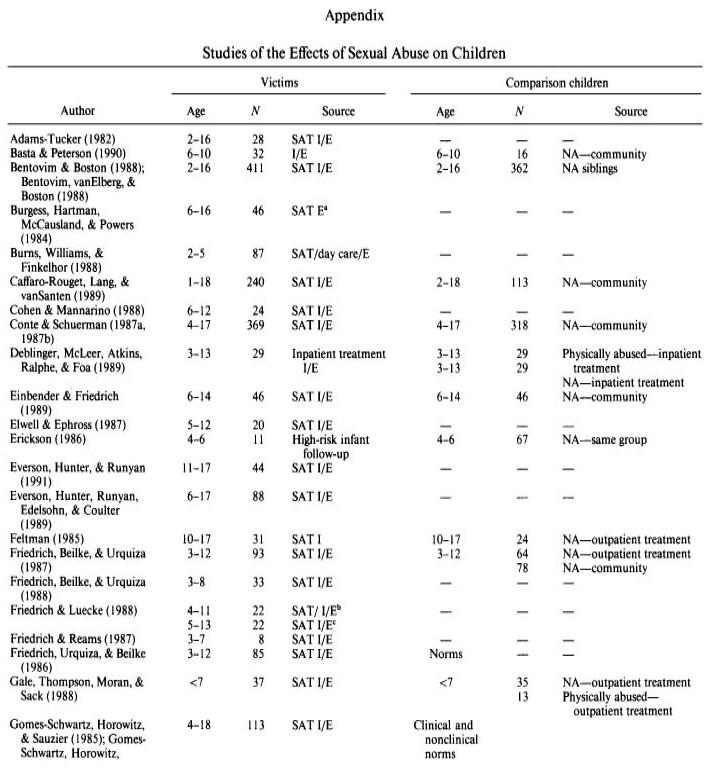
A review of 45 studies clearly demonstrated that sexually abused children had more symptoms than nonabused children, with abuse accounting for 15—45% of the variance. Fears, posttraumatic stress disorder, behavior problems, sexualized behaviors, and poor self-esteem occurred most frequently among a long list of symptoms noted, but no one symptom characterized a majority of sexually abused children. Some symptoms were specific to certain ages, and approximately one third of victims had no symptoms. Penetration, the duration and frequency of the abuse, force, the relationship of the perpetrator to the child, and maternal support affected the degree of symptomatology. About two thirds of the victimized children showed recovery during the first 12—18 months. The findings suggest the absence of any specific syndrome in children who have been sexually abused and no single traumatizing process.
ABSTRACT
A review of 45 studies clearly demonstrated that sexually abused children had more symptoms than nonabused children, with abuse accounting for 15—45% of the variance. Fears, posttraumatic stress disorder, behavior problems, sexualized behaviors, and poor self-esteem occurred most frequently among a long list of symptoms noted, but no one symptom characterized a majority of sexually abused children. Some symptoms were specific to certain ages, and approximately one third of victims had no symptoms. Penetration, the duration and frequency of the abuse, force, the relationship of the perpetrator to the child, and maternal support affected the degree of symptomatology. About two thirds of the victimized children showed recovery during the first 12—18 months. The findings suggest the absence of any specific syndrome in children who have been sexually abused and no single traumatizing process.

;
In a Philippine Town, Child Prostitution, Despite Protests, Is a Way of Life;
New York Times,
Feb 05 1989
Parents come out in support of pedophiles.
Parents come out in support of pedophiles.