 English
 Français
 Deutsch
 Español
;
The Sexual Behavior of the Human Female;
888 pp
Kinsey c.s.' book "The Sexual Behavior of the Human Female", 1953, is given here as a long pdf file.
Kinsey c.s.' book "The Sexual Behavior of the Human Female", 1953, is given here as a long pdf file.
;
Kinsey - The Sexual Behavior of the Human Male;
819 pp.
Here is given the text of the book "Sexual behavior in the Human Male", Kinsey c.s., 1948, in a long PDF file.
Here is given the text of the book "Sexual behavior in the Human Male", Kinsey c.s., 1948, in a long PDF file.
;
Kinsey Report -- excerpted entries on homosexuality;
Excerpts from a book
Excerpts from Kinsey et al's Sexual Behavior in the Human Male:
[Chapter 7: Age and Sexual Outlet, pp. 259-261] Homosexual activity and age.
[Chapter 8: Marital Status and Sexual Outlet, pp. 259-261]
[Chapter 10: Social Level and Sexual Outlet] - [sub-heading: Incidences and Frequencies of Sexual Outlet, pp. 357-362] & [sub-heading: Patterns of Behavior, pp. 383-384]
[Chapter 12: Rural-Urban Background and Sexual Outlet, pp. 455-459]
Excerpts from Kinsey et al's Sexual Behavior in the Human Male:
[Chapter 7: Age and Sexual Outlet, pp. 259-261] Homosexual activity and age.
[Chapter 8: Marital Status and Sexual Outlet, pp. 259-261]
[Chapter 10: Social Level and Sexual Outlet] - [sub-heading: Incidences and Frequencies of Sexual Outlet, pp. 357-362] & [sub-heading: Patterns of Behavior, pp. 383-384]
[Chapter 12: Rural-Urban Background and Sexual Outlet, pp. 455-459]
;
American Sexual Behavior and The Kinsey Report (excerpts);
Several excerpts
Excerpts from: American Sexual Behavior and The Kinsey Report; New York: Greystone Press, 1948.
The same factors which governed the development of our actual sexual behavior seem to have set up the psychological blocks which have been the obstacles to our knowledge.
Observation and a reading of history show that not all people at all times and in all lands have the same attitudes toward sex. Yet the pattern of Western civilization has been established - and Westerners have sought to impose it upon the rest of the world - as if only one set of sexual customs was either desirable or natural.
The sexual behavior of people is based on a great many different traditions, superstitions, impulses and individual experiences. But our attitudes toward sex are not even as reasonable as our behavior.
Homosexual experience before adolescence was more frequent [than heterosexual] among the subjects studied for the Kinsey Report ...
These statistical data may shock many parents.
The Report has set forth the facts.
Only after the fear of parental displeasure has been removed can we find out what that taboo can do to the child's mind. Perhaps the silliest attitude parents can take is the peremptory order "Stop!" ....
Excerpts from: American Sexual Behavior and The Kinsey Report; New York: Greystone Press, 1948.
The same factors which governed the development of our actual sexual behavior seem to have set up the psychological blocks which have been the obstacles to our knowledge.
Observation and a reading of history show that not all people at all times and in all lands have the same attitudes toward sex. Yet the pattern of Western civilization has been established - and Westerners have sought to impose it upon the rest of the world - as if only one set of sexual customs was either desirable or natural.
The sexual behavior of people is based on a great many different traditions, superstitions, impulses and individual experiences. But our attitudes toward sex are not even as reasonable as our behavior.
Homosexual experience before adolescence was more frequent [than heterosexual] among the subjects studied for the Kinsey Report ...
These statistical data may shock many parents.
The Report has set forth the facts.
Only after the fear of parental displeasure has been removed can we find out what that taboo can do to the child's mind. Perhaps the silliest attitude parents can take is the peremptory order "Stop!" ....
;
Sexual Behavior in the Human Male (Chapter 21 - HOMOSEXUAL OUTLET);
0-1
[...] Homosexual contacts account, therefore, for a rather small but still significant portion of the total outlet of the human male. [...]
If homosexual activity persists on as large a scale as it does, in the face of the very considerable public sentiment against it and in spite of the severity of the penalties that our Anglo-American culture has placed upon it through the centuries, there seems some reason for believing that such activity would appear in the histories of a much larger portion of the population if there were no social restraints.
[...]
The homosexual has been a significant part of human sexual activity ever since the dawn of history, primarily because it is an expression of capacities that are basic in the human animal.
[...] Homosexual contacts account, therefore, for a rather small but still significant portion of the total outlet of the human male. [...]
If homosexual activity persists on as large a scale as it does, in the face of the very considerable public sentiment against it and in spite of the severity of the penalties that our Anglo-American culture has placed upon it through the centuries, there seems some reason for believing that such activity would appear in the histories of a much larger portion of the population if there were no social restraints.
[...]
The homosexual has been a significant part of human sexual activity ever since the dawn of history, primarily because it is an expression of capacities that are basic in the human animal.

;
Navigating the Stigma of Pedophilia: The Experiences of Nine Minor Attracted Men in Canada;
99 pp
This thesis presents findings and analysis arising from semi-structured qualitative interviews with nine minor-attracted men (i.e. men who are primarily attracted to children and/or adolescents) in Canada.
The central research question is “how do minor-attracted people understand and manage their stigmatized identities?” I situated the participants' experiences within a broader social context by reviewing relevant academic literature, laws, and dominant cultural attitudes. Utilizing a symbolic-interactionist approach, and drawing on Goffman's concept of “stigma,” t
his thesis illustrates the unique challenges facing minor-attracted people.
The study reveals that minor-attracted people become aware of their sexuality at an early age, experience stress caused by real or perceived societal rejection, and encounter both positive and negative reacti
The conclusion underscores the need for a new approach to dealing with
minor-attraction in contemporary Western society. I offer eight recommendations for instituting a strategy which incorporates empathy, education, and anti-discrimination measures.
This thesis presents findings and analysis arising from semi-structured qualitative interviews with nine minor-attracted men (i.e. men who are primarily attracted to children and/or adolescents) in Canada.
The central research question is “how do minor-attracted people understand and manage their stigmatized identities?” I situated the participants' experiences within a broader social context by reviewing relevant academic literature, laws, and dominant cultural attitudes. Utilizing a symbolic-interactionist approach, and drawing on Goffman's concept of “stigma,” t
his thesis illustrates the unique challenges facing minor-attracted people.
The study reveals that minor-attracted people become aware of their sexuality at an early age, experience stress caused by real or perceived societal rejection, and encounter both positive and negative reacti
The conclusion underscores the need for a new approach to dealing with
minor-attraction in contemporary Western society. I offer eight recommendations for instituting a strategy which incorporates empathy, education, and anti-discrimination measures.
;
Pedophilia and Sexual Offending against Children - Theory, Asessment, and Intervention - Second Edition - Quotes and Summaries;
329 pp
This new edition represents a critical review and integration of many active lines of research on pedophilia, hebephilia, sexual offending against children, incest, risk assessment, and treatment. My aim is to provide an accessible and scholarly book that summarizes the evidence to drive better research, policies, and practices, to prevent sexual offenses against children and to improve the lives of persons with pedophilia or hebephilia.
Some readers may be surprised that helping persons with pedophilia or hebephilia is part of my aim in this book. I ask you to imagine, whatever your sexual preferences are, that social norms and laws prohibited you from expressing your sexuality in the way you would like. Very serious consequences could result if you did express your sexual interest, including loss of employment; social ostracism; estrangement from family and friends; long prison sentences; and then a range of legal restrictions regarding residence, movement, and public notifications about you post sentence. Even if you never expressed your sexual interest, you would live in anxiety and fear because of the severe stigma associated with your sexual interest, so that it would be very difficult if not impossible to disclose to family members, friends, and others around you. That is the situation that persons with pedophilia or hebephilia currently face.
The field seems to have moved from a vigorous debate about whether sex offender treatment works at all to more fine-rained questions about what forms of treatment, for who, and under what conditions. This does not negate the many questions regarding assessment and treatment
for different populations, including non-offending persons with pedophilia, females, and juveniles.
I hope this book is a useful starting point for researchers, practitioners, and policymakers in setting an agenda for further work on these important topics. I am looking forward to the next decade of progress.
This new edition represents a critical review and integration of many active lines of research on pedophilia, hebephilia, sexual offending against children, incest, risk assessment, and treatment. My aim is to provide an accessible and scholarly book that summarizes the evidence to drive better research, policies, and practices, to prevent sexual offenses against children and to improve the lives of persons with pedophilia or hebephilia.
Some readers may be surprised that helping persons with pedophilia or hebephilia is part of my aim in this book. I ask you to imagine, whatever your sexual preferences are, that social norms and laws prohibited you from expressing your sexuality in the way you would like. Very serious consequences could result if you did express your sexual interest, including loss of employment; social ostracism; estrangement from family and friends; long prison sentences; and then a range of legal restrictions regarding residence, movement, and public notifications about you post sentence. Even if you never expressed your sexual interest, you would live in anxiety and fear because of the severe stigma associated with your sexual interest, so that it would be very difficult if not impossible to disclose to family members, friends, and others around you. That is the situation that persons with pedophilia or hebephilia currently face.
The field seems to have moved from a vigorous debate about whether sex offender treatment works at all to more fine-rained questions about what forms of treatment, for who, and under what conditions. This does not negate the many questions regarding assessment and treatment
for different populations, including non-offending persons with pedophilia, females, and juveniles.
I hope this book is a useful starting point for researchers, practitioners, and policymakers in setting an agenda for further work on these important topics. I am looking forward to the next decade of progress.
;
The Phylogeny of Malel/Female Differences in Sexual Behavior;
pp 122 - 149
This chapter offered a biology-based contribution toward a better understanding of the male/female dimorphism of human sexual behavior.
This dimorphism helps in explaining why adult human sexual behavior with children and adolescents is almost exclusively an adult male phenomenon.
However, the views elucidated in this chapter should by no means be misused to excuse or justify socially insensitive behavior toward any adult female, any child, or any adolescent or to reinforce socially unjust male dominance.
Rather, biological knowledge that clarifies human behavioral predispositions should encourage the prevention of negative behavior and enhance the personal and social aspects of human relationships.
This chapter offered a biology-based contribution toward a better understanding of the male/female dimorphism of human sexual behavior.
This dimorphism helps in explaining why adult human sexual behavior with children and adolescents is almost exclusively an adult male phenomenon.
However, the views elucidated in this chapter should by no means be misused to excuse or justify socially insensitive behavior toward any adult female, any child, or any adolescent or to reinforce socially unjust male dominance.
Rather, biological knowledge that clarifies human behavioral predispositions should encourage the prevention of negative behavior and enhance the personal and social aspects of human relationships.
;
Dominance, Submission, and Love: Sexual Pathologies from the Perspective of Ethology;
150 - 175
In human sexual behavior, strata of different phylogenetic origins can be distinguished. Sexuality based upon the mechanisms of male dominance and female submission, which characterizes the reptiles, also constitutes the basic layer of human sexuality. This reptilian heritage is superimposed, however, by a more recently acquired sexuality characterized by affiliation and love. The new potentiality to act in a friendly manner evolved with the development of parental care independently in birds and in mammals.
In normal human sexual behavior, the archaic agonal sexuality is controlled by affiliative sexuality and, therefore, is characterized by love. Agonal sexuality is still with us, however, as indicated, among other features, by the phallic male-dominance displays, by a male hormonal response linked to dominance achievement, and by the sexual fantasies of submission that are experienced by females. Agonal sexuality normally is under the control of affiliative sexuality, and therefore, humans correctly associate sex with love. Certain forms of sexuality, such as sadomasochism and a particular form of male homosexuality, are explained as being a regression to the archaic agonal sexuality.
Pedophilia and pedosexual behavior are explained within the regression context, too. Children have characteristics, such as small size, that facilitate adult males' feeling dominant to them, as occurs in pedosexual behavior.
Since human adult/adult romantic love is derived by phylogeny from parental caregiving behavior, it is easily seen how, in some adult humans, the feeling of love toward children has been retained and eroticized, which is the true meaning of the term "pedophilia."
In human sexual behavior, strata of different phylogenetic origins can be distinguished. Sexuality based upon the mechanisms of male dominance and female submission, which characterizes the reptiles, also constitutes the basic layer of human sexuality. This reptilian heritage is superimposed, however, by a more recently acquired sexuality characterized by affiliation and love. The new potentiality to act in a friendly manner evolved with the development of parental care independently in birds and in mammals.
In normal human sexual behavior, the archaic agonal sexuality is controlled by affiliative sexuality and, therefore, is characterized by love. Agonal sexuality is still with us, however, as indicated, among other features, by the phallic male-dominance displays, by a male hormonal response linked to dominance achievement, and by the sexual fantasies of submission that are experienced by females. Agonal sexuality normally is under the control of affiliative sexuality, and therefore, humans correctly associate sex with love. Certain forms of sexuality, such as sadomasochism and a particular form of male homosexuality, are explained as being a regression to the archaic agonal sexuality.
Pedophilia and pedosexual behavior are explained within the regression context, too. Children have characteristics, such as small size, that facilitate adult males' feeling dominant to them, as occurs in pedosexual behavior.
Since human adult/adult romantic love is derived by phylogeny from parental caregiving behavior, it is easily seen how, in some adult humans, the feeling of love toward children has been retained and eroticized, which is the true meaning of the term "pedophilia."
;
Deviants and Dissidents;
184 pp
My dissertation takes the child as its focus to understand both liberation politics and social conservative movements in the postwar United States. I reveal that, even as leftist social movements viewed children as possessing “sexuality” and argued for the liberation of children’s sexual expression, they simultaneously invoked the child as a vulnerable figure who must be protected from sexual abuse and violence in a dangerous postwar culture.
Ultimately, the protectionist rhetoric about children’s sexuality proved more powerful and influential than the libratory rhetoric, in large part because it shared features with the burgeoning rhetoric of the religious right, who found political power in a broad call to “save the children.”
My analysis of these competing rhetorical frameworks reveals the ways in which the child came to structure late-20th-century political discourse by marking the limits of liberation. Using children’s sexuality as a point of entry into postwar political activism, my dissertation sheds light on the evolution of political identities. Ultimately, my work highlights the shrinking of progressive political possibilities and the emergence of a consolidated conservative political discourse.
My dissertation takes the child as its focus to understand both liberation politics and social conservative movements in the postwar United States. I reveal that, even as leftist social movements viewed children as possessing “sexuality” and argued for the liberation of children’s sexual expression, they simultaneously invoked the child as a vulnerable figure who must be protected from sexual abuse and violence in a dangerous postwar culture.
Ultimately, the protectionist rhetoric about children’s sexuality proved more powerful and influential than the libratory rhetoric, in large part because it shared features with the burgeoning rhetoric of the religious right, who found political power in a broad call to “save the children.”
My analysis of these competing rhetorical frameworks reveals the ways in which the child came to structure late-20th-century political discourse by marking the limits of liberation. Using children’s sexuality as a point of entry into postwar political activism, my dissertation sheds light on the evolution of political identities. Ultimately, my work highlights the shrinking of progressive political possibilities and the emergence of a consolidated conservative political discourse.
;
Die griechische Knabenliebe (extract, English translation);
62-66
This points to the fact that the term "homosexuality" is used with many different meanings, and it is indeed very important to expose and overcome an underlying confusion of terms which goes unnoticed here as well, and which is firmly rooted in the popular imagination and has not been thoroughly abandoned even by science. It has enormous impact, because it causes barriers to understanding and communication that may even have disastrous practical consequences.
This points to the fact that the term "homosexuality" is used with many different meanings, and it is indeed very important to expose and overcome an underlying confusion of terms which goes unnoticed here as well, and which is firmly rooted in the popular imagination and has not been thoroughly abandoned even by science. It has enormous impact, because it causes barriers to understanding and communication that may even have disastrous practical consequences.
- [Ipce remarks: This same analysis can be made regarding "pedophiles" and "pedophilia".]
;
The Abused/Abuser Hypothesis of Child Sexual Abuse: A Critical Review of Theory and Research;
488-509
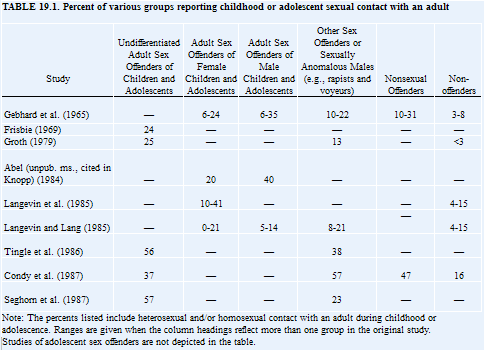
A widespread belief among the general public and professionals alike is that “sexual abuse causes sexual abuse”. That is, sexually abused children and adolescents who have engaged in sexual behavior with an adult (or a significantly older adolescent) are commonly thought to be at risk in later years of themselves becoming sexually involved with children and adolescents. This belief is referred to here as the “abused/abuser hypothesis of child and adolescent sexual abuse.”
Given the popularity of the abused/abuser hypothesis, it is perhaps surprising to find that there is a dearth of evidence supporting it. This is not to say that there is a substantial body of contradictory evidence. Rather, only a handful of studies have actually investigated the presumed association, and the designs and methods of these studies have been less than ideal. Most of the relevant data come from retrospective studies of adults that do not allow for direct causal analysis.
"The conclusion that seems warranted from the review is that childhood and adolescent sexual contact with adults is neither a necessary nor a sufficient cause for becoming an adjudicated sex offender of children or adolescents."
"Thus, sexual contact with an adult during childhood or adolescence is not a necessary cause for becoming an adjudicated adult sex offender of children and adolescents. Sexual contact with an adult during childhood or adolescence also does not appear to be a sufficient cause for becoming an adjudicated sex offender of children and adolescents."
"In summary, the abused/abuser hypothesis — the belief that sexual behavior between adults and children or adolescents causes those children and adolescents, as adults, to become sexually involved with other children and adolescents — is inadequate and incorrect."
"The belief that sexual abuse causes sexual abuse, the so-called “abused/abuser hypothesis,” is simplistic and misleading."
"The conclusion reached is that sexual contact with an adult during childhood or adolescence is neither a necessary nor a sufficient cause of adult sexual interest in children or adolescents."
A widespread belief among the general public and professionals alike is that “sexual abuse causes sexual abuse”. That is, sexually abused children and adolescents who have engaged in sexual behavior with an adult (or a significantly older adolescent) are commonly thought to be at risk in later years of themselves becoming sexually involved with children and adolescents. This belief is referred to here as the “abused/abuser hypothesis of child and adolescent sexual abuse.”
Given the popularity of the abused/abuser hypothesis, it is perhaps surprising to find that there is a dearth of evidence supporting it. This is not to say that there is a substantial body of contradictory evidence. Rather, only a handful of studies have actually investigated the presumed association, and the designs and methods of these studies have been less than ideal. Most of the relevant data come from retrospective studies of adults that do not allow for direct causal analysis.
"The conclusion that seems warranted from the review is that childhood and adolescent sexual contact with adults is neither a necessary nor a sufficient cause for becoming an adjudicated sex offender of children or adolescents."
"Thus, sexual contact with an adult during childhood or adolescence is not a necessary cause for becoming an adjudicated adult sex offender of children and adolescents. Sexual contact with an adult during childhood or adolescence also does not appear to be a sufficient cause for becoming an adjudicated sex offender of children and adolescents."
"In summary, the abused/abuser hypothesis — the belief that sexual behavior between adults and children or adolescents causes those children and adolescents, as adults, to become sexually involved with other children and adolescents — is inadequate and incorrect."
"The belief that sexual abuse causes sexual abuse, the so-called “abused/abuser hypothesis,” is simplistic and misleading."
"The conclusion reached is that sexual contact with an adult during childhood or adolescence is neither a necessary nor a sufficient cause of adult sexual interest in children or adolescents."


;
Pedophilia: A Specific Instance of New Phylism Theory ...;
18 pp
In society and in the criminal justice system, there are the prevalent assumptions that pedophilia is a voluntary orientation and a product of jaded depravity and that the next step will be sadistic assault and molestation ending up in lust murder. These assumptions are faulty and are based on rare and sporadic cases in which there is an overlapping of pedophilia, which is a paraphilia of the eligibilic/stigmatic type, with a paraphilia of the sacrificial/expiatory type. Pedophilia, both androphilic and gynephilic, is its own syndrome, unaccompanied by sacrificial or expiatory cruelty.
. . .
The pedophile's attachment to a child represents a merger of parental and erotic love.
. . .
Based on its roots in the Greek language, "pedophilia" means "child love." Two meanings of love are telescoped into the one word. One meaning is love as in parental love and pairbonding between parent and child. The other meaning is love as in making love and the sexual bonding of two partners, one of which is a juvenile. The two meanings share in common the reciprocality of bonding between two people.
In society and in the criminal justice system, there are the prevalent assumptions that pedophilia is a voluntary orientation and a product of jaded depravity and that the next step will be sadistic assault and molestation ending up in lust murder. These assumptions are faulty and are based on rare and sporadic cases in which there is an overlapping of pedophilia, which is a paraphilia of the eligibilic/stigmatic type, with a paraphilia of the sacrificial/expiatory type. Pedophilia, both androphilic and gynephilic, is its own syndrome, unaccompanied by sacrificial or expiatory cruelty.
. . .
The pedophile's attachment to a child represents a merger of parental and erotic love.
. . .
Based on its roots in the Greek language, "pedophilia" means "child love." Two meanings of love are telescoped into the one word. One meaning is love as in parental love and pairbonding between parent and child. The other meaning is love as in making love and the sexual bonding of two partners, one of which is a juvenile. The two meanings share in common the reciprocality of bonding between two people.
;
Pedophilia: Biosocial Dimensions;
600 pp
Most of the lay and professional literature although voluminous, reflect a narrow anthropo-, ethno-, and chrono-centrism that precludes any real understanding of the topic with anything more than the preconceptions of our times. [...]
[...] This volume adds to this data base by including new, biosocial contribution from the perspectives of history, political science, sexology, biology, primatology, anthropology, experimental and developmental psychology, and psychiatry. What results is a transspecies, transcultural, and transhistorical perspective that gives new biosocial insights into the roots of pedophilia as the phenomenon is found in contemporary industrialized societies.
Most of the lay and professional literature although voluminous, reflect a narrow anthropo-, ethno-, and chrono-centrism that precludes any real understanding of the topic with anything more than the preconceptions of our times. [...]
[...] This volume adds to this data base by including new, biosocial contribution from the perspectives of history, political science, sexology, biology, primatology, anthropology, experimental and developmental psychology, and psychiatry. What results is a transspecies, transcultural, and transhistorical perspective that gives new biosocial insights into the roots of pedophilia as the phenomenon is found in contemporary industrialized societies.
;
Quotes from: A fundamental attribution error? Rethinking cognitive distortions;
37 pp
The notion of ‘cognitive distortion’ has become enshrined in the offender treatment literature over the last 20 years, yet the concept still suffers from a lack of de?nitional clarity.
Treatment programmes for offenders often aim to eliminate excuse-making as a primary aim, and decision-makers place great weight on the degree to which an offender “takes responsibility” for his or her offending.
Yet, the relationship between these after-the-fact explanations and future crime is not at all clear. Indeed, the designation of post hoc excuses as criminogenic may itself be an example of fallacious thinking.
The notion of ‘cognitive distortion’ has become enshrined in the offender treatment literature over the last 20 years, yet the concept still suffers from a lack of de?nitional clarity.
Treatment programmes for offenders often aim to eliminate excuse-making as a primary aim, and decision-makers place great weight on the degree to which an offender “takes responsibility” for his or her offending.
Yet, the relationship between these after-the-fact explanations and future crime is not at all clear. Indeed, the designation of post hoc excuses as criminogenic may itself be an example of fallacious thinking.
;
David - A True Story;
60 pps
The following is a story of a great boy - and a great boylover. The story and its author can serve as sorely needed role models to young boylovers who have nowhere else to turn for guidance. - Ipce
What follows this introduction is the true story of a man and a boy’s passionate love for one another. It is meant to provide a small glimpse into just one of many such positive, though precarious and often dangerous, intergenerational friendships. These sometimes romantic friendships have existed throughout recorded, and one would assume unrecorded, history and they continue to exist. For those that strangely pretend to know the consequences of such couplings, without having any real knowledge about boylovers or the boys whose lives we’re sometimes part of, this was written for you, too.
The following is a story of a great boy - and a great boylover. The story and its author can serve as sorely needed role models to young boylovers who have nowhere else to turn for guidance. - Ipce
What follows this introduction is the true story of a man and a boy’s passionate love for one another. It is meant to provide a small glimpse into just one of many such positive, though precarious and often dangerous, intergenerational friendships. These sometimes romantic friendships have existed throughout recorded, and one would assume unrecorded, history and they continue to exist. For those that strangely pretend to know the consequences of such couplings, without having any real knowledge about boylovers or the boys whose lives we’re sometimes part of, this was written for you, too.
;
Reconstructing Paedophilia;
133 pp
There is a growing need for research to facilitate a better understanding of paedophilia. This study aims to make a contribution in this regard by providing an analysis of current discourses in paedophilia research as well as a phenomenological exploration of how the male paedophile constructs his close relationships with children.
In an attempt to circumvent these obstacles, it is argued that the psychological need to form close relationships is a universal one. On this basis the central components of close relationships are presented as a conceptual framework. These components are then applied to an exploratory phenomenological investigation and analysis of the ways in which three paedophilic men interpret, understand and construct their relationships with children.
There is a growing need for research to facilitate a better understanding of paedophilia. This study aims to make a contribution in this regard by providing an analysis of current discourses in paedophilia research as well as a phenomenological exploration of how the male paedophile constructs his close relationships with children.
In an attempt to circumvent these obstacles, it is argued that the psychological need to form close relationships is a universal one. On this basis the central components of close relationships are presented as a conceptual framework. These components are then applied to an exploratory phenomenological investigation and analysis of the ways in which three paedophilic men interpret, understand and construct their relationships with children.
;
Deviations: A Gayle Rubin Reader;
504 pp
Deviations is the definitive collection of writing by Gayle S. Rubin, a pioneering theorist and activist in feminist, lesbian and gay, queer, and sexuality studies since the 1970s.
Rubin first rose to prominence in 1975 with the publication of “The Traffic in Women,” an essay that had a galvanizing effect on feminist thinking and theory. In another landmark piece, “Thinking Sex,” she examined how certain sexual behaviors are constructed as moral or natural, and others as unnatural.
That essay became one of queer theory’s foundational texts.
Along with such canonical work, Deviations features less well-known but equally insightful writing on many subjects.
This book brings together a canonical collection of her writing, but it is more than a reader: she rewrites the genealogy of sexuality studies, giving us a precise intellectual history of sexuality studies that recognises the pivotal role played by academic homosexuals ...
A must read!
Ipce editor's note: Book included here for downloading.
Deviations is the definitive collection of writing by Gayle S. Rubin, a pioneering theorist and activist in feminist, lesbian and gay, queer, and sexuality studies since the 1970s.
Rubin first rose to prominence in 1975 with the publication of “The Traffic in Women,” an essay that had a galvanizing effect on feminist thinking and theory. In another landmark piece, “Thinking Sex,” she examined how certain sexual behaviors are constructed as moral or natural, and others as unnatural.
That essay became one of queer theory’s foundational texts.
Along with such canonical work, Deviations features less well-known but equally insightful writing on many subjects.
This book brings together a canonical collection of her writing, but it is more than a reader: she rewrites the genealogy of sexuality studies, giving us a precise intellectual history of sexuality studies that recognises the pivotal role played by academic homosexuals ...
A must read!
Ipce editor's note: Book included here for downloading.
;
Taboo Sex Research: Thinking Outside the Box;
10 pp,
Aug 31 2013
Foreword to a collection of essays on Censoring Sex Research, reviewing recent history of sex research censorship.
Foreword to a collection of essays on Censoring Sex Research, reviewing recent history of sex research censorship.
;
Censoring Sex Research: The Debate over Male Intergenerational Relations;
368 pp
This volume sheds light on one of the most explosive episodes of censure of academic scholarship in recent decades. Bruce Rind, a former psychology professor at Temple University, investigated sexual relations between male adults and adolescents through history and across cultures, from highly institutionalized relationships in Ancient Greece and Rome, to 33 contemporary cultures including the USA, and among various species. His conclusions that these relations, when consensual, are not always negative was radical, but based in his research findings. Even before publication of an invited article on the topic, he was subjected to intensive attacks, censured, and censored. This book presents a substantially extended version of Rind’s original, unpublished article, plus 12 scholarly responses to his work that argue for or against Rind’s conclusions or offer useful context on his work. For anyone interested in sex research and the academic freedom issues surrounding it, whether supportive of or vehemently opposed to Rind’s ideas, this book is a must-read.
This volume sheds light on one of the most explosive episodes of censure of academic scholarship in recent decades. Bruce Rind, a former psychology professor at Temple University, investigated sexual relations between male adults and adolescents through history and across cultures, from highly institutionalized relationships in Ancient Greece and Rome, to 33 contemporary cultures including the USA, and among various species. His conclusions that these relations, when consensual, are not always negative was radical, but based in his research findings. Even before publication of an invited article on the topic, he was subjected to intensive attacks, censured, and censored. This book presents a substantially extended version of Rind’s original, unpublished article, plus 12 scholarly responses to his work that argue for or against Rind’s conclusions or offer useful context on his work. For anyone interested in sex research and the academic freedom issues surrounding it, whether supportive of or vehemently opposed to Rind’s ideas, this book is a must-read.
;
The Consequences of Sexual Abuse of Minors;
Chapter, summarized
The Consequences of Sexual Abuse of Minors - On behalf of the Commission for Examination of Sexual Abuse of Minors in the Roman-Catholic Church [* in the Netherlands]; In: Rapport Commissie Deetman, Balans, 2011, Part 2. Summary and conclusions in English by Frans E J Gieles, PhD.
In this essay, sexual abuse is, conform the scientific and juridical mores, defined as "... sexual-genital manipulation of a child below the age of sixteen, by an adult of whom the child is dependent or with whom he or she has a relationship of confidence, with the aim of satisfaction of the sexual need of the first. [...] There is an age difference, and/or a difference in power, by which the child is not able to refuse the sexual contact, which is not consensual."
Research of the later consequences of sexual abuse is done in three phases or generations of research.
The most recent research explores what has appeared to be the most central factor: disturbance of the stress regulation.
There is consensus about harm for the physical and emotional health, especially the attachment and sexuality, even if the consequences are invisible at first sight. They are just like a time bomb, that explodes as soon as, in adulthood, the impact of the events becomes significant.
The Consequences of Sexual Abuse of Minors - On behalf of the Commission for Examination of Sexual Abuse of Minors in the Roman-Catholic Church [* in the Netherlands]; In: Rapport Commissie Deetman, Balans, 2011, Part 2. Summary and conclusions in English by Frans E J Gieles, PhD.
In this essay, sexual abuse is, conform the scientific and juridical mores, defined as "... sexual-genital manipulation of a child below the age of sixteen, by an adult of whom the child is dependent or with whom he or she has a relationship of confidence, with the aim of satisfaction of the sexual need of the first. [...] There is an age difference, and/or a difference in power, by which the child is not able to refuse the sexual contact, which is not consensual."
Research of the later consequences of sexual abuse is done in three phases or generations of research.
The most recent research explores what has appeared to be the most central factor: disturbance of the stress regulation.
There is consensus about harm for the physical and emotional health, especially the attachment and sexuality, even if the consequences are invisible at first sight. They are just like a time bomb, that explodes as soon as, in adulthood, the impact of the events becomes significant.
;
Alice in Wonderland: Sexual Upbringing in America;
287 pp
We can't stop our children from finding out about types of sexuality that we don't like. But if we openly and honestly discuss sex with our children, we can help make them responsible and caring in their own sexual choices regardless of what today's world exposes them to.
As I will shortly discuss, we know that infants masturbate and children of all ages explore each other's genitalia. So sex in children is far from dormant.
Let's be honest about preadolescent sexuality.
If we want to reduce exploitation of children, we have to empower children. Young people need to know that they have real choices to make in the area of sexuality. To do that we must develop a pluralistic rather than a dogmatic approach to sex.
Forbidding or ignoring all child sexuality does not give a child control over his or her sexuality. Only when children are given the right to say yes to some forms of sexual exploration will children feel that they have the responsibility to say no to other sexual practices.
We can't stop our children from finding out about types of sexuality that we don't like. But if we openly and honestly discuss sex with our children, we can help make them responsible and caring in their own sexual choices regardless of what today's world exposes them to.
As I will shortly discuss, we know that infants masturbate and children of all ages explore each other's genitalia. So sex in children is far from dormant.
Let's be honest about preadolescent sexuality.
If we want to reduce exploitation of children, we have to empower children. Young people need to know that they have real choices to make in the area of sexuality. To do that we must develop a pluralistic rather than a dogmatic approach to sex.
Forbidding or ignoring all child sexuality does not give a child control over his or her sexuality. Only when children are given the right to say yes to some forms of sexual exploration will children feel that they have the responsibility to say no to other sexual practices.
;
The Secret of Bryn Estyn: The Making of a Modern Witch Hunt by R. Webster - Review;
Extent unknown
Richard Webster sets out to tell the ‘story of the story’ of Bryn Estyn, the approved school at the centre of the North Wales child abuse scandal. It’s a story that has everything: personal animus, fantasy, intrigue, alleged Masonic conspiracy, bizarre sex acts and courtroom drama.
Webster leads us from the early investigations, which found no evidence of systematic abuse in children’s homes in North Wales, through the persistent rumours that led to the reopening of criminal and civil inquiries.
Richard Webster sets out to tell the ‘story of the story’ of Bryn Estyn, the approved school at the centre of the North Wales child abuse scandal. It’s a story that has everything: personal animus, fantasy, intrigue, alleged Masonic conspiracy, bizarre sex acts and courtroom drama.
Webster leads us from the early investigations, which found no evidence of systematic abuse in children’s homes in North Wales, through the persistent rumours that led to the reopening of criminal and civil inquiries.
;
Paedophiles in Society: Reflecting on Sexuality, Abuse and Hope;
243 pp
This book is not like any other book you may have read on paedophiles, or adult sexual attraction to children, or child protection. It is not about the medical, forensic, psychological, psychiatric, legal or criminological aspects of these phenomena.
Those issues are adequately dealt with in other texts. Instead, this book is about ordinariness, about culture and society around us and about how people in everyday life think about and make sense of men being sexually attracted to children
(the book says something too about women sexually attracted to children but the focus is predominantly on men).
This book is not like any other book you may have read on paedophiles, or adult sexual attraction to children, or child protection. It is not about the medical, forensic, psychological, psychiatric, legal or criminological aspects of these phenomena.
Those issues are adequately dealt with in other texts. Instead, this book is about ordinariness, about culture and society around us and about how people in everyday life think about and make sense of men being sexually attracted to children
(the book says something too about women sexually attracted to children but the focus is predominantly on men).
;
Understanding and Addressing Sexual Attraction to Children: A Study of Paedophiles in Contemporary Society;
?
This ground-breaking book demystifies the field of adult sexual attraction to children, countering the emotionality surrounding the topic of paedophilia in the popular media by careful presentation of research data and interview material. Addressing how we can work together to reduce sexual offending in this population, this text bridges the gulf in understanding between those who want to protect children and those who feel sexual attraction to children – and recognises that they are sometimes the same people.
This ground-breaking book demystifies the field of adult sexual attraction to children, countering the emotionality surrounding the topic of paedophilia in the popular media by careful presentation of research data and interview material. Addressing how we can work together to reduce sexual offending in this population, this text bridges the gulf in understanding between those who want to protect children and those who feel sexual attraction to children – and recognises that they are sometimes the same people.