
;
Sexual Victimology vs. Philosophy of Science
Sexual victimology is a blend of social science, criminology, and victimization-based feminism that advocates social and legal reform. As with other forms of victimology, sexual victimology holds as a basic tenet that victimization, which is defined in increasingly broad terms, typically produces lasting psychological damage; this view invited the medicalization of victimization, which prompted expansion of therapeutic services that embraced victimological assumptions as a basis for treatment.
However, nobody thinks of whether sexual victimology can be considered as an empirical science at all. Noone has ever evaluated sexual victimology with relation to philosophy of science.
Occam Razor Principle [...] Popper's Falsifiability Principle [...]
Is sexual victimology scientific? [...]
The statement: Adult-child sex causes psychological maladjustment, is not falsifiable, so sexual victimology is a pseudoscience.
Sexual victimology is a blend of social science, criminology, and victimization-based feminism that advocates social and legal reform. As with other forms of victimology, sexual victimology holds as a basic tenet that victimization, which is defined in increasingly broad terms, typically produces lasting psychological damage; this view invited the medicalization of victimization, which prompted expansion of therapeutic services that embraced victimological assumptions as a basis for treatment.
However, nobody thinks of whether sexual victimology can be considered as an empirical science at all. Noone has ever evaluated sexual victimology with relation to philosophy of science.
Occam Razor Principle [...] Popper's Falsifiability Principle [...]
Is sexual victimology scientific? [...]
The statement: Adult-child sex causes psychological maladjustment, is not falsifiable, so sexual victimology is a pseudoscience.
;
Trajectories in online child sexual exploitation offending in Australia;
Trends & issues in crime and criminal justice, No. 524 January 2017
Although the full extent and nature of the sexual exploitation of children is only beginning to be recognised, it is a problem of global significance that requires strong and effective responses. The extent to which the viewing of child exploitation material (CEM) is linked to involvement in producing such material, sharing it and using it to groom and then assault children is a key concern. Most such material is held online, and it is important to understand how offenders use the internet to access CEM and to groom children for sexual exploitation.
This exploratory study examines data relating to a sample of offenders convicted of online child sexual exploitation offences under Australian Commonwealth law, to determine how online forms of child sexual exploitation and offline child sexual exploitation, or contact offending, are related.
The majority of offenders in this study appeared to commit only online offences, although in a minority of cases there was a connection between exploitative material, grooming and contact offending.
This study is an important early step in improving our understanding of offenders and points to the need for further assessment of the nature of online child sexual exploitation and its relationship to other forms of sexual and violent offences.
Although the full extent and nature of the sexual exploitation of children is only beginning to be recognised, it is a problem of global significance that requires strong and effective responses. The extent to which the viewing of child exploitation material (CEM) is linked to involvement in producing such material, sharing it and using it to groom and then assault children is a key concern. Most such material is held online, and it is important to understand how offenders use the internet to access CEM and to groom children for sexual exploitation.
This exploratory study examines data relating to a sample of offenders convicted of online child sexual exploitation offences under Australian Commonwealth law, to determine how online forms of child sexual exploitation and offline child sexual exploitation, or contact offending, are related.
The majority of offenders in this study appeared to commit only online offences, although in a minority of cases there was a connection between exploitative material, grooming and contact offending.
This study is an important early step in improving our understanding of offenders and points to the need for further assessment of the nature of online child sexual exploitation and its relationship to other forms of sexual and violent offences.

;
Deferred prosecution for softcore child porn,
Jan 11 2017
In the early 2010s, I was one of many targets of a national police raid against child pornography, in a Western European country. The reason they paid me a visit was that I had saved a few softcore images of young girls in a private web album. ... A prosecutor decided to offer me deferred prosecution because the pictures I had uploaded were “not that serious”. ... I had to sign a contract which mainly meant that I agreed to undergo a psychiatric, polyclinic “treatment” at a forensic clinic, as an outpatient. I was not allowed to choose an external therapist or sexologist of my own liking, but I simply had to accept whatever they would impose on me. I decided to agree, because the alternative would be a public court case that could easily affect my whole life.
[...]
At the clinic, it soon became clear that anyone with paedophilic feelings was automatically seen as a psychiatric patient. ... Predictably, all this was quite humiliating, dehumanising and alienating for me. ... Anything you said could and often would be used to increase the pathologising of your particular case. . . . Any type of erotic attraction to children would in itself be pathological and this was also true for a child’s attraction to an adult.
In the early 2010s, I was one of many targets of a national police raid against child pornography, in a Western European country. The reason they paid me a visit was that I had saved a few softcore images of young girls in a private web album. ... A prosecutor decided to offer me deferred prosecution because the pictures I had uploaded were “not that serious”. ... I had to sign a contract which mainly meant that I agreed to undergo a psychiatric, polyclinic “treatment” at a forensic clinic, as an outpatient. I was not allowed to choose an external therapist or sexologist of my own liking, but I simply had to accept whatever they would impose on me. I decided to agree, because the alternative would be a public court case that could easily affect my whole life.
[...]
At the clinic, it soon became clear that anyone with paedophilic feelings was automatically seen as a psychiatric patient. ... Predictably, all this was quite humiliating, dehumanising and alienating for me. ... Anything you said could and often would be used to increase the pathologising of your particular case. . . . Any type of erotic attraction to children would in itself be pathological and this was also true for a child’s attraction to an adult.
;
Forget the four percent - Remember the one percent,
Aug 08 2017
Now and then, I have said that the research of Rind c.s. should prove that a sexual experience during childhood in only four percent should result in lasting harm, and only for girls and only for cases of incest and force. This is not correct.
I discovered this in a shock after someone said that this was only one percent. In my text to correct this into 4%, I wanted to place a link to this cipher in Rind’s meta-analysis. This 4% cannot be found there! ...
The 1% can be found in Rind’s meta=analysis, but this cipher has another meaning.
... Explanation ... Snakes in the grass ... Contemplation ...
Now and then, I have said that the research of Rind c.s. should prove that a sexual experience during childhood in only four percent should result in lasting harm, and only for girls and only for cases of incest and force. This is not correct.
I discovered this in a shock after someone said that this was only one percent. In my text to correct this into 4%, I wanted to place a link to this cipher in Rind’s meta-analysis. This 4% cannot be found there! ...
The 1% can be found in Rind’s meta=analysis, but this cipher has another meaning.
... Explanation ... Snakes in the grass ... Contemplation ...
;
A Blueprint When Feeling Blue: How A Mental Health Diagnosis Can Be Empowering
A Canadian study that was facilitated in 2001 explored factors in the lives of adults with a mental illness that influenced the degree of empowerment felt in their lives. Every participant was in some kind of mental health treatment (either therapy, medication management, a peer support group, or a combination of more than one treatment method). The study revealed that the two factors below had a significant influence on empowerment:
1.) Personal motivation: When consumers of mental health services were able to take more initiative in making choices, it resulted in improved confidence, skill development, and greater sense of control over their lives.
2.) Supportive Relationships: Consumers of mental health services reported feeling more empowered when their personal and professional relationships were supportive and fair. This resulted in increased participation and involvement in the community, particularly if they were able to connect with a community of peers who they saw on a regular basis.
I have actually witnessed the peer support models become increasingly common in the past decade and know of individuals who have discovered a sense of purpose once they become involved in peer support. These kinds of groups and relationships have the potential to offer mental health consumers a sense of connection that may be difficult to find elsewhere.
Giving and receiving mutual support to other with a mental illness can provide empowerment and a sense of purpose.
A Canadian study that was facilitated in 2001 explored factors in the lives of adults with a mental illness that influenced the degree of empowerment felt in their lives. Every participant was in some kind of mental health treatment (either therapy, medication management, a peer support group, or a combination of more than one treatment method). The study revealed that the two factors below had a significant influence on empowerment:
1.) Personal motivation: When consumers of mental health services were able to take more initiative in making choices, it resulted in improved confidence, skill development, and greater sense of control over their lives.
2.) Supportive Relationships: Consumers of mental health services reported feeling more empowered when their personal and professional relationships were supportive and fair. This resulted in increased participation and involvement in the community, particularly if they were able to connect with a community of peers who they saw on a regular basis.
I have actually witnessed the peer support models become increasingly common in the past decade and know of individuals who have discovered a sense of purpose once they become involved in peer support. These kinds of groups and relationships have the potential to offer mental health consumers a sense of connection that may be difficult to find elsewhere.
Giving and receiving mutual support to other with a mental illness can provide empowerment and a sense of purpose.


;
Child Pornography viewers not Pedophiles
There is a misconception that people who view child pornography go on to become child molesters. The actual statistics do not support this hypothesis. [...]
Over the years, I have found that most of the people who view kiddie porn do so in the privacy of their home and never go on to have contact with any minor. [...]
There is a world of difference between looking at something and acting on it. [...]
Unfortunately, now, you can get more time in prison for looking at a video than actually committing a contact sex offense.
There is a misconception that people who view child pornography go on to become child molesters. The actual statistics do not support this hypothesis. [...]
Over the years, I have found that most of the people who view kiddie porn do so in the privacy of their home and never go on to have contact with any minor. [...]
There is a world of difference between looking at something and acting on it. [...]
Unfortunately, now, you can get more time in prison for looking at a video than actually committing a contact sex offense.
;
Childhood ‘Innocence’ is Not Ideal: Virtue Ethics and Child–Adult Sex;
Sexuality & Culture;
April 2018,
Malón (Arch Sexual Behav 44(4):1071–1083, 2015) concluded that the usual arguments against sexual relationships between adults and prepubertal children are inadequate to rule out the moral permissibility of such behaviour in all circumstances.
Malón (Sex Cult 21(1):247–269, 2017) applied virtue ethics in an attempt to remedy the postulated deficiency. The present paper challenges the virtue ethics approach taken in the second of Malón’s articles by:
(1) contesting the view that sex is an exceptional aspect of morality, to which a virtue approach needs to be applied;
(2) contesting the view that virtue ethics succeed, where other arguments fail, against the moral admissibility of child–adult sexual relations;
(3) proposing that such relations can be seen as virtuous in the context of an alternative view of what constitutes virtue.
Note / Anmerkung: Sehen Sie im Datei: Uebersetzung.
Malón (Arch Sexual Behav 44(4):1071–1083, 2015) concluded that the usual arguments against sexual relationships between adults and prepubertal children are inadequate to rule out the moral permissibility of such behaviour in all circumstances.
Malón (Sex Cult 21(1):247–269, 2017) applied virtue ethics in an attempt to remedy the postulated deficiency. The present paper challenges the virtue ethics approach taken in the second of Malón’s articles by:
(1) contesting the view that sex is an exceptional aspect of morality, to which a virtue approach needs to be applied;
(2) contesting the view that virtue ethics succeed, where other arguments fail, against the moral admissibility of child–adult sexual relations;
(3) proposing that such relations can be seen as virtuous in the context of an alternative view of what constitutes virtue.
Note / Anmerkung: Sehen Sie im Datei: Uebersetzung.
;
Demonizing Freedom
An Historical and actual overview of 'Satanic Rituals' in history and now.
An overview of the moral panic in the USA.
An overview of the sex revolution in Western Germany: the Indianerkommune, and the Kanalratten in Germany and Russia - and demonizing pedophile movement after the Sex Revolution of the 1960s – 1970s.
An Historical and actual overview of 'Satanic Rituals' in history and now.
An overview of the moral panic in the USA.
An overview of the sex revolution in Western Germany: the Indianerkommune, and the Kanalratten in Germany and Russia - and demonizing pedophile movement after the Sex Revolution of the 1960s – 1970s.
;
FUMA -A Brief History
In 2012 Stephen James and Adam Powell initiated the 'Forum for the Understanding of Minor Attraction' (FUMA). The plan was to form a group of 'minor-attracted people' (MAPs), partly for the purpose of peer support, but also to try and find a way of communicating with the 'outside world' about the realities of living with minor attraction and attempt to combat stereotypes of MAPs. ... ... ... ...
Looking back over the history of FUMA's development, some observers may wonder whether it couldn't have achieved more. ...
In 2012 Stephen James and Adam Powell initiated the 'Forum for the Understanding of Minor Attraction' (FUMA). The plan was to form a group of 'minor-attracted people' (MAPs), partly for the purpose of peer support, but also to try and find a way of communicating with the 'outside world' about the realities of living with minor attraction and attempt to combat stereotypes of MAPs. ... ... ... ...
Looking back over the history of FUMA's development, some observers may wonder whether it couldn't have achieved more. ...
;
Love or Laws: When Law Punishes Life;
Essays on Law, Policy and Psychiatry;
4,
Love or Laws: When Law Punishes Life (Essays on Law, Policy and Psychiatry, Vol. 4, 2018) is a study on so-called ‘sex laws’ or age-of-consent laws. The study takes a critical point of departure and attempts to demonstrate that ages of consent are rather arbitrary legal instruments for so-called child protection. In fact, they are ineffective and do not protect children effectively against sexual abuse. [...]
The essays sets out to propose an altogether different solution: a love reform instead of a law reform, which means a different way of looking at the problem.
[...] With links to PDF and paper edition of the book
Love or Laws: When Law Punishes Life (Essays on Law, Policy and Psychiatry, Vol. 4, 2018) is a study on so-called ‘sex laws’ or age-of-consent laws. The study takes a critical point of departure and attempts to demonstrate that ages of consent are rather arbitrary legal instruments for so-called child protection. In fact, they are ineffective and do not protect children effectively against sexual abuse. [...]
The essays sets out to propose an altogether different solution: a love reform instead of a law reform, which means a different way of looking at the problem.
[...] With links to PDF and paper edition of the book
;
MAP Starting Guide
“Minor-attracted person” ["MAP"] is anyone with a romantic or sexual interest in people who have not yet reached the age of consent. The category is broad enough to include even minors themselves, if they develop feelings and practices that can be considered sexual in their general tract between each other. However, this category is fairly new and most people don’t see the difference between attraction to minors and pedophilia, which is, itself, charged with great amounts of stigma. Because of that, the self-esteem of minor-attracted people is severely damaged, they hide and develop self-hatred. But it’s important for the minor attracted person to understand that they are not a threat to minors, that their attraction is fine in other cultures and that, putting things that way, attraction to minors isn’t a disease per itself, but is made such by society. That should help minor-attracted people to accept themselves wholeheartedly, to see cultural phenomena as passive of changing, improve understanding of themselves and point to help, if such is needed.
“Minor-attracted person” ["MAP"] is anyone with a romantic or sexual interest in people who have not yet reached the age of consent. The category is broad enough to include even minors themselves, if they develop feelings and practices that can be considered sexual in their general tract between each other. However, this category is fairly new and most people don’t see the difference between attraction to minors and pedophilia, which is, itself, charged with great amounts of stigma. Because of that, the self-esteem of minor-attracted people is severely damaged, they hide and develop self-hatred. But it’s important for the minor attracted person to understand that they are not a threat to minors, that their attraction is fine in other cultures and that, putting things that way, attraction to minors isn’t a disease per itself, but is made such by society. That should help minor-attracted people to accept themselves wholeheartedly, to see cultural phenomena as passive of changing, improve understanding of themselves and point to help, if such is needed.
;
The Pedophile Genocide in Russia
It is trendy nowadays to condole with Jews. Nazi books-burning, labor discrimination, imposing token-wearing, putting into ghettos, imprisonments, castrations and executions are considered as crimes against humanity. Nevertheless those who denounce such actions cut pedophiliac propaganda shot, do not allow child-lovers work everywhere non-pedophiles can, issue public proscription lists of child-lovers and mark their homes, do not allow pedophiles to attend the territories where non-pedophiles are welcomed, imprison child-lovers life-long and bait with prisoners, provide chemical castration and kill. Kill those who kill nobody.
In this article you will learn how to die in the Russian-speaking countries.
It is trendy nowadays to condole with Jews. Nazi books-burning, labor discrimination, imposing token-wearing, putting into ghettos, imprisonments, castrations and executions are considered as crimes against humanity. Nevertheless those who denounce such actions cut pedophiliac propaganda shot, do not allow child-lovers work everywhere non-pedophiles can, issue public proscription lists of child-lovers and mark their homes, do not allow pedophiles to attend the territories where non-pedophiles are welcomed, imprison child-lovers life-long and bait with prisoners, provide chemical castration and kill. Kill those who kill nobody.
In this article you will learn how to die in the Russian-speaking countries.
;
Pedophilia and Sexual Offending against Children - Theory, Asessment, and Intervention - Second Edition - Quotes and Summaries;
329 pp
This new edition represents a critical review and integration of many active lines of research on pedophilia, hebephilia, sexual offending against children, incest, risk assessment, and treatment. My aim is to provide an accessible and scholarly book that summarizes the evidence to drive better research, policies, and practices, to prevent sexual offenses against children and to improve the lives of persons with pedophilia or hebephilia.
Some readers may be surprised that helping persons with pedophilia or hebephilia is part of my aim in this book. I ask you to imagine, whatever your sexual preferences are, that social norms and laws prohibited you from expressing your sexuality in the way you would like. Very serious consequences could result if you did express your sexual interest, including loss of employment; social ostracism; estrangement from family and friends; long prison sentences; and then a range of legal restrictions regarding residence, movement, and public notifications about you post sentence. Even if you never expressed your sexual interest, you would live in anxiety and fear because of the severe stigma associated with your sexual interest, so that it would be very difficult if not impossible to disclose to family members, friends, and others around you. That is the situation that persons with pedophilia or hebephilia currently face.
The field seems to have moved from a vigorous debate about whether sex offender treatment works at all to more fine-rained questions about what forms of treatment, for who, and under what conditions. This does not negate the many questions regarding assessment and treatment
for different populations, including non-offending persons with pedophilia, females, and juveniles.
I hope this book is a useful starting point for researchers, practitioners, and policymakers in setting an agenda for further work on these important topics. I am looking forward to the next decade of progress.
This new edition represents a critical review and integration of many active lines of research on pedophilia, hebephilia, sexual offending against children, incest, risk assessment, and treatment. My aim is to provide an accessible and scholarly book that summarizes the evidence to drive better research, policies, and practices, to prevent sexual offenses against children and to improve the lives of persons with pedophilia or hebephilia.
Some readers may be surprised that helping persons with pedophilia or hebephilia is part of my aim in this book. I ask you to imagine, whatever your sexual preferences are, that social norms and laws prohibited you from expressing your sexuality in the way you would like. Very serious consequences could result if you did express your sexual interest, including loss of employment; social ostracism; estrangement from family and friends; long prison sentences; and then a range of legal restrictions regarding residence, movement, and public notifications about you post sentence. Even if you never expressed your sexual interest, you would live in anxiety and fear because of the severe stigma associated with your sexual interest, so that it would be very difficult if not impossible to disclose to family members, friends, and others around you. That is the situation that persons with pedophilia or hebephilia currently face.
The field seems to have moved from a vigorous debate about whether sex offender treatment works at all to more fine-rained questions about what forms of treatment, for who, and under what conditions. This does not negate the many questions regarding assessment and treatment
for different populations, including non-offending persons with pedophilia, females, and juveniles.
I hope this book is a useful starting point for researchers, practitioners, and policymakers in setting an agenda for further work on these important topics. I am looking forward to the next decade of progress.
;
Preventing Sexual Abuse: Perspectives of Minor- Attracted Persons About Seeking Help;
Sexual Abuse
The primary aim of this exploratory research was to gain information from minor-attracted persons (MAPs) about their
(a) formal and informal experiences with help-seeking for minor attraction,
(b) perceived barriers to seeking help for concerns about minor attraction, and
(c) treatment priorities as identified by consumers of these services.
A nonrandom, purposive sample of MAPs (n = 293, 154 completed all questions) was recruited via an online survey.
Results show that 75% of participants did seek formal help from a professional; however, just less than half of them found the experience to be helpful. Characteristics of helpful therapeutic encounters included nonjudgmental attitudes, knowledge about minor attraction, and viewing clients in a person-centered and holistic way. Barriers to help seeking included uncertainty about confidentiality, fear of negative reaction or judgment, difficulties finding a therapist knowledgeable about MAPs, and financial constraints. Understanding or reducing attraction to minors were common treatment goals, but participants also prioritized addressing general mental health and well-being related to depression, anxiety, loneliness, and low self-esteem.
Implications for effective and ethical counseling and preventive interventions for MAPs are discussed.
The primary aim of this exploratory research was to gain information from minor-attracted persons (MAPs) about their
(a) formal and informal experiences with help-seeking for minor attraction,
(b) perceived barriers to seeking help for concerns about minor attraction, and
(c) treatment priorities as identified by consumers of these services.
A nonrandom, purposive sample of MAPs (n = 293, 154 completed all questions) was recruited via an online survey.
Results show that 75% of participants did seek formal help from a professional; however, just less than half of them found the experience to be helpful. Characteristics of helpful therapeutic encounters included nonjudgmental attitudes, knowledge about minor attraction, and viewing clients in a person-centered and holistic way. Barriers to help seeking included uncertainty about confidentiality, fear of negative reaction or judgment, difficulties finding a therapist knowledgeable about MAPs, and financial constraints. Understanding or reducing attraction to minors were common treatment goals, but participants also prioritized addressing general mental health and well-being related to depression, anxiety, loneliness, and low self-esteem.
Implications for effective and ethical counseling and preventive interventions for MAPs are discussed.
;
References at Childhood ‘Innocence’ is Not Ideal: Virtue Ethics and Child–Adult Sex, Tom O'Carroll;
Sexuality & Culture
References at "Childhood ‘Innocence’ is Not Ideal: Virtue Ethics and Child–Adult Sex" by Tom O'Carroll.
References at "Childhood ‘Innocence’ is Not Ideal: Virtue Ethics and Child–Adult Sex" by Tom O'Carroll.
;
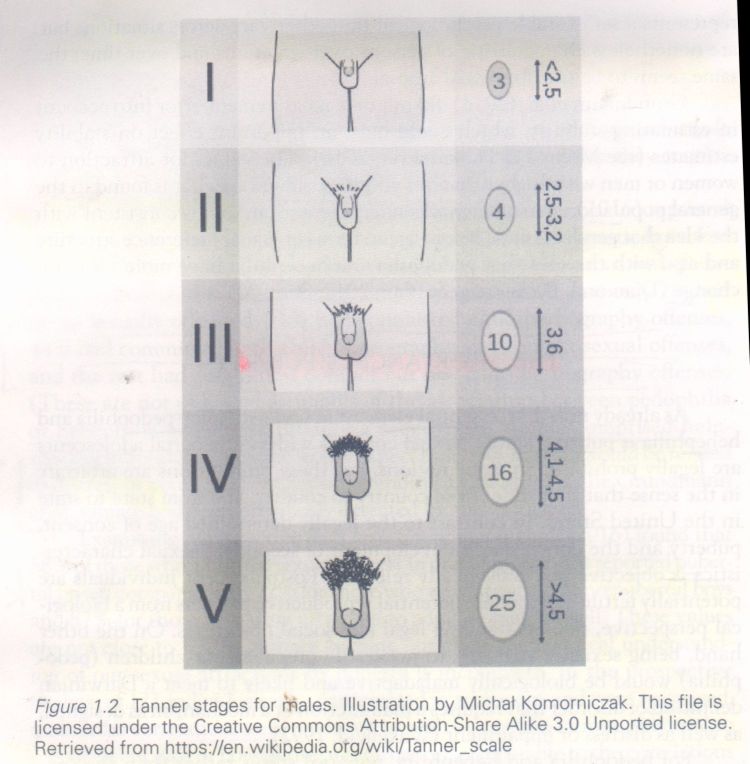
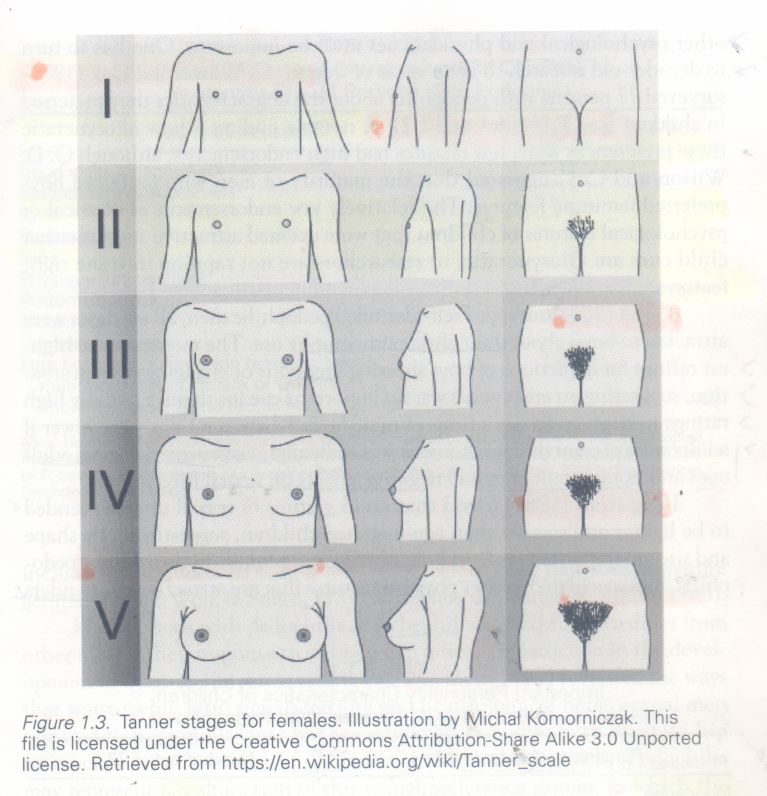
The Tanner Stages and more from Seto 2018
Figures 1.2, 1.3, 2.2., a link in chapter 2 and table 8.2
in Seto's book.
Figures 1.2, 1.3, 2.2., a link in chapter 2 and table 8.2
in Seto's book.
;
The Witch-Burning of Abgail Simon
On Nov. 26, [2014 ?] in Grand Rapids, MI, Abigail (a former tutor at a Catholic high school) was convicted at trial of three counts of
- "first-degree criminal sexual conduct," a felony with a maximum sentence of 25-years to life in prison and a mandatory minimum of 8-25 years,
- for allegedly having sex with a student who she claimed was not only the aggressor in their sexual intrigue but also forced himself on her 3 times; and
- also the felony of "accosting a minor for immoral purposes" for exchanging hundreds of emails and text-messages with her "victim," a 6'3", 220 lb. biological man of 15 and football star who initially confessed to the authorities and also testified under oath at a pretrial hearing that Abigail's version of what occurred was true but later recanted and claimed not only that he didn't force himself on her but also that she was the initiator of their liaison and controlled the action and relationship. [...]
On Jan. 14, 2015, the judge was "merciful," imposing the mandatory-minimum sentence of "only" 8-25 years in prison. [...]
He didn't have the discretion to impose a sane and "just" and condign and rational sentence. [...]
Even if he had such discretion, however, he probably would have sentenced her to 4-6 years in prison if not longer rather than "only" 6-12 months in jail or 1-2 years in prison, knowing the hysteria and outrage such "leniency" would incite not only in Grand Rapids and Michigan but nationwide [...].
On Nov. 26, [2014 ?] in Grand Rapids, MI, Abigail (a former tutor at a Catholic high school) was convicted at trial of three counts of
- "first-degree criminal sexual conduct," a felony with a maximum sentence of 25-years to life in prison and a mandatory minimum of 8-25 years,
- for allegedly having sex with a student who she claimed was not only the aggressor in their sexual intrigue but also forced himself on her 3 times; and
- also the felony of "accosting a minor for immoral purposes" for exchanging hundreds of emails and text-messages with her "victim," a 6'3", 220 lb. biological man of 15 and football star who initially confessed to the authorities and also testified under oath at a pretrial hearing that Abigail's version of what occurred was true but later recanted and claimed not only that he didn't force himself on her but also that she was the initiator of their liaison and controlled the action and relationship. [...]
On Jan. 14, 2015, the judge was "merciful," imposing the mandatory-minimum sentence of "only" 8-25 years in prison. [...]
He didn't have the discretion to impose a sane and "just" and condign and rational sentence. [...]
Even if he had such discretion, however, he probably would have sentenced her to 4-6 years in prison if not longer rather than "only" 6-12 months in jail or 1-2 years in prison, knowing the hysteria and outrage such "leniency" would incite not only in Grand Rapids and Michigan but nationwide [...].
;
What is doxxing (with examples) and how do you avoid it,
Mar 05 2018
Doxxing (also written as “doxing”) is an online threat to your privacy. Although this fad has been around in the hacker community since the 1990s, it is now become a major threat to anyone who uses the internet.
Doxxing involves researching the details of people’s lives. The purpose of this practice is either to expose that person to legal prosecution, to embarrass the victim, to draw criticism towards that person, or to cause them physical harm.
People’s lives have been ruined by doxxing. Some doxxing attacks lead to a mass campaign of public shaming, the online equivalent of mobbing. The effects can cause people to lose their jobs, their families, and even their homes. Targets of major doxxing attacks have been forced into hiding and have had to delete all of their online accounts and change their identities.
So, let’s find out more about doxxing and how to avoid it.
Doxxing (also written as “doxing”) is an online threat to your privacy. Although this fad has been around in the hacker community since the 1990s, it is now become a major threat to anyone who uses the internet.
Doxxing involves researching the details of people’s lives. The purpose of this practice is either to expose that person to legal prosecution, to embarrass the victim, to draw criticism towards that person, or to cause them physical harm.
People’s lives have been ruined by doxxing. Some doxxing attacks lead to a mass campaign of public shaming, the online equivalent of mobbing. The effects can cause people to lose their jobs, their families, and even their homes. Targets of major doxxing attacks have been forced into hiding and have had to delete all of their online accounts and change their identities.
So, let’s find out more about doxxing and how to avoid it.
;
The Commercial Exploitation of Abuse - A Study on Policy;
Essays on Law, Policy and Psychiatry;
8,
‘The Commercial Exploitation of Abuse: A Study on Policy (Essays on Law, Policy and Psychiatry, Vol. 8)’ is an essay about what the author calls the ‘abuse-centered culture,’ which is obviously a culture that puts people behind bars for love, when only focusing on certain ways how bodies are touched, fondled or otherwise erotically stimulated, when those bodies belong to a group of people legally defined as ‘children.’
Intro to a book in a pdf edition and a printed edition.
‘The Commercial Exploitation of Abuse: A Study on Policy (Essays on Law, Policy and Psychiatry, Vol. 8)’ is an essay about what the author calls the ‘abuse-centered culture,’ which is obviously a culture that puts people behind bars for love, when only focusing on certain ways how bodies are touched, fondled or otherwise erotically stimulated, when those bodies belong to a group of people legally defined as ‘children.’
Intro to a book in a pdf edition and a printed edition.
;
How to Persecute a Pedophile
Imagine, you work in the Ukrainian Police. A pervert Kyrýlo Yevhénovych Halaburdá lives in your city Dnipró. Once in 2012 or earlier you noticed his profile in a social network where he called himself a pedophile and even posted his messages towards one 13-years-old girl. You hope this character is fake or fictional. ...
In 2014 you got to know that Kyrylo Halaburda had petitioned to parliament for adult-child sex legalization. The petition was numbered as 09-0756.04.14/01-08.14 and sent to government. That's why the Deputy Minister of Justice of Ukraine Ruslán Riaboshápka directed your office to investigate who Kyrylo was. ...
You're a policeman, and know it for sure. The pedophile must be persecuted in illegal way, and you know how to make it safe for you. ...
You're a policeman, you can outrage and threaten a pedophile without any risk. ...
A pedophile is not a demon, he's just a human being, he depends upon people, which are his enemies. Pedophile's friends cannot help, and enemies can do with him whatever they want. There is no lie, no betrayal, no menace, no violence, no imprisonment, no rape, no mutilation, no murder, no torture that cannot be justified as child protection.
Imagine, you work in the Ukrainian Police. A pervert Kyrýlo Yevhénovych Halaburdá lives in your city Dnipró. Once in 2012 or earlier you noticed his profile in a social network where he called himself a pedophile and even posted his messages towards one 13-years-old girl. You hope this character is fake or fictional. ...
In 2014 you got to know that Kyrylo Halaburda had petitioned to parliament for adult-child sex legalization. The petition was numbered as 09-0756.04.14/01-08.14 and sent to government. That's why the Deputy Minister of Justice of Ukraine Ruslán Riaboshápka directed your office to investigate who Kyrylo was. ...
You're a policeman, and know it for sure. The pedophile must be persecuted in illegal way, and you know how to make it safe for you. ...
You're a policeman, you can outrage and threaten a pedophile without any risk. ...
A pedophile is not a demon, he's just a human being, he depends upon people, which are his enemies. Pedophile's friends cannot help, and enemies can do with him whatever they want. There is no lie, no betrayal, no menace, no violence, no imprisonment, no rape, no mutilation, no murder, no torture that cannot be justified as child protection.
;
Politically, we are failing to save ourselves;
Posted on Heretic TOC Forum
I was acquainted with the UK branch of Stop it Now! (SIN) on and off from 2007 to 2015. SIN began in the US ... SIN has spread its influence across the world to other countries including the UK and the Netherlands ...
The UK branch denies that minor attracted people exist. According to them, nobody is a paedophile. It is a “media stereotype”. They find the very idea that any adult person could be sexually attracted to a child preposterous in spite of many people telling them that this is the case. They believe a child has nothing to offer an adult. ...
SIN UK is part of a wider movement that wants to see the complex questions about nature and the universe reduced to a few simple axioms ...
SIN believe that sex offending is a “learned behaviour” that can be “unlearned”. ...
the “therapist” systematically torments the client for admitting that they have these feelings. ... As they do not believe minor attraction exists, they cannot accept either that people can have paedophilic feelings but not act on them. ...
I think that SIN NL is a good deal better than this.
I was acquainted with the UK branch of Stop it Now! (SIN) on and off from 2007 to 2015. SIN began in the US ... SIN has spread its influence across the world to other countries including the UK and the Netherlands ...
The UK branch denies that minor attracted people exist. According to them, nobody is a paedophile. It is a “media stereotype”. They find the very idea that any adult person could be sexually attracted to a child preposterous in spite of many people telling them that this is the case. They believe a child has nothing to offer an adult. ...
SIN UK is part of a wider movement that wants to see the complex questions about nature and the universe reduced to a few simple axioms ...
SIN believe that sex offending is a “learned behaviour” that can be “unlearned”. ...
the “therapist” systematically torments the client for admitting that they have these feelings. ... As they do not believe minor attraction exists, they cannot accept either that people can have paedophilic feelings but not act on them. ...
I think that SIN NL is a good deal better than this.
;
The Roots of Violence;
Essays on Law, Policy and Psychiatry, Vol. 10;
10,
‘The Roots of Violence: Why Humans Are Not By Nature Violent’ (Essays on Law, Policy and Psychiatry, Vol. 10, 2018) is an analytical and policy study that presents abundant evidence that human beings are not by nature violent and that violence therefore is a conditioned response. The scientific disciplines examined are anthropology, biology, neurology, pedagogy, psychoanalysis, and sociology.
The book shows the historical development of the roots of violence as they sprang forth from the patriarchal murder cultures that were putting an end to the peaceful matriarchal empires such as the Minoan Civilization in Crete.
[...]
Based on the research being on the table, the author draws policy conclusions for the prevention of violence both in the social and the educational domain.
‘The Roots of Violence: Why Humans Are Not By Nature Violent’ (Essays on Law, Policy and Psychiatry, Vol. 10, 2018) is an analytical and policy study that presents abundant evidence that human beings are not by nature violent and that violence therefore is a conditioned response. The scientific disciplines examined are anthropology, biology, neurology, pedagogy, psychoanalysis, and sociology.
The book shows the historical development of the roots of violence as they sprang forth from the patriarchal murder cultures that were putting an end to the peaceful matriarchal empires such as the Minoan Civilization in Crete.
[...]
Based on the research being on the table, the author draws policy conclusions for the prevention of violence both in the social and the educational domain.
;
Open letter to Michael Seto,...,
Jul 20 2019
This open letter was sent by letter and e-mail to the five persons / organizations on July 20th 2019 and will be sent in addition to the information by e-mail to sexologists publishing about "pedophilia".
For many years, you have systematically spread false information about the age at the onset of puberty. As evidenced below, the puberty of girls begins several years before the age information that you give. Your false age ratings cause people to receive a "pedophilia" diagnosis, even though these people are not "pedophilic" according to your own "pedophilia" definition of the desire of pre-pubertals.
This open letter was sent by letter and e-mail to the five persons / organizations on July 20th 2019 and will be sent in addition to the information by e-mail to sexologists publishing about "pedophilia".
For many years, you have systematically spread false information about the age at the onset of puberty. As evidenced below, the puberty of girls begins several years before the age information that you give. Your false age ratings cause people to receive a "pedophilia" diagnosis, even though these people are not "pedophilic" according to your own "pedophilia" definition of the desire of pre-pubertals.
;
Finding The Right Rehab – A Buyer’s Guide
Do you or a loved one need addiction treatment for alcohol or drugs? Thousands blindly walk into addiction treatment in expensive rehab centres and find that the reality doesn't meet expectations. ...
If you're considering rehab treatment, first check our ultimate guide for complete instructions on how to find the right rehab centre for you. ...
A rehab stay normally follows the sequence Detox > Rehab > Aftercare.
Do you or a loved one need addiction treatment for alcohol or drugs? Thousands blindly walk into addiction treatment in expensive rehab centres and find that the reality doesn't meet expectations. ...
If you're considering rehab treatment, first check our ultimate guide for complete instructions on how to find the right rehab centre for you. ...
A rehab stay normally follows the sequence Detox > Rehab > Aftercare.
;
The Legal Split in Child Protection - Overcoming the Double Standard;
Essays on Law, Policy and Psychiatry;
9,
The Legal Split in Child Protection: Overcoming the Double Standard (Essays on Law, Policy and Psychiatry, Vol. 9) - 2019 Apple Books Edition - is a study that attempts to redefine child protection, and goes as far as formulating a new paradigm of child protection that is healed of the legal split that pervades it until now. The study explains that the laws for protecting the child against abuse are following a fundamental split in social mores and statutory regulation of physical violence against children, on one hand, and sexual relationships with children, on the other.
Links to the book in PDF Format and the paperback edition are given.
The Legal Split in Child Protection: Overcoming the Double Standard (Essays on Law, Policy and Psychiatry, Vol. 9) - 2019 Apple Books Edition - is a study that attempts to redefine child protection, and goes as far as formulating a new paradigm of child protection that is healed of the legal split that pervades it until now. The study explains that the laws for protecting the child against abuse are following a fundamental split in social mores and statutory regulation of physical violence against children, on one hand, and sexual relationships with children, on the other.
Links to the book in PDF Format and the paperback edition are given.